In 2021, Lander County↗ET graduated two out of three seniors. The district sat nearly 15 points below the state average, posting a 66.7% graduation rate while Nevada as a whole held steady at 81.3%. Three years later, Lander County's Class of 2024 graduated at 90.7%, nine points above the state. No other Nevada district came close to that swing.
The turnaround happened in a place most Nevadans have never visited. Battle Mountain, the county seat, sits on Interstate 80 between Winnemucca and Elko. Its economy runs on gold. Its school district enrolls roughly 1,000 students across four schools, including a K-12 campus in Austin, 90 miles to the south on a two-lane road through the Toiyabe Range. Battle Mountain High School enrolled 63 twelfth-graders in 2023-24, so every senior who crosses the stage moves the rate by more than a point and a half.
The jump that stuck
The biggest single-year gain came between the Class of 2021 and the Class of 2022: 66.7% to 85.5%, an 18.8-point leap. That kind of jump in a small district could be noise, a single cohort that happened to finish strong. What makes Lander's trajectory unusual is what happened next. The Class of 2023 climbed to 90.9%. The Class of 2024 held at 90.7%. A one-year spike reverted. A three-year climb suggests something structural changed.
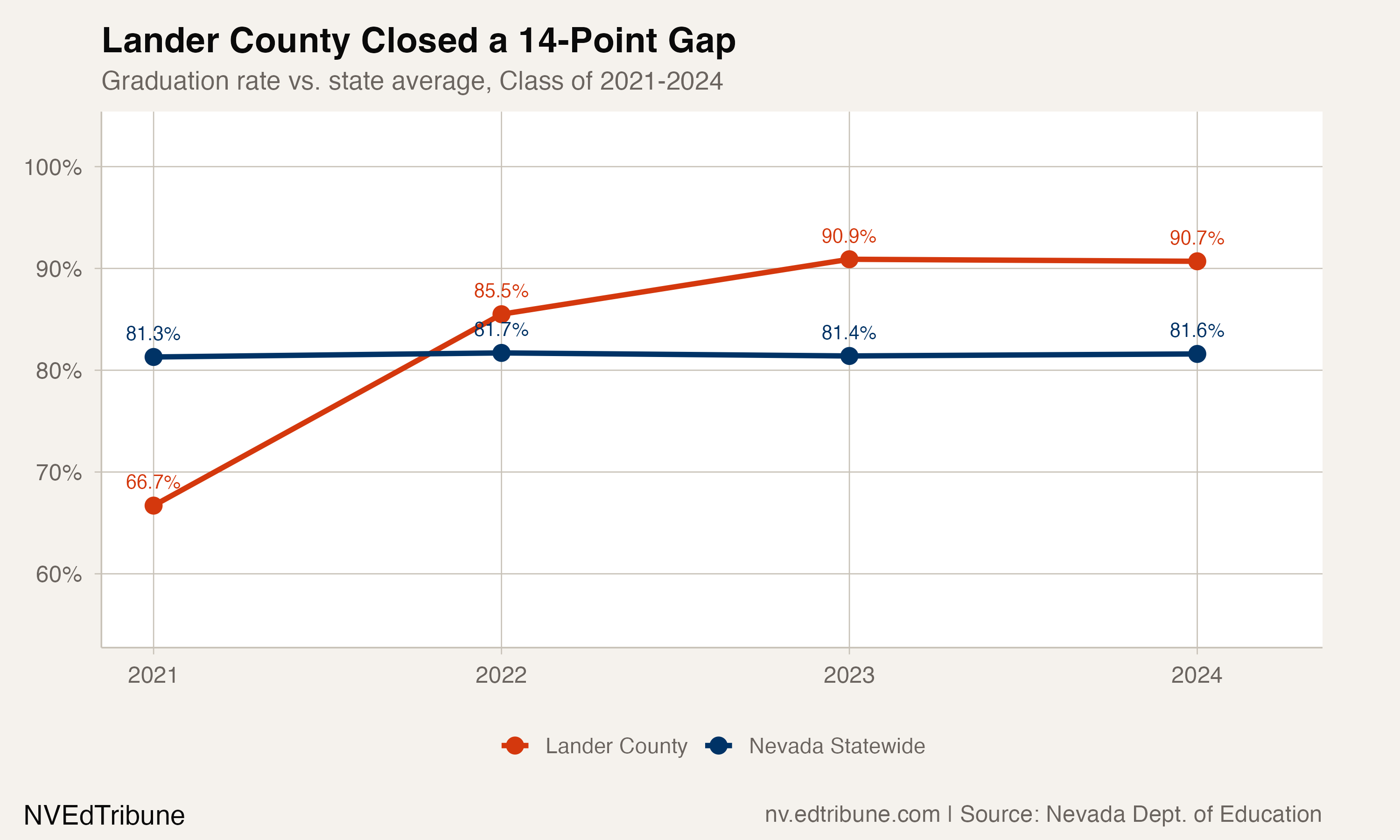
Nevada's statewide graduation rate barely moved over the same period: 81.3% to 81.6%. The state flat-lined while Lander sprinted. Among the 14 districts and charter authorities with comparable data in both years, the next-largest gain was White Pine at 7.4 points. Lander's improvement was more than triple that.
Where the gains came from
The most striking piece of Lander's turnaround is not the headline rate. It is the equity story underneath it.
In 2021, economically disadvantaged students in Lander County graduated at 52.6%, a full 14.1 points below the district's overall rate and 26.4 points below the state average for economically disadvantaged students, which sat at 79.0%. By 2024, Lander's economically disadvantaged rate had reached 89.4%, closing the internal gap to just 1.3 points. A 36.8-point gain in three years.
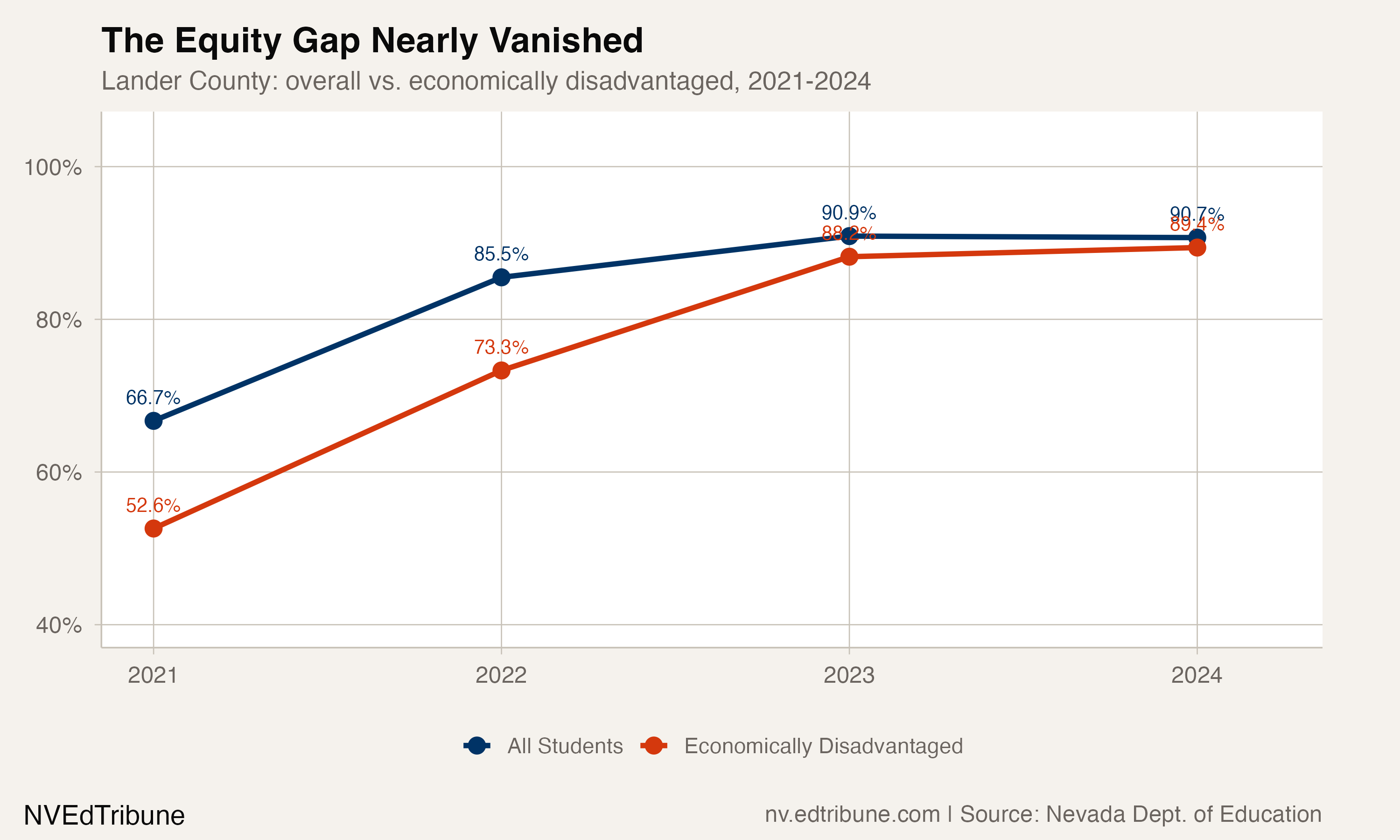
White students, about 57% of enrollment, went from 65.8% to 91.4%. Hispanic students, a third of enrollment, improved from 81.0% to 89.5% over the three years where data is available (2021-2023; no 2024 rate is published for the group). Special education students started at 44.4% in 2021, the lowest subgroup rate in the district, and reached 50.0% in 2022, after which no further rate is published.
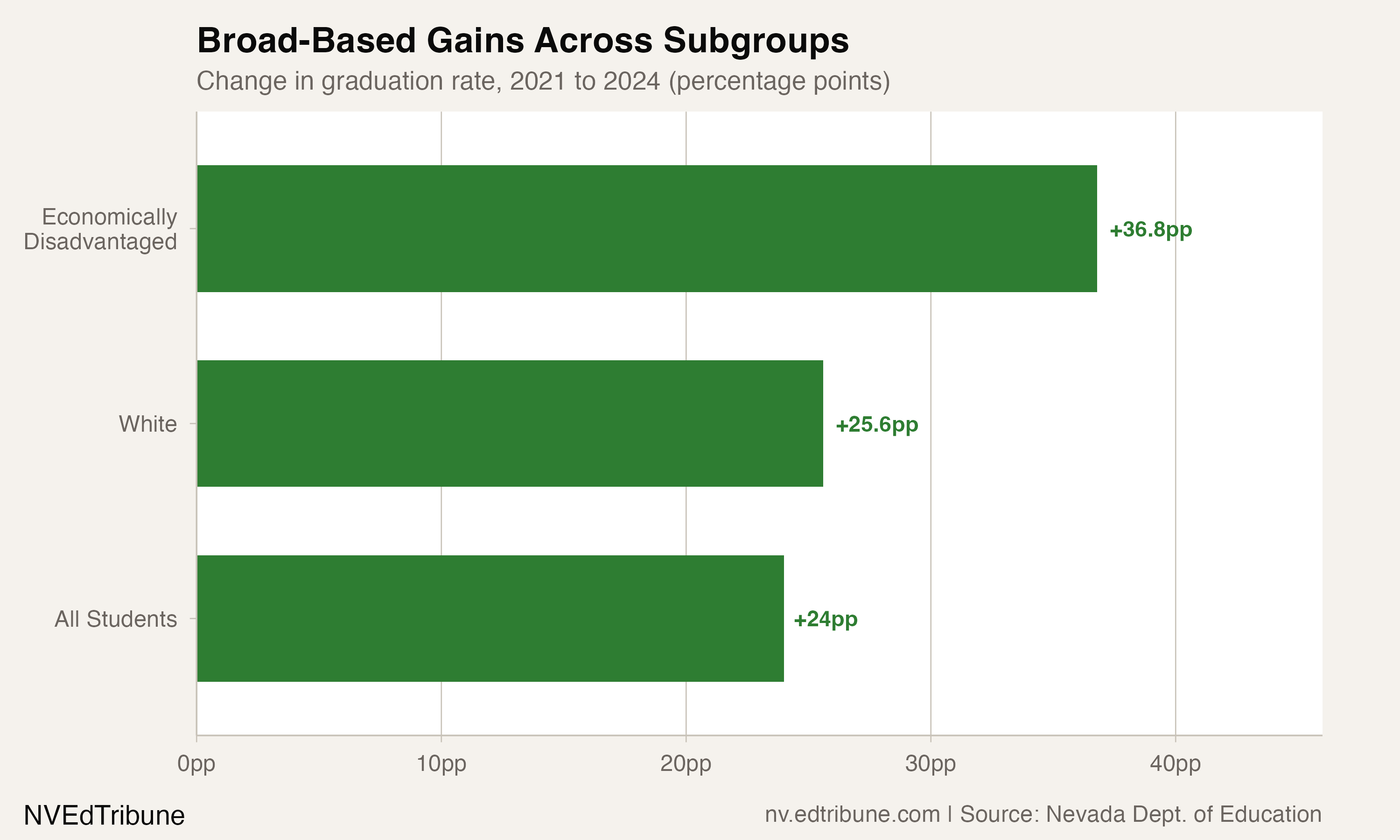
The pattern across subgroups matters. When a turnaround shows up in only one demographic, it often reflects a classification change or a cohort anomaly. Lander's gains were broad-based: the overall rate, the white rate, the Hispanic rate, and the economically disadvantaged rate all moved substantially in the same direction. That breadth is harder to explain away.
What a district this size can do differently
Lander County operates on a four-day school week, Monday through Thursday. The district has invested in wraparound services infrastructure that would be unusual for a system this size, including a Director of Wraparound Services, a Director of Special Education, and a Director of Transition and Assistive Technology. For a district with roughly 1,000 students, that level of support staffing signals a deliberate bet on keeping students connected.
The district also runs a "Growing Our Own" staffing program through a partnership with Southern Utah University Online, providing staff access to low-cost education degrees including administrative licensure designed for Nevada certification. In a county 230 miles from Reno and 300 miles from Las Vegas, recruiting teachers through traditional pipelines is not a realistic strategy. Training community members who already live in Battle Mountain is.
"Because employees are vital to the success of Lander County School District, the district is providing access to low-cost college degrees through education provider Southern Utah University Online." — Lander County School District
Whether these specific investments drove the graduation rate gain is not provable from the data alone. The timing aligns: a district that restructured its support services and teacher pipeline saw its completion rate climb and hold. But small cohort sizes mean the rate is sensitive to individual students, and no controlled comparison exists.
Lander in context: rural Nevada's uneven results
Lander's turnaround stands out partly because other rural Nevada districts did not follow the same path. Among the state's smallest districts, results were mixed.
White Pine gained 7.4 points, reaching 91.2%. Pershing held steady at 94.7%, already high. But Mineral County fell 12.2 points, dropping from 88.9% to 76.7%, the steepest decline among all Nevada districts with available data. Eureka, Esmeralda, Lincoln, and Storey have too many suppressed years to track trends.
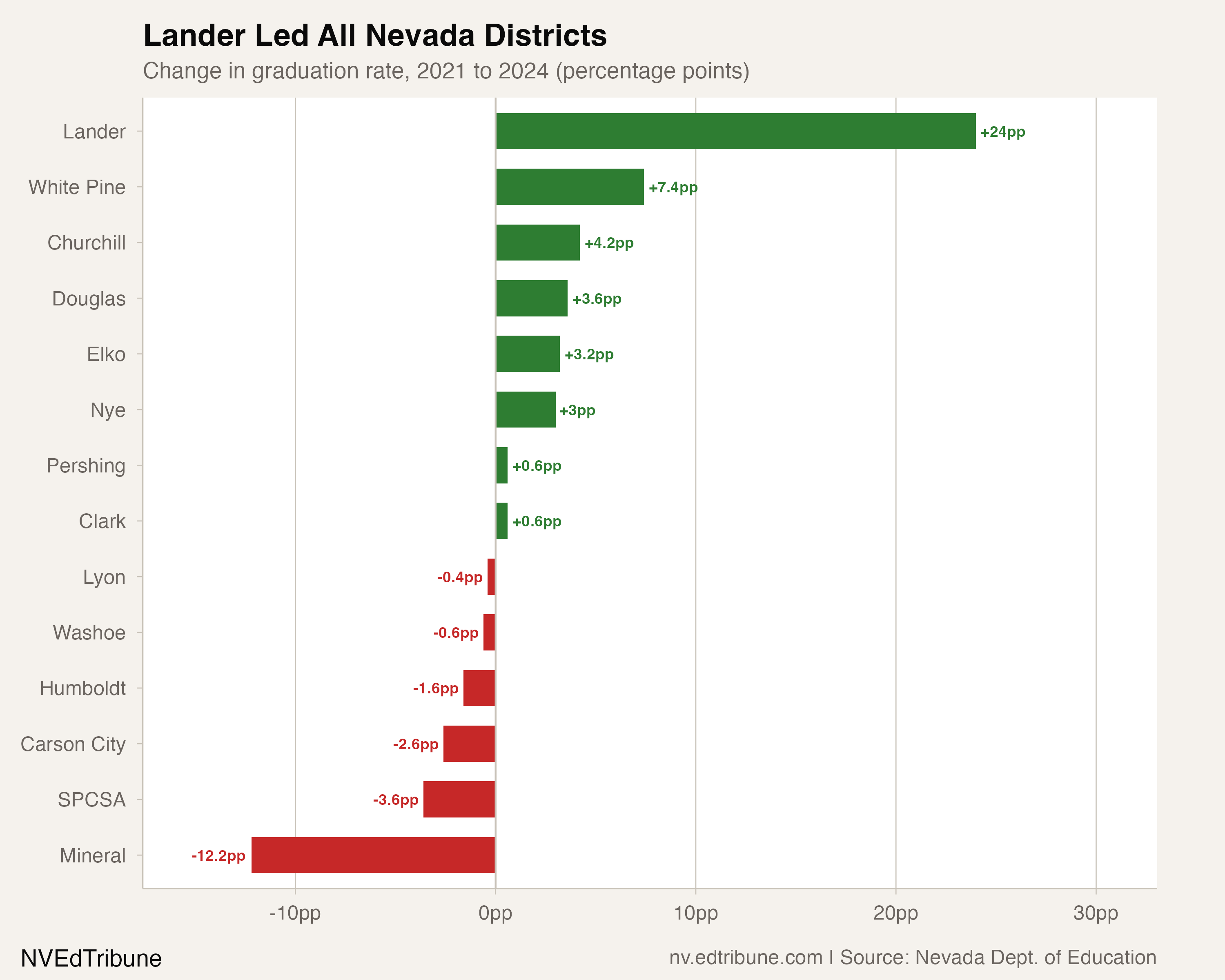
The divergence between Lander and Mineral, two small rural mining counties separated by about 150 miles, underscores that "rural" is not a single condition. District leadership, community stability, and the specific choices a school board makes about how to spend limited resources produce different outcomes even in similar contexts.
The small-cohort caveat
Any honest assessment of Lander's numbers must acknowledge that a senior class of roughly 63 students amplifies every outcome. A single student who finishes or doesn't shifts the rate by about 1.6 percentage points. The Class of 2021's 66.7% rate may have been depressed by COVID-era disruptions that hit small, rural, connectivity-limited communities harder than urban ones, making the baseline artificially low.
But three consecutive years above 85% is not a statistical accident, even in a small district. And the equity closure, with economically disadvantaged students moving from 52.6% to 89.4%, represents too many individual students finishing who previously would not have to be explained by chance alone.
What comes next
The question Lander's data raises is whether a 90% graduation rate is a ceiling or a plateau. Battle Mountain High School posted 92.3% in 2023, suggesting the school-level trajectory may already have answered that. The more interesting question for the rest of Nevada is whether anything Lander did is transferable, or whether the conditions that made it possible, a tight-knit mining community, a small enough system that every student is known by name, a four-day school week, are inherently local. Attendance is not the mechanism, at least not over this window. Lander's chronic-absence rate did not fall while its graduation rate climbed; it was higher for the Class of 2024 than for the Class of 2021.
Nevada's statewide rate has been stuck between 81% and 82% for four years. Lander itself sat at 66.7% four years ago, further behind than any Nevada district reported in 2024, when the lowest published rate was Mineral's 76.7%. A district can start that far back and still finish nine points ahead of the state, even if the recipe doesn't travel easily.
Detailed code that reproduces the analysis and figures in this article is available exclusively to EdTribune subscribers.
Discussion
Sign in to join the discussion.
Loading comments...