Roughly 155,000 Nevada students were chronically absent in 2024-25. That is one in three students statewide who missed 10% or more of enrolled school days -- the equivalent of nearly four weeks of instruction.
The enrollment-weighted chronic absenteeism rate across Nevada's 685 schools stands at 32.6%, nearly double the pre-COVID school-average rate of 19.9% recorded in 2018-19. Even the best-performing large district in the state, Washoe County, has a weighted rate of 30.5%. Only charter schools managed to crack below 25% as a sector.
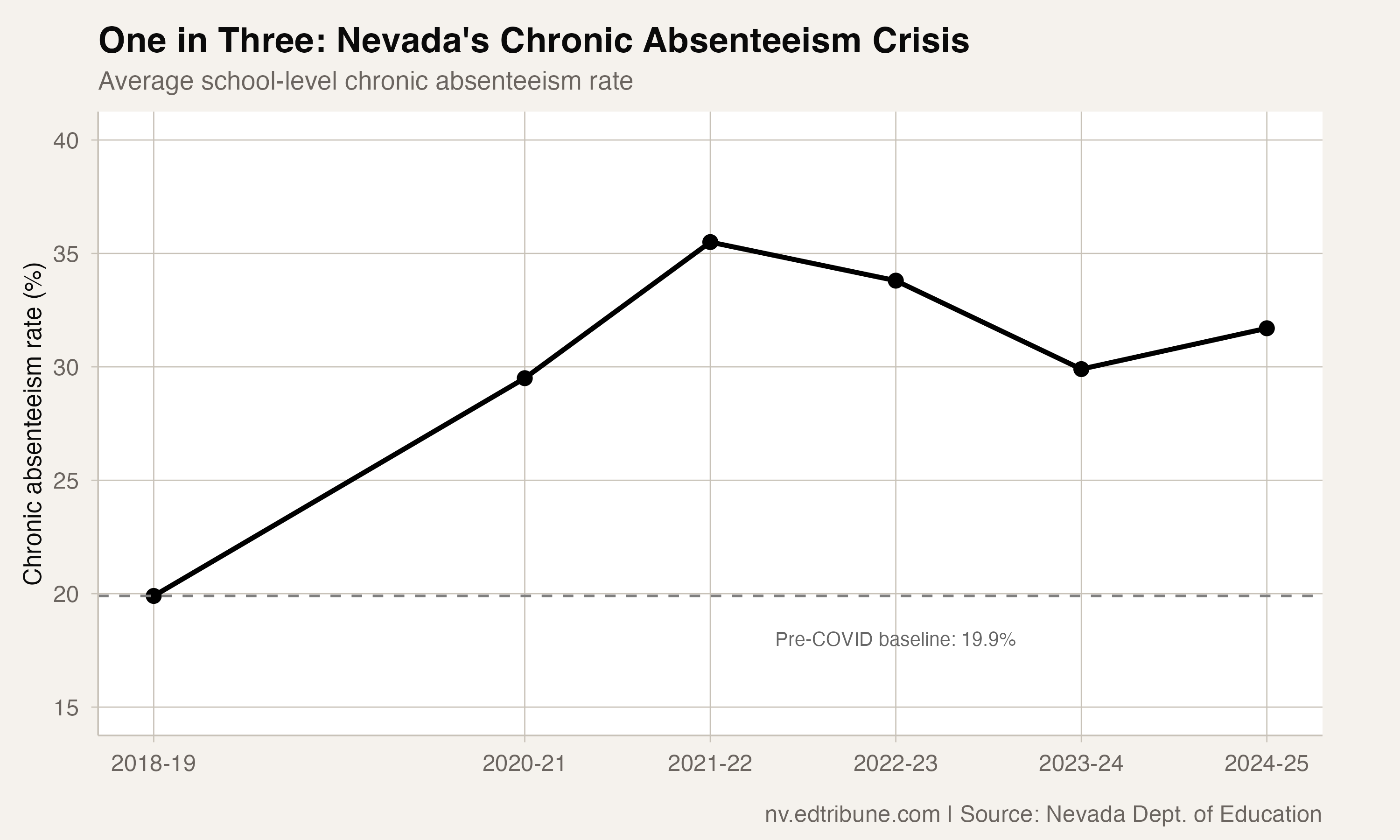
The numbers behind the number
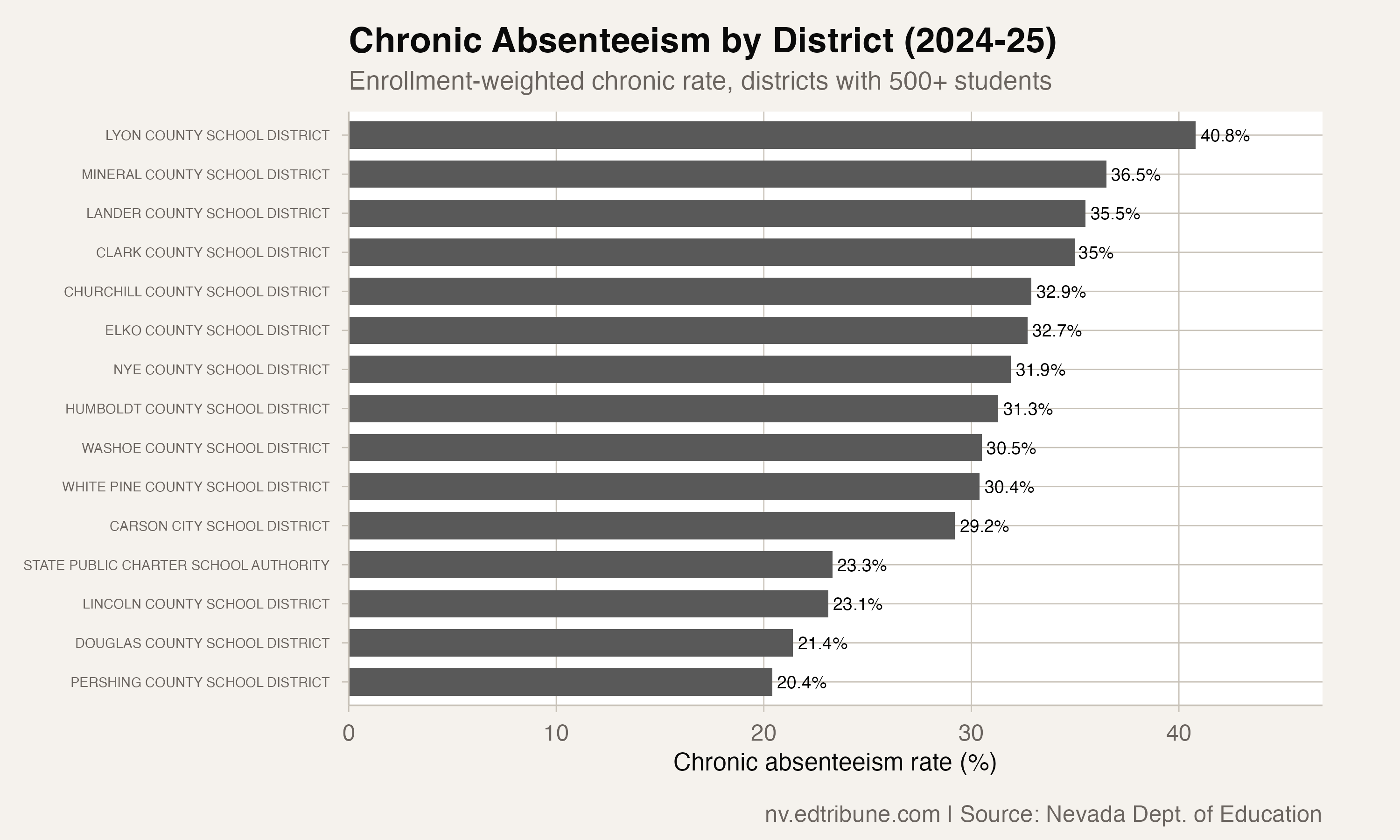
At Clark County School District↗ET, the nation's fifth-largest, roughly 106,000 of 302,043 students were chronically absent, a weighted rate of 35%. That single district accounts for nearly 70% of all chronically absent students in the state.
Washoe County↗ET, the second-largest traditional district with 63,628 students, has a weighted rate of 30.5%, meaning about 19,400 students crossed the chronic threshold. Charter schools under the State Public Charter School Authority collectively enrolled 60,666 students at a 23.3% weighted rate, the lowest of any major enrollment grouping.
The rural picture is more varied but often worse. Esmeralda County↗ET, with just 78 students, has the highest weighted rate of any district at 48.7%. Lyon County↗ET, the highest among districts with more than 1,000 students, stands at 40.8%. Mineral County↗ET stands at 36.5%, and Lander County↗ET at 35.5%.
The distribution has shifted
The scale of the crisis becomes clearer when you look at how schools sort. Before the pandemic, 17.3% of Nevada schools had chronic rates below 10%, what most states would consider a healthy attendance level. In 2024-25, just 3.6% of schools hit that mark -- 25 out of 685.
Meanwhile, nearly half of all schools now have chronic rates above 30%. Before COVID, 13.7% did. And 70 schools, about one in ten, have rates above 50%, meaning a majority of students at those schools are chronically absent.
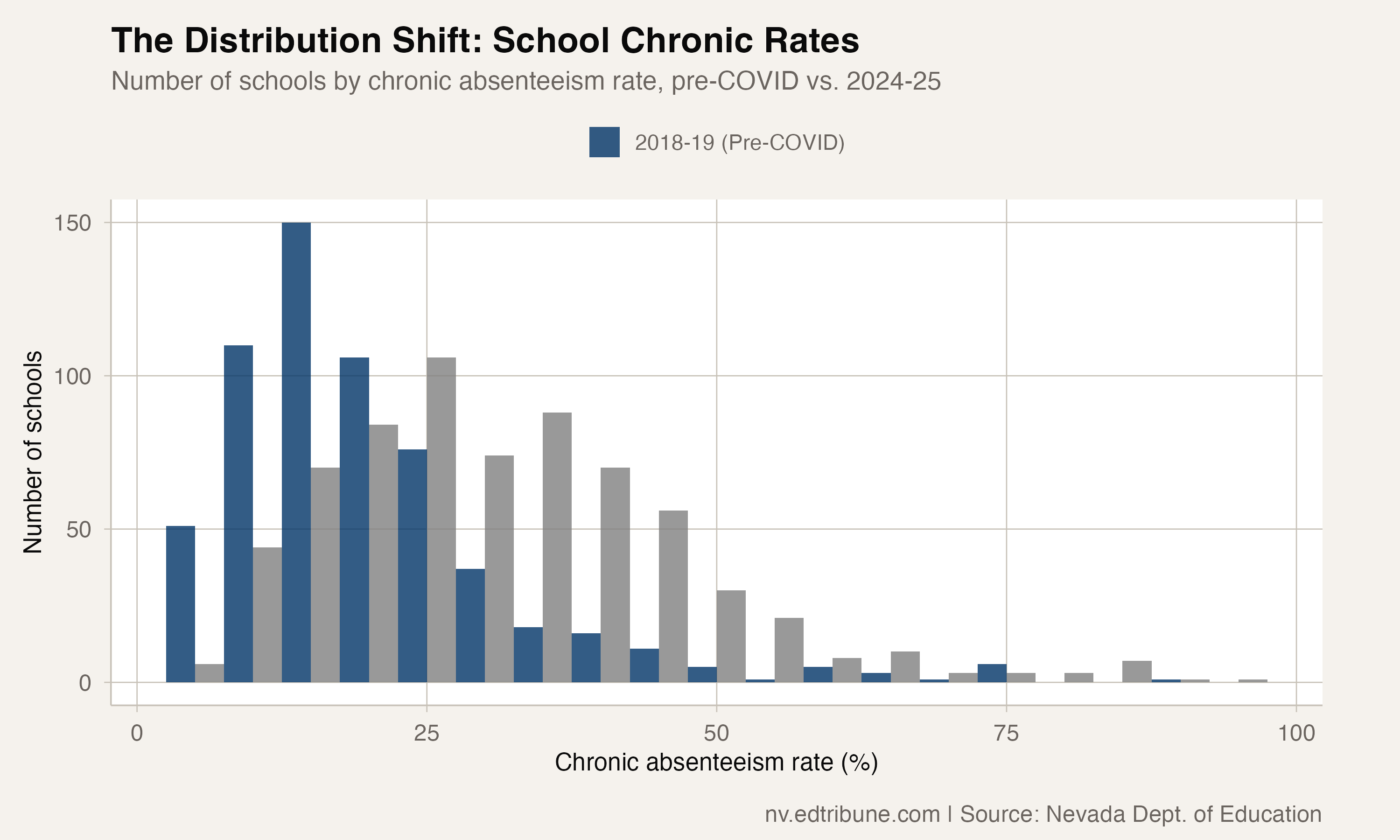
The middle has hollowed out. Where the pre-COVID distribution peaked in the 10-20% range, the 2024-25 distribution peaks in the 25-35% range. Schools that would have been considered outliers six years ago are now average.
What 155,000 means
Nevada's Pupil-Centered Funding Plan allocates dollars based on enrollment, not attendance, which means every one of these 155,000 students generates per-pupil funding even as they miss a month or more of school. The state spent approximately $10,500 per pupil in 2024-25. That amounts to roughly $1.6 billion flowing to educate students who are not consistently present to receive it.
Applied Analysis, a Las Vegas research firm, has estimated that unaddressed chronic absenteeism could cost Southern Nevada $14.4 billion over the next 20 graduating classes, based on reduced lifetime earnings and tax revenue for students who fall behind academically. Research from the University of Chicago Consortium on School Research found that students who miss 10% or more of school in any year are significantly less likely to graduate on time.
Communities In Schools of Nevada, which served 98,000-plus students statewide through its integrated student support model, has expanded rapidly since the pandemic. But the scale of 155,000 chronically absent students dwarfs even ambitious intervention programs.
The data underneath
Two important caveats shape these numbers. First, the statewide weighted rate of 32.6% is calculable only for 2024-25, because Nevada did not report enrollment alongside chronic absenteeism data in prior years. Earlier years use an unweighted mean of school rates, which gives the same weight to a 50-student rural school and a 2,500-student Las Vegas high school. The unweighted mean for 2025 is 31.7%, reasonably close to the weighted figure.
Second, the Nevada Department of Education's official statewide chronic rate for the free-or-reduced-price-lunch subgroup is 26.9%, substantially lower than the 32.6% weighted school-level figure. The difference likely reflects both the subgroup definition (FRL, not all students) and the aggregation method. Neither number is wrong; they measure different things.
What both measures agree on: the problem is immense, it has not recovered, and it touches every corner of the state.
Detailed code that reproduces the analysis and figures in this article is available exclusively to EdTribune subscribers.
Discussion
Sign in to join the discussion.
Loading comments...