At Ruby S. Thomas Elementary School in Las Vegas, 82.8% of the 624 students enrolled in 2024-25 were chronically absent. At Western High School, the figure was 70.6% among 2,745 students. At Chaparral High School, 63.4% of 2,242 students. These are not small alternative programs. They are full-size neighborhood schools where missing a month or more of instruction is the norm, not the exception.
They are also a sliver of a much larger problem. Clark County School District↗ET, the nation's fifth-largest, had an estimated 106,000 chronically absent students in 2024-25 -- more than one in three of its 302,043 students. The enrollment-weighted chronic rate of 35% has barely budged from the 2021-22 crisis peak despite 20,000-plus home visits and a new dedicated attendance office.
The concentration
Clark County's chronic absenteeism is not just Nevada's biggest problem. It is Nevada's problem, period. The district accounts for 63.6% of the state's public school enrollment but 68.3% of its chronically absent students. CCSD's 106,000 chronically absent students outnumber the entire enrollment of Washoe County School District↗ET, the state's second-largest traditional district at 63,628.
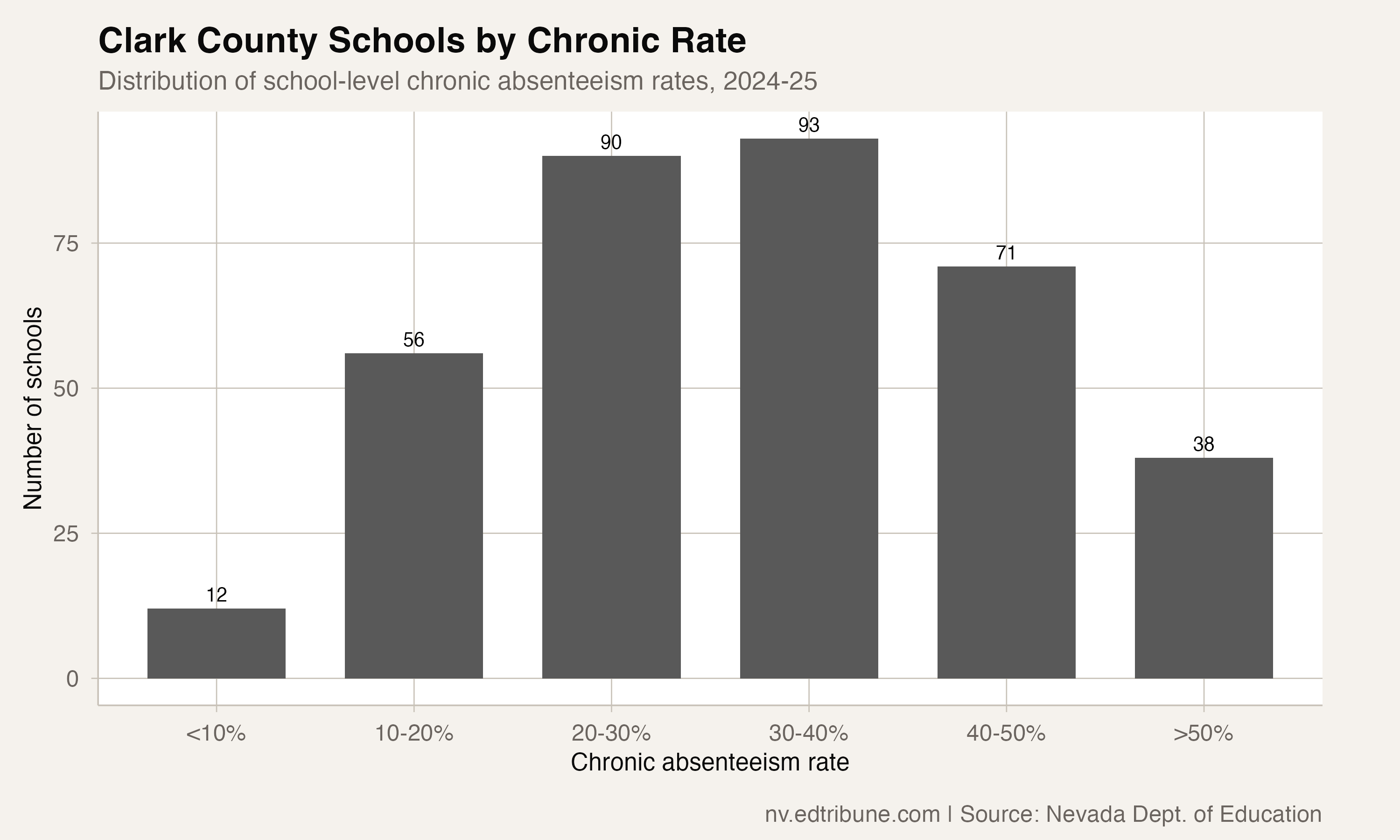
Thirty-eight Clark County schools had chronic rates above 50% in 2024-25, meaning a majority of students were chronically absent. The worst include Miley Achievement Center (91.6%), Mission High School (83.3%), and Ruby S. Thomas Elementary (82.8%). Even excluding the alternative and virtual programs that often have structurally high absenteeism, dozens of traditional neighborhood schools exceed 50%.
The trajectory
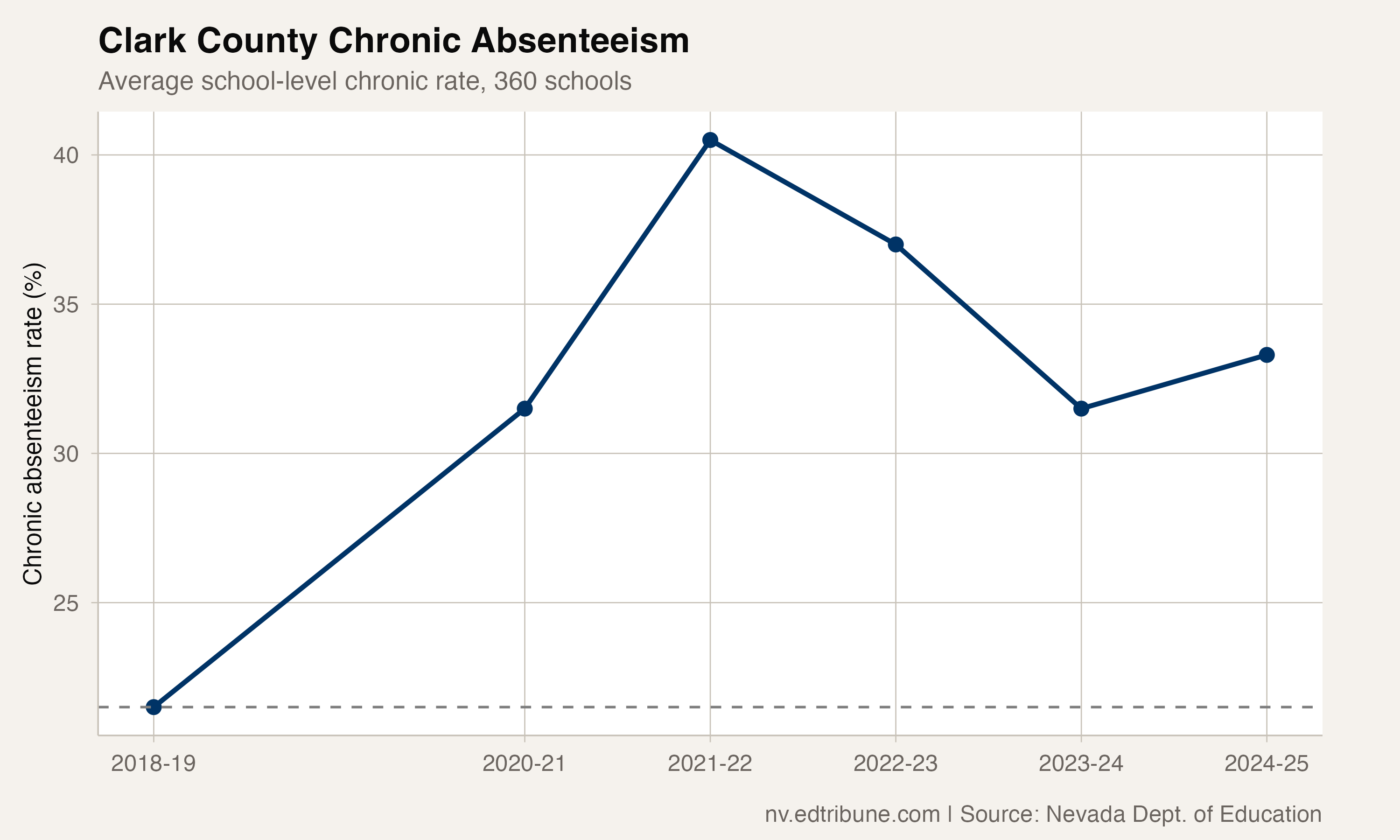
Clark County's school-mean chronic rate was 21.5% before the pandemic. It nearly doubled to 40.5% in 2021-22, then improved to 31.5% by 2023-24. But the 2024-25 data shows a reversal to 33.3%, erasing about a third of the previous year's progress.
The weighted rate of 35% is higher than the school mean because larger schools tend to have higher chronic rates. When a 3,000-student high school like Western runs above 70%, it pulls the weighted average up more than a dozen small schools with moderate rates can pull it down.
The response and its limits
CCSD's response has been substantial. The district's attendance office conducted more than 20,000 home visits during the 2024-25 school year, deployed attendance teams to the highest-need schools, and partnered with Communities In Schools of Nevada. Applied Analysis, a Las Vegas research firm, projects that unaddressed chronic absenteeism could cost Southern Nevada $14.4 billion over the next 20 graduating classes in reduced lifetime earnings and economic output, or roughly $610 million for the Class of 2025 alone.
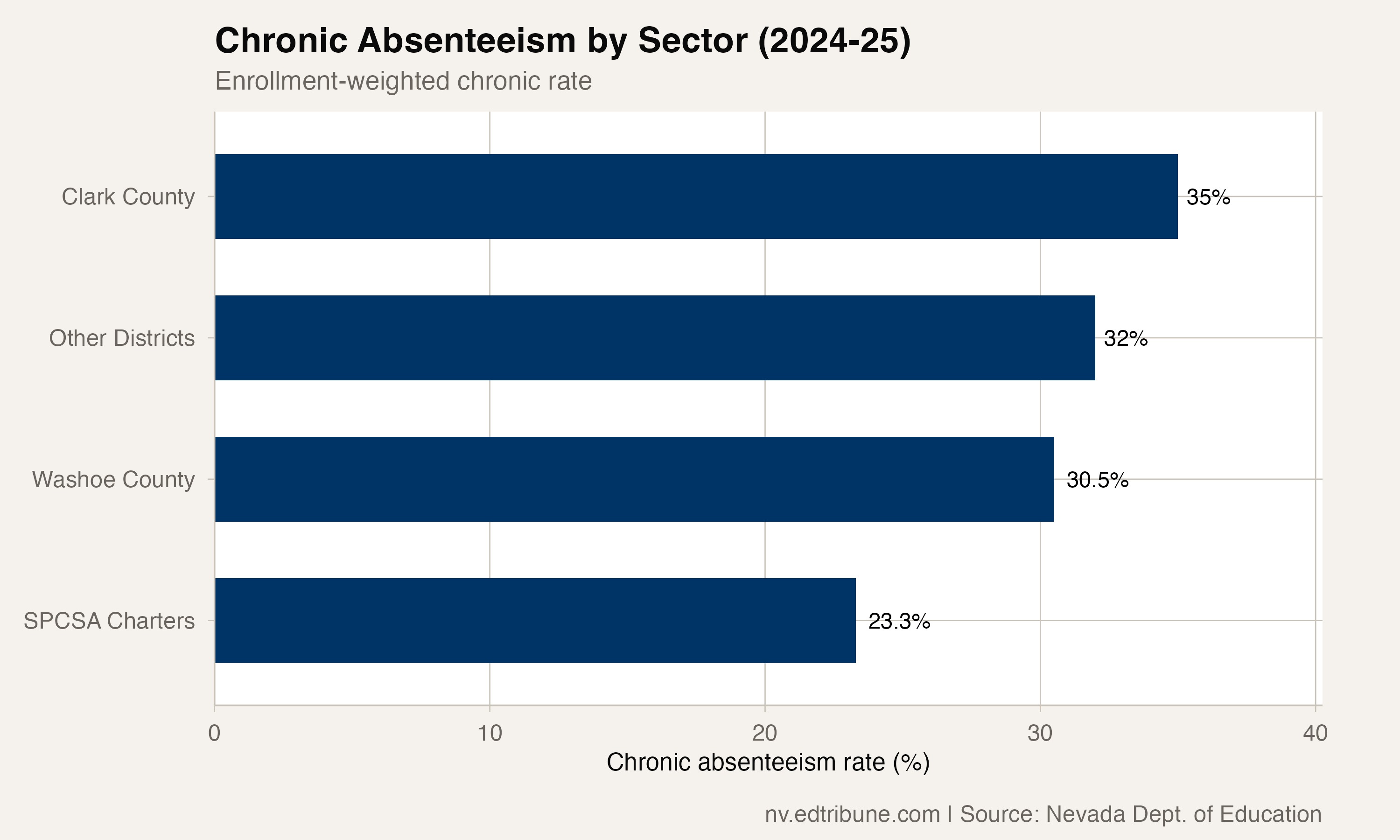
The charter school comparison is instructive, if imperfect. The State Public Charter School Authority's 71 schools collectively post a weighted chronic rate of 23.3%, nearly 12 points below Clark County. Some of this gap reflects selection effects -- charter families may be more engaged with schooling by virtue of having chosen a school -- but the magnitude is hard to dismiss entirely. Even Washoe County, which serves a broadly comparable urban-suburban population in Reno, runs 4.5 points lower than Clark.
The scale problem
What makes Clark County's situation distinctive is not the rate but the count. A 35% chronic rate applied to 302,000 students means more than 100,000 children are missing a month or more of school. At that scale, home visits and attendance teams operate at the margins. Even 20,000 home visits, a genuine logistical achievement, reach fewer than one in five chronically absent students.
Nevada's Pupil-Centered Funding Plan allocates dollars based on enrollment, not attendance. CCSD receives per-pupil funding for all 302,043 enrolled students regardless of how many actually show up. Whether attendance-based funding would change behavior or simply penalize already-struggling schools is an open question, but the current model creates no direct financial incentive for the district to reduce absenteeism. The incentive is purely educational, which should be enough but evidently is not.
Detailed code that reproduces the analysis and figures in this article is available exclusively to EdTribune subscribers.
Discussion
Sign in to join the discussion.
Loading comments...