Coral Academy Windmill has a chronic absenteeism rate of 6.9%. Beacon Academy of Nevada has a rate of 87.2%. Both are charter schools authorized by the same State Public Charter School Authority. The 80-point spread between them is wider than the gap between any two traditional school districts in the state.
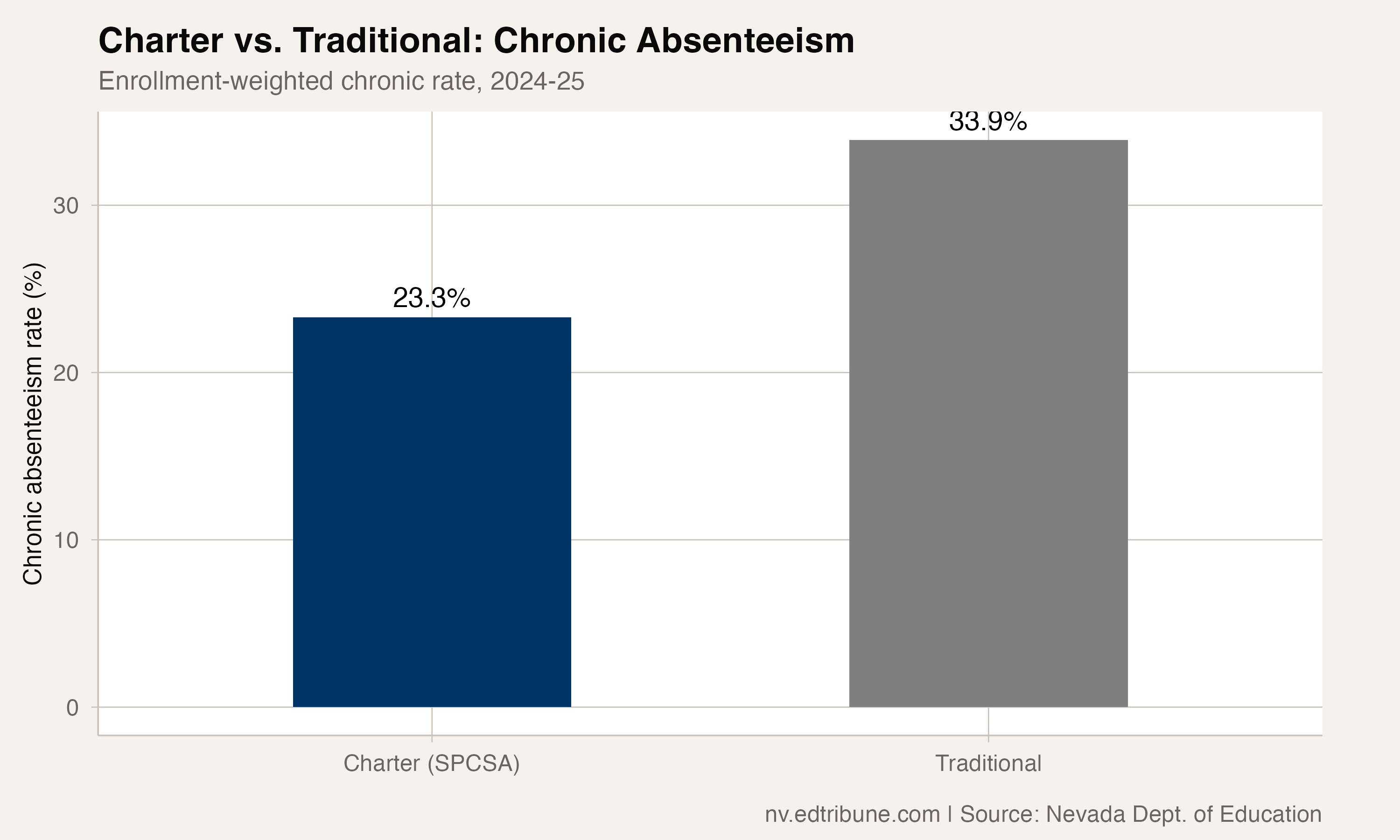
That spread defines the charter attendance story in Nevada. On average, SPCSA charter schools significantly outperform traditional districts: a weighted chronic rate of 23.3% versus 33.9%, a gap of more than 10 percentage points. But the charter sector is not a single system. It is a collection of independently operated schools whose attendance outcomes range from the best in the state to the worst.
The best performers
Seven SPCSA schools have chronic rates below 10%, a threshold that fewer than 4% of all Nevada schools meet. Coral Academy campuses dominate the top tier: Windmill at 6.9% (415 students), Tamarus at 8.1% (394 students), Centennial Hills at 8.2% (681 students). Doral Academy of Northern Nevada in Reno posts 7.2% among 996 students. Somerset Academy Lone Mountain hits 8.6% with 993 students.
These are not small schools cherry-picking compliant families. Doral Academy of Northern Nevada and Somerset Academy Lone Mountain each serve nearly 1,000 students. Somerset Academy Sky Pointe serves 2,152 at an 11.3% chronic rate. Pinecrest Academy Inspirada serves 1,191 at 9.7%.
What these schools share is a model built around parental engagement contracts, structured daily schedules, and academic cultures where attendance is treated as non-negotiable rather than aspirational. Whether that model can transfer to traditional districts serving students with fewer family resources is the central question.
The worst performers
The same charter authority oversees Beacon Academy (87.2%, 743 students), Southern Nevada Trades High School (84.3%, 83 students), Young Women's Leadership Academy (79.4%, 141 students), and Eagle Charter Schools (77.6%, 170 students). Democracy Prep's three Las Vegas campuses range from 52% to 63% chronic absenteeism across nearly 1,300 combined students.
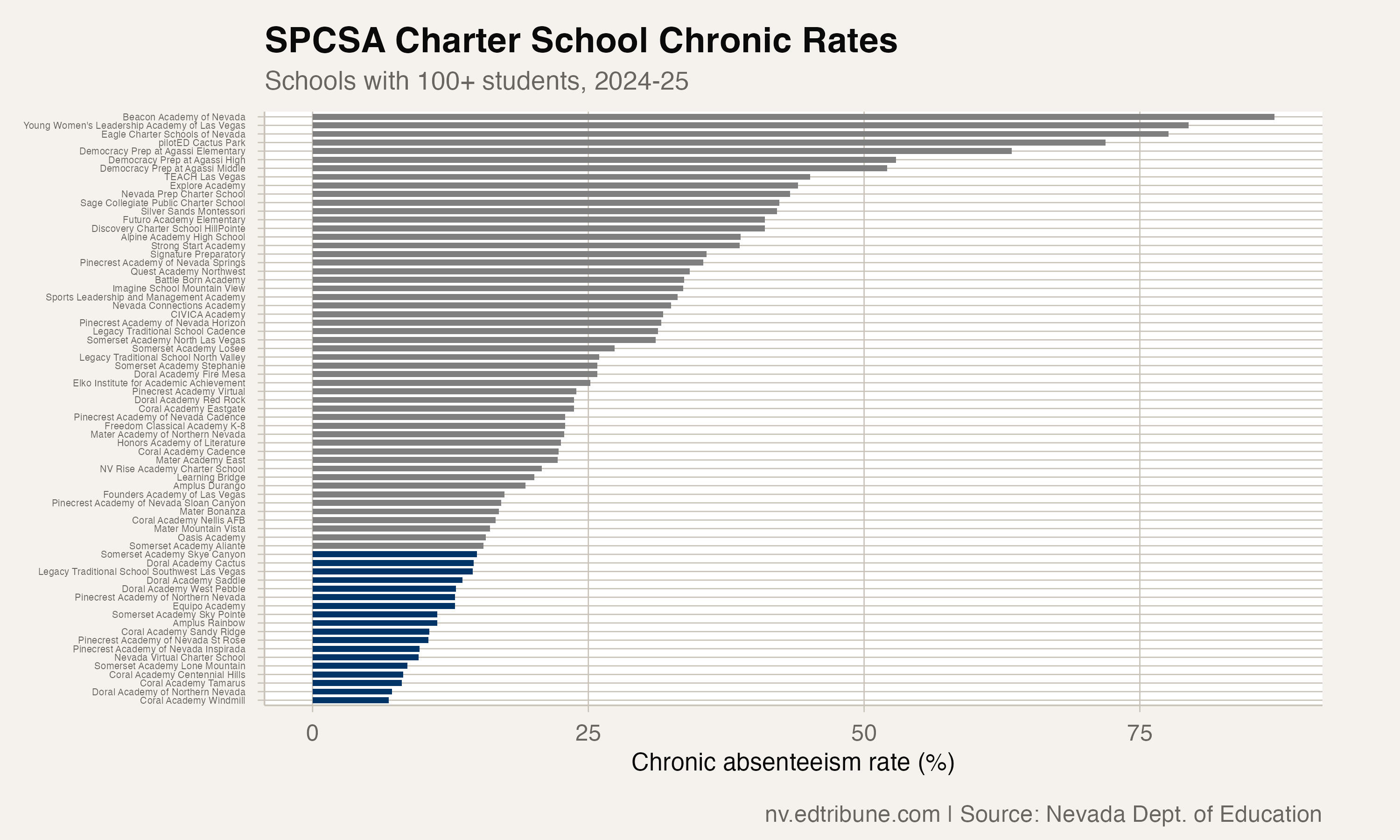
Nine of 71 SPCSA schools exceed 50% chronic absenteeism. Twenty have rates above 30%. The charter sector's low weighted average is driven by a cluster of large, well-performing schools that pull the number down despite a long tail of struggling campuses.
Selection effects and honest comparison
The charter attendance advantage comes with significant caveats. Charter schools in Nevada require families to actively choose them, which introduces selection effects: families who complete applications and arrange transportation tend to be more engaged in their children's education. Traditional districts serve everyone, including families in crisis, students experiencing homelessness, and children in foster care.
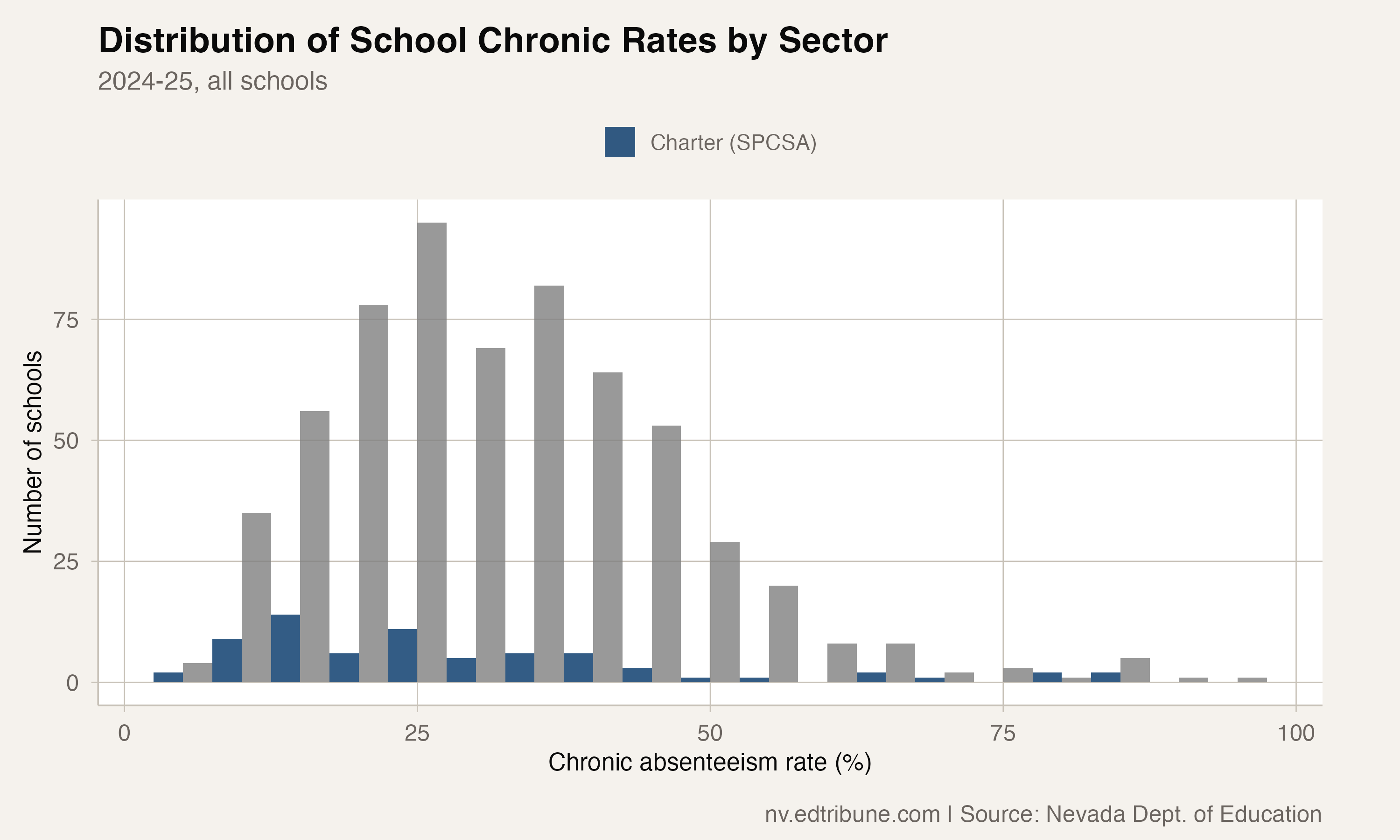
The charter sector also does not operate virtual schools with structurally high chronic rates. Nevada Learning Academy at CCSD, the largest virtual school at 3,204 students and 74.3% chronic, sits within Clark County's numbers. Nevada Virtual Charter School, at 9.6% and 1,717 students, is the notable exception: a virtual charter with attendance outcomes comparable to the best brick-and-mortar campuses.
The 10.6-point gap between charter and traditional sector weighted rates is real, but it compares fundamentally different student populations under fundamentally different operating conditions. A traditional district that adopted every Coral Academy practice would still serve students that Coral Academy does not.
What the gap does and does not prove
The charter advantage proves that chronic absenteeism rates in the single digits are achievable at scale in Nevada, with Nevada students, under current conditions. That matters. It disproves the argument that 30%+ chronic rates are somehow inevitable given the state's demographics or culture.
What it does not prove is that traditional districts are failing due to effort or competence. The gap more likely reflects structural differences: voluntary enrollment versus assigned enrollment, family engagement as a precondition versus family engagement as a goal, and the option to counsel out students who do not comply versus the mandate to serve everyone who arrives.
Detailed code that reproduces the analysis and figures in this article is available exclusively to EdTribune subscribers.
Discussion
Sign in to join the discussion.
Loading comments...