Nevada's traditional public school districts have lost 53,160 students since 2019, an 11.7% decline. Over that same span, the charter sector gained 28,201. The charter gains did not replace what traditional districts lost. They absorbed roughly half of it, leaving a net hole of 24,959 students in the state's public education system. The distinction matters: Nevada is not simply shuffling students between sectors. It is losing students from the system entirely while simultaneously redistributing the ones who remain.
The charter sector's share of total enrollment has nearly doubled, from 8.5% in 2018-19 to 14.9% in 2025-26. The number of charter entities grew from 29 to 51. At current per-pupil funding of $9,051, the 28,201 students now enrolled in charters instead of traditional schools represent roughly $255 million in annual per-pupil funding that shifted between sectors.
The divergence accelerated in 2026
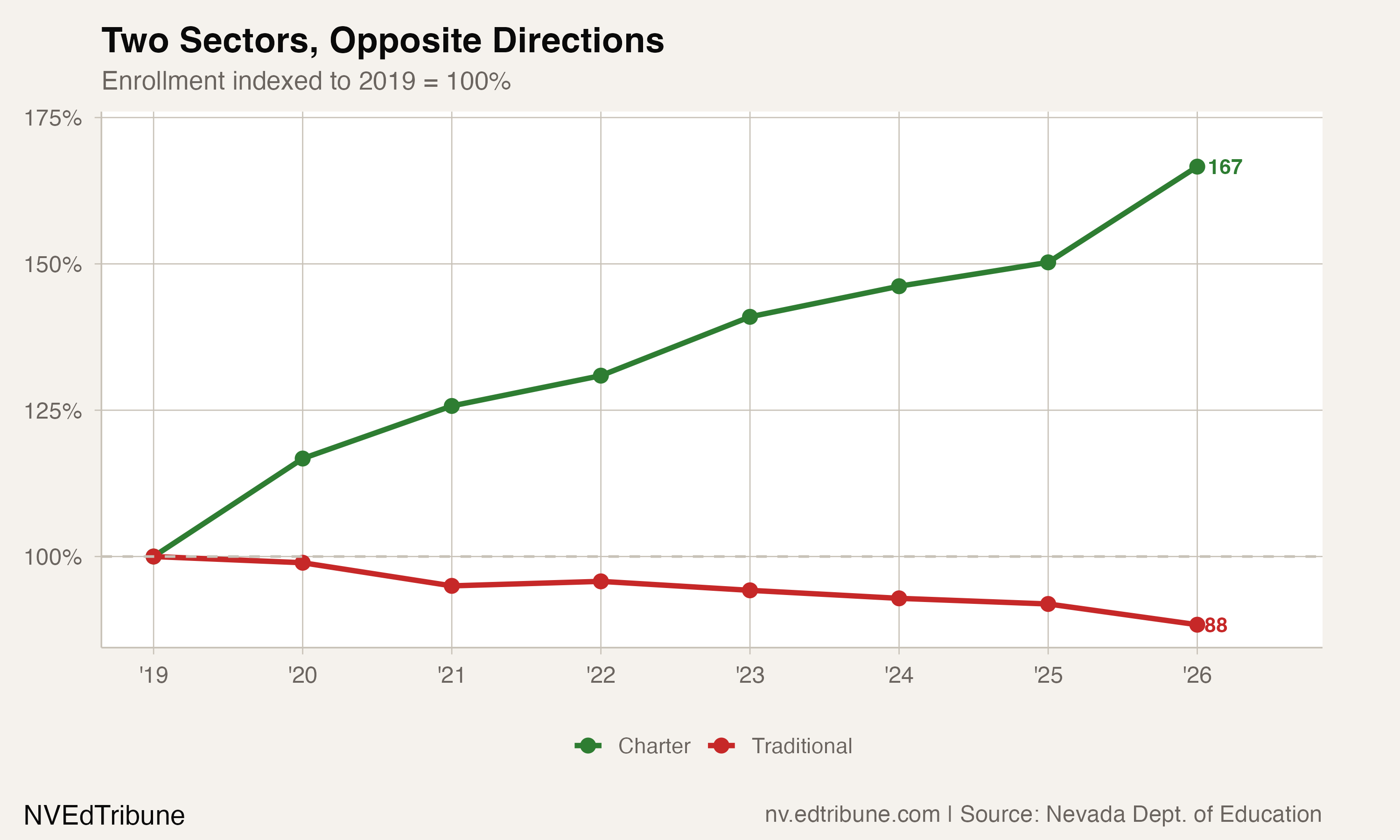
Indexed to 2019, charter enrollment stands at 167% of its starting point. Traditional enrollment stands at 88%. The gap between the two lines widened sharply in 2025-26, when traditional districts lost 16,176 students and charters gained 6,925.
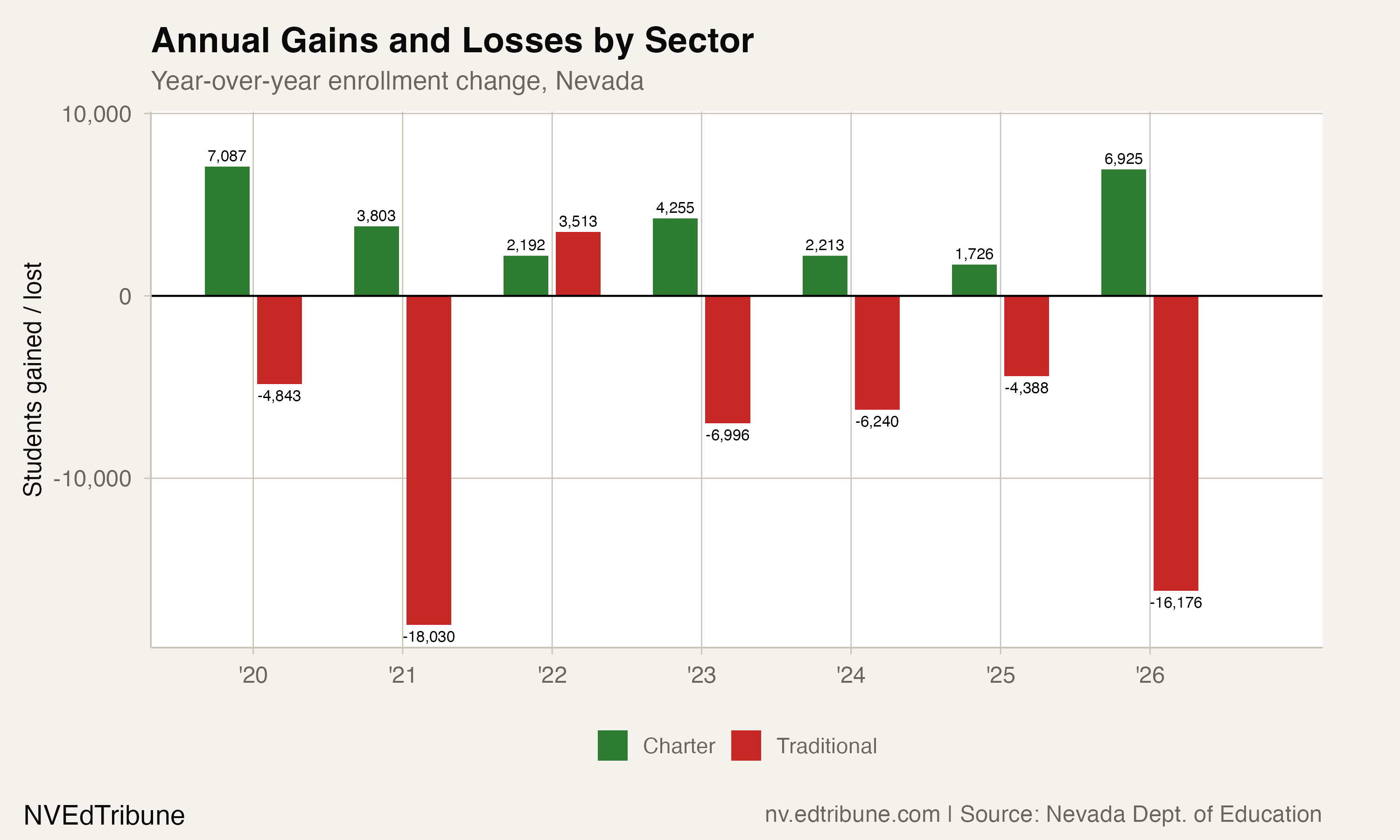
The 2026 numbers deserve a caveat. In January 2025, Clark County School District↗ET transferred oversight of six charter schools it had been operating to the State Public Charter School Authority. Those six schools, including Odyssey Charter School, The Delta Academy, Innovations International, Explore Knowledge Academy, and Rainbow Dreams, brought approximately 5,135 students into the SPCSA's enrollment count. They had previously been counted under Clark County's traditional total. Of the charter sector's reported 6,925-student gain in 2026, 5,135 came from this administrative reclassification. Organic growth across existing charters was closer to 1,790.
The transfer also inflated Clark County's reported loss. Clark's stated decline of 14,451 students in 2026 includes roughly 4,694 students who did not leave the district. They continued attending the same schools under a different authorizer. The adjusted loss, closer to 9,757, is still the largest single-year drop outside the pandemic year.
Even after stripping out the transfer effect, the seven-year trend is unmistakable. Between 2019 and 2025, before the transfer distorted the numbers, charters gained 21,276 students organically (50.3%) while traditional districts lost 36,984 (-8.1%).
Clark County bore 82% of the damage
Clark County accounts for 43,746 of the 53,160 students lost from the traditional sector since 2019, or 82.3%. The district's enrollment has fallen from 335,333 to 291,587, a 13.0% decline.
The fiscal consequences have arrived. Clark County will have $50 million less to fund schools in 2026-27. Of its 375 schools, 284 face budget reductions. A district memo outlined 1,246 positions slated for surplus: 682 licensed teachers, 500 support staff, and 64 administrators.
"I've talked to people at elementary schools where now they're assuming that there's going to be 39 kids in a fifth-grade class." -- Rebecca Dirks Garcia, Nevada PTA president-elect, News 3 Las Vegas
The kindergarten pipeline signals more losses ahead. Clark County's current kindergarten cohort is 17,678 students, nearly 30% smaller than its senior class of 24,505. Every year, the district graduates a larger cohort than the one entering.
Washoe County School District↗ET lost 3,935 students over the same period (-5.8%), a smaller share of the statewide total but a steady erosion. No other traditional district lost more than 1,111 (Douglas County, -19.0%).
A handful of networks drove charter growth
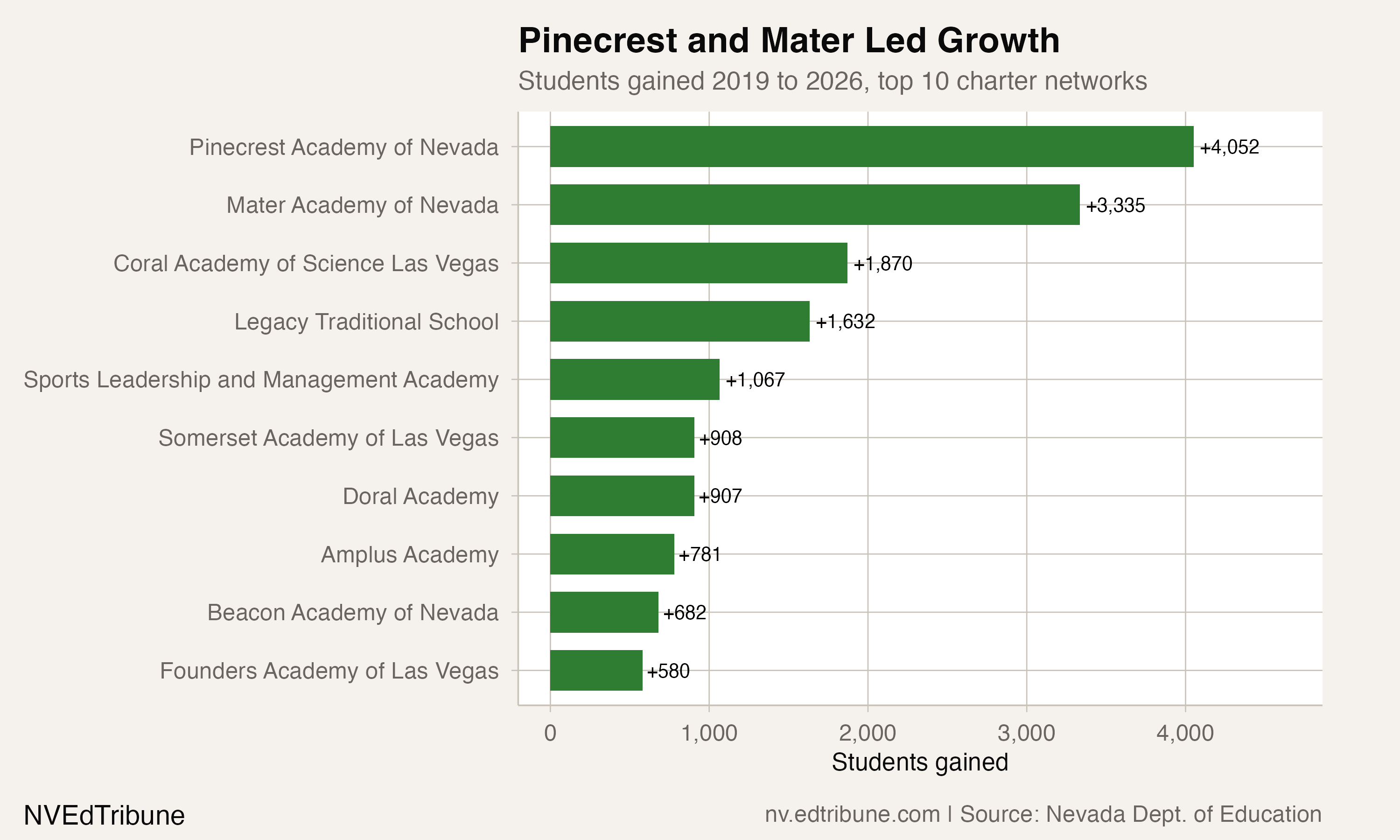
Charter growth was not evenly distributed. Two networks, Pinecrest Academy of Nevada (+4,052, +91.6%) and Mater Academy of Nevada (+3,335, +170.0%), together account for more than a quarter of the sector's total gain. Coral Academy of Science Las Vegas (+1,870) and Legacy Traditional School (+1,632) round out the top four.
Somerset Academy of Las Vegas remains the single largest charter entity at 9,534 students, but its growth has been modest: just 908 students added, a 10.5% increase. The sector's expansion is being driven less by the established players scaling up and more by mid-size networks doubling or tripling in size.
Nevada's legislature has actively encouraged this expansion. Assembly Bill 400, signed in 2023, granted cities and counties the ability to sponsor charter schools. Henderson and North Las Vegas both won approval as charter authorizers in 2024, opening a new pathway for charter growth outside the SPCSA system. The state has also committed $31 million for charter transportation since 2023 and $38 million for charter teacher pay increases in 2025, reducing two of the sector's historical cost disadvantages.
The demographic gap between sectors has vanished
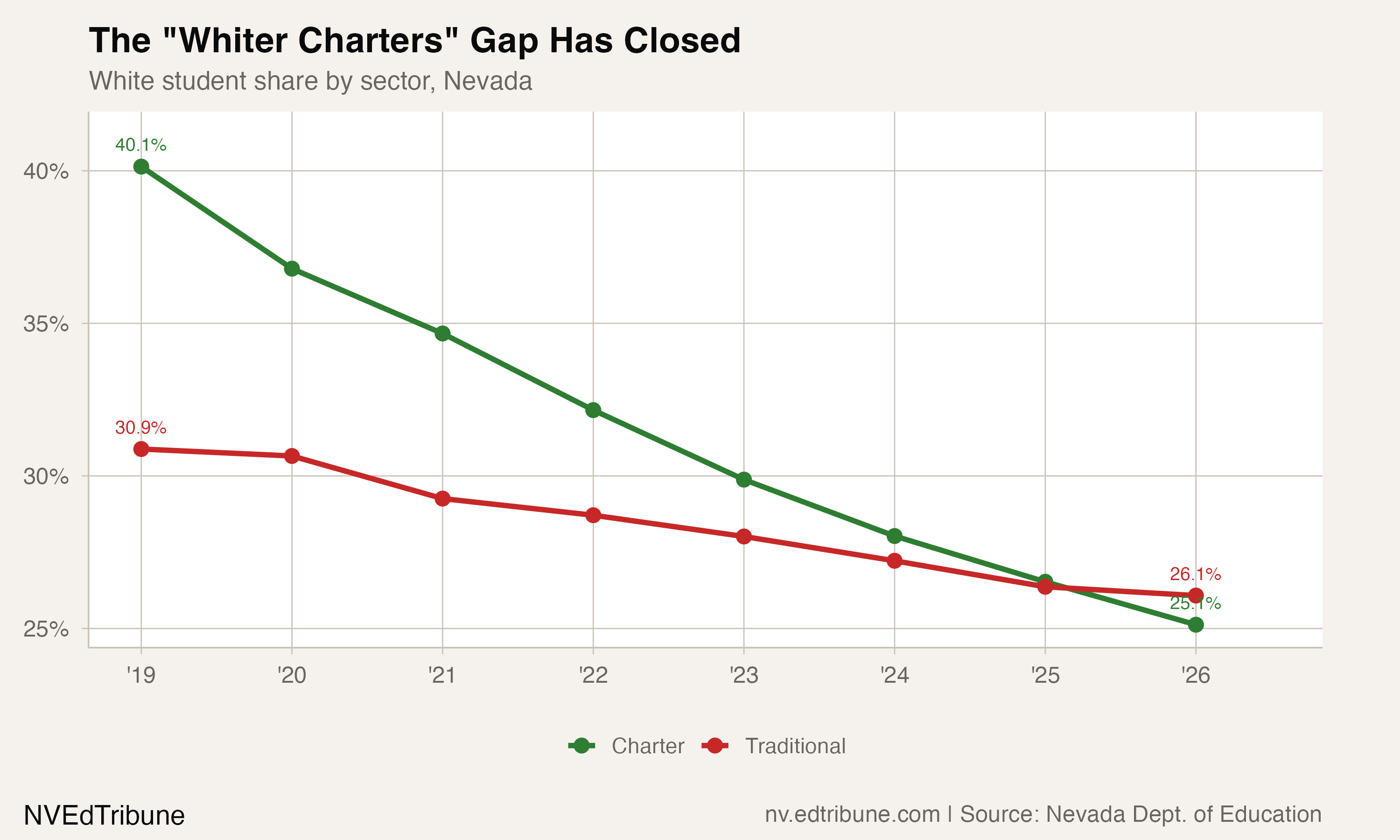
In 2019, Nevada's charter schools skewed notably whiter than traditional districts: 40.1% white versus 30.9%, a 9.2 percentage-point gap that critics pointed to as evidence the sector served a different population.
By 2025-26, the gap has functionally closed. Charter schools are 25.1% white; traditional districts are 26.1%. The charter sector is now slightly less white than the traditional sector. Hispanic enrollment in charters has risen from 31.4% to 42.5%, approaching the traditional sector's 46.5%.
Two forces drove the convergence. Newer charters opened in more diverse neighborhoods and enrolled more Hispanic students as they expanded. At the same time, traditional districts lost white students faster than they lost students overall, concentrating the remaining enrollment among students of color.
Chris Daly of the Nevada State Education Association told The Nevada Independent that "charter schools love to compare themselves and never correct for demographic differences." The enrollment data suggests the comparison is becoming more apples-to-apples on race, though gaps persist in other dimensions. The same Nevada Independent analysis found that 86% of traditional public school students qualify for free or reduced-price lunch, compared to 64% in charter schools. Charter students are also less likely to be English learners or to receive special education services.
One in seven, and climbing
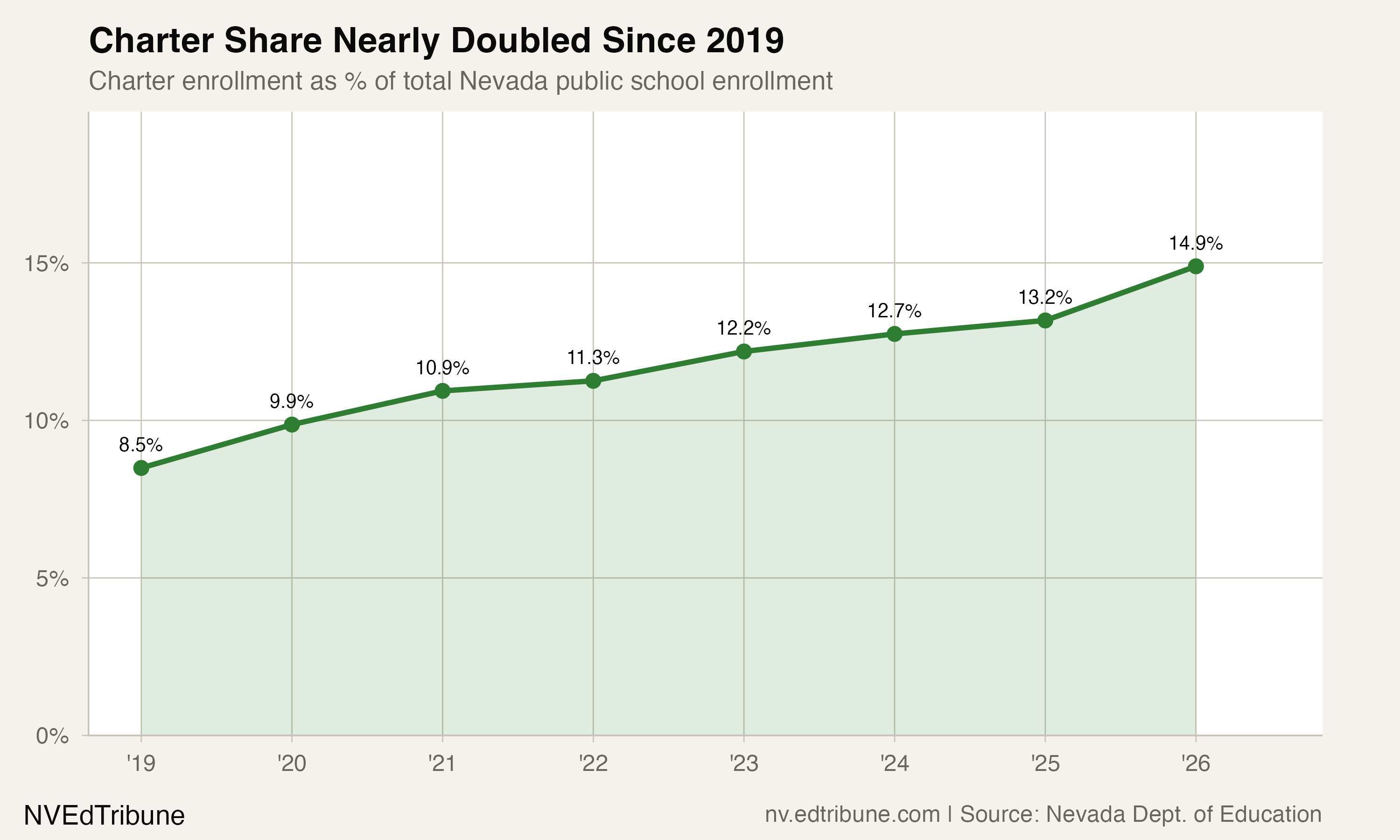
One in seven Nevada public school students now attends a charter school. The share has risen every year since the data begins, from 8.5% in 2019 to 14.9% in 2026. At 2019-2025 growth rates, charters would hit one in five students by 2030.
Nevada's traditional districts are funding infrastructure built for 456,000 students while serving 403,000. Each departing student takes $9,051 in state per-pupil funding but leaves behind a building, a bus route, and a share of fixed administrative costs that do not shrink proportionally. The $50 million budget gap Clark County faces next year is the arithmetic of that mismatch playing out in real time.
Detailed code that reproduces the analysis and figures in this article is available exclusively to EdTribune subscribers.
Discussion
Sign in to join the discussion.
Loading comments...