Correction: An earlier version of this article stated that nineteen charter entities that did not exist in 2019 now enroll 11,130 students. The correct figures are 23 charter entities enrolling 13,373 students. The article has been updated.
Five years is long enough to call it. Nevada's traditional public school districts lost 22,873 students during the pandemic's first two years. They have since lost an additional 30,287. The post-COVID period has been worse than COVID itself.
Of the 51 districts that existed in both 2019 and 2026, just 25 have returned to their pre-pandemic enrollment levels. The 26 that have not include 15 of 17 county districts: Clark↗ET, Washoe↗ET, Carson, Elko, Douglas, Churchill, Lyon, Humboldt, and seven more. The recovered districts are almost exclusively charter schools. Only two traditional districts, Nye County and Lander County, had more students in 2026 than in 2019.
The gap that kept growing
The conventional framing of pandemic enrollment loss assumes a drop followed by a recovery. Nevada's traditional sector never got the second part.
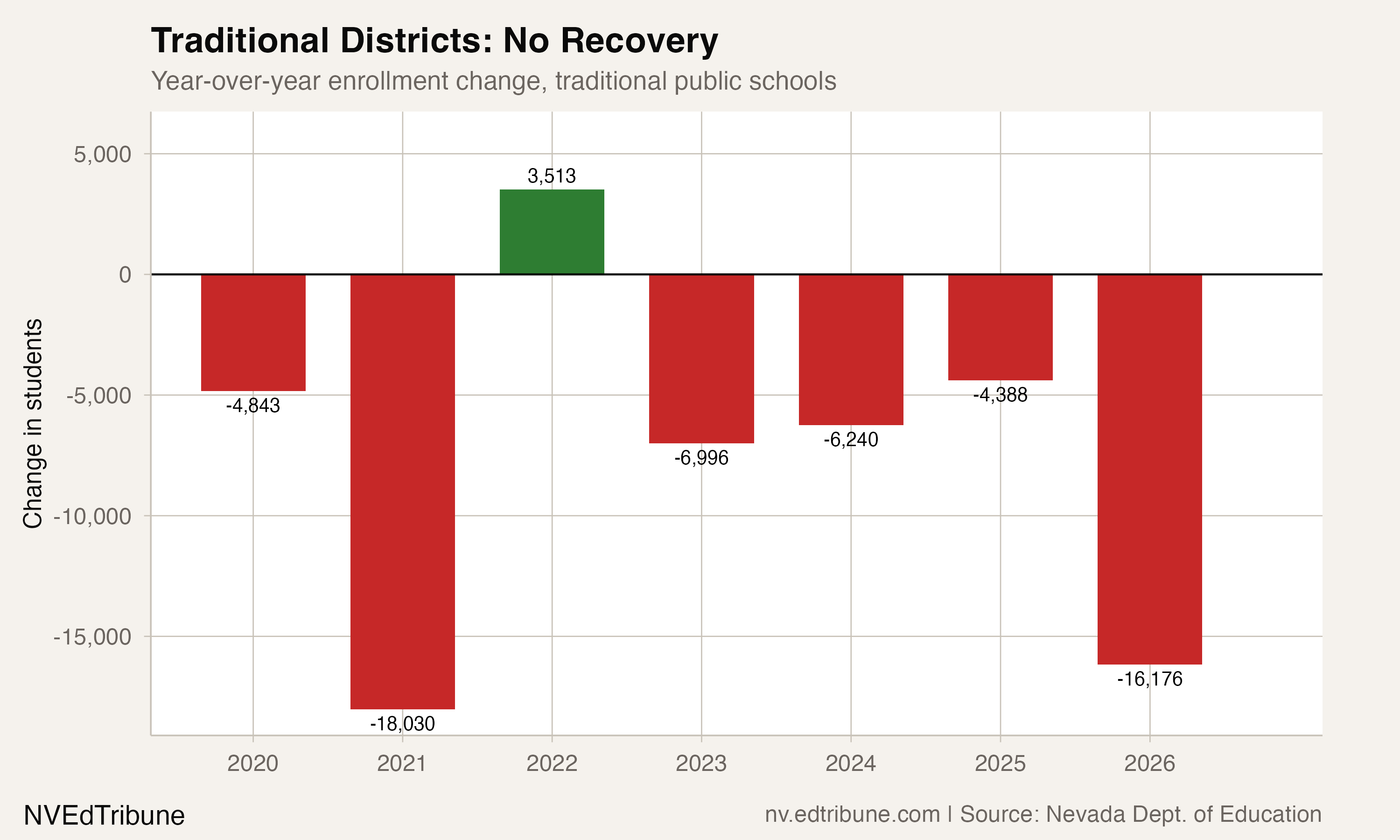
In the 2021-22 school year, traditional districts clawed back 3,513 students, the only positive year since the pandemic. Then the losses resumed: 6,996 in 2022-23, 6,240 in 2023-24, 4,388 in 2024-25. And in 2025-26, the bottom fell out again with a loss of 16,176 students, nearly matching the 18,030-student COVID-year drop.
Statewide, Nevada enrolled 498,616 students in 2018-19 and 473,657 in 2025-26, a net decline of 24,959 or 5.0%. But that aggregate masks the divergence between sectors. Traditional districts went from 456,283 to 403,123, a loss of 53,160 students (11.7%). Charter schools went from 42,333 to 70,534, a gain of 28,201 (66.6%).
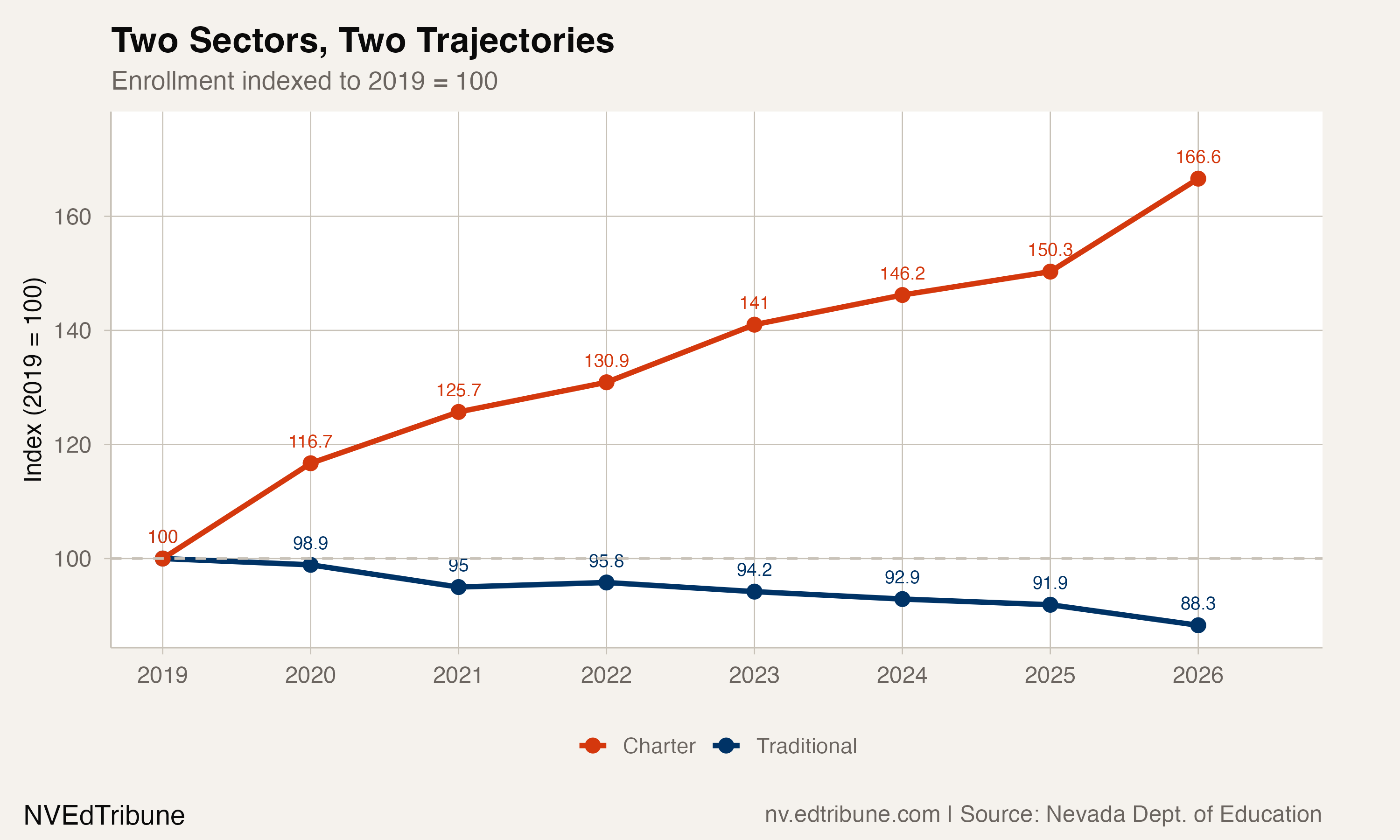
The charter sector's share of Nevada enrollment has nearly doubled, from 8.5% in 2019 to 14.9% in 2026. Twenty-three charter entities that did not exist in 2019 now enroll 13,373 students.
Clark County is the crater
Clark County School District dominates this story to an unusual degree. Its loss of 43,746 students since 2019, a 13.0% decline, exceeds the entire state's net loss of 24,959. The math works because charter growth partially offsets Clark's collapse at the state level.
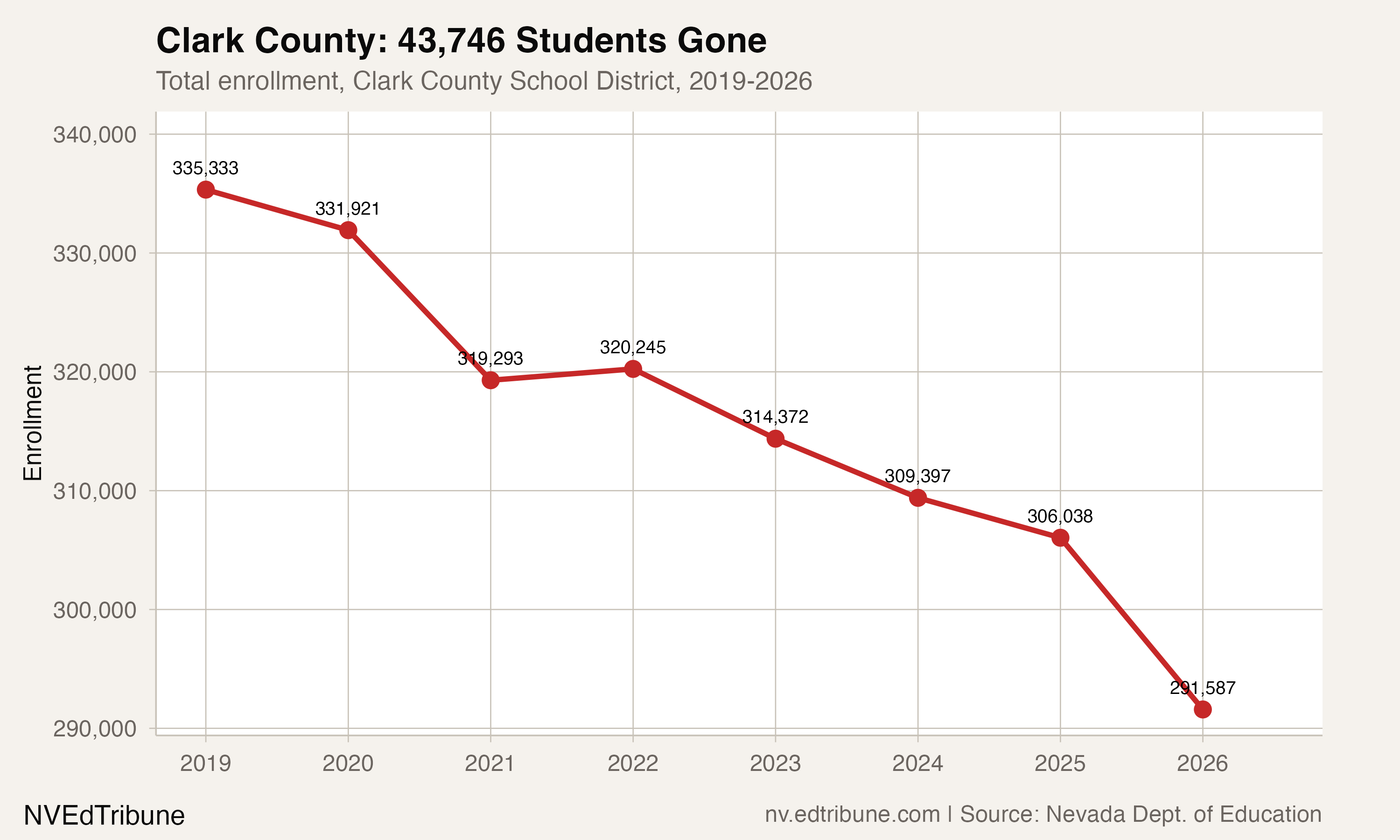
The district lost 16,040 students during the pandemic's acute phase (2019 to 2021). In the four years since, it has lost an additional 27,706, 1.7 times the COVID drop. The 2025-26 year alone saw Clark shed 14,451 students, a single-year loss that approaches the entire two-year pandemic decline.
The fiscal consequences are concrete. At Nevada's base per-pupil allocation of $9,051 for 2025-26, Clark's cumulative loss translates to roughly $396 million in annual funding that would have flowed to the district at 2019 enrollment levels. The district projects a $50 million budget shortfall for the 2026-27 school year.
"For decades, we were hiring thousands of educators. ... It is a shift." — Superintendent Jhone Ebert, Las Vegas Sun, Feb. 2026
That shift has already reached staffing. The district has identified nearly 1,200 employees for surplus, including 682 licensed educators, 500 support professionals, and 64 administrators. Of 375 schools, 284 face budget reductions.
The acceleration problem
For six of Nevada's 19 traditional districts, the post-pandemic period has produced larger enrollment losses than the pandemic itself. Clark is the most consequential, but the pattern extends to Carson City↗ET (COVID loss of 385, post-COVID loss of 555), Douglas↗ET (456, then 655), and three smaller counties.
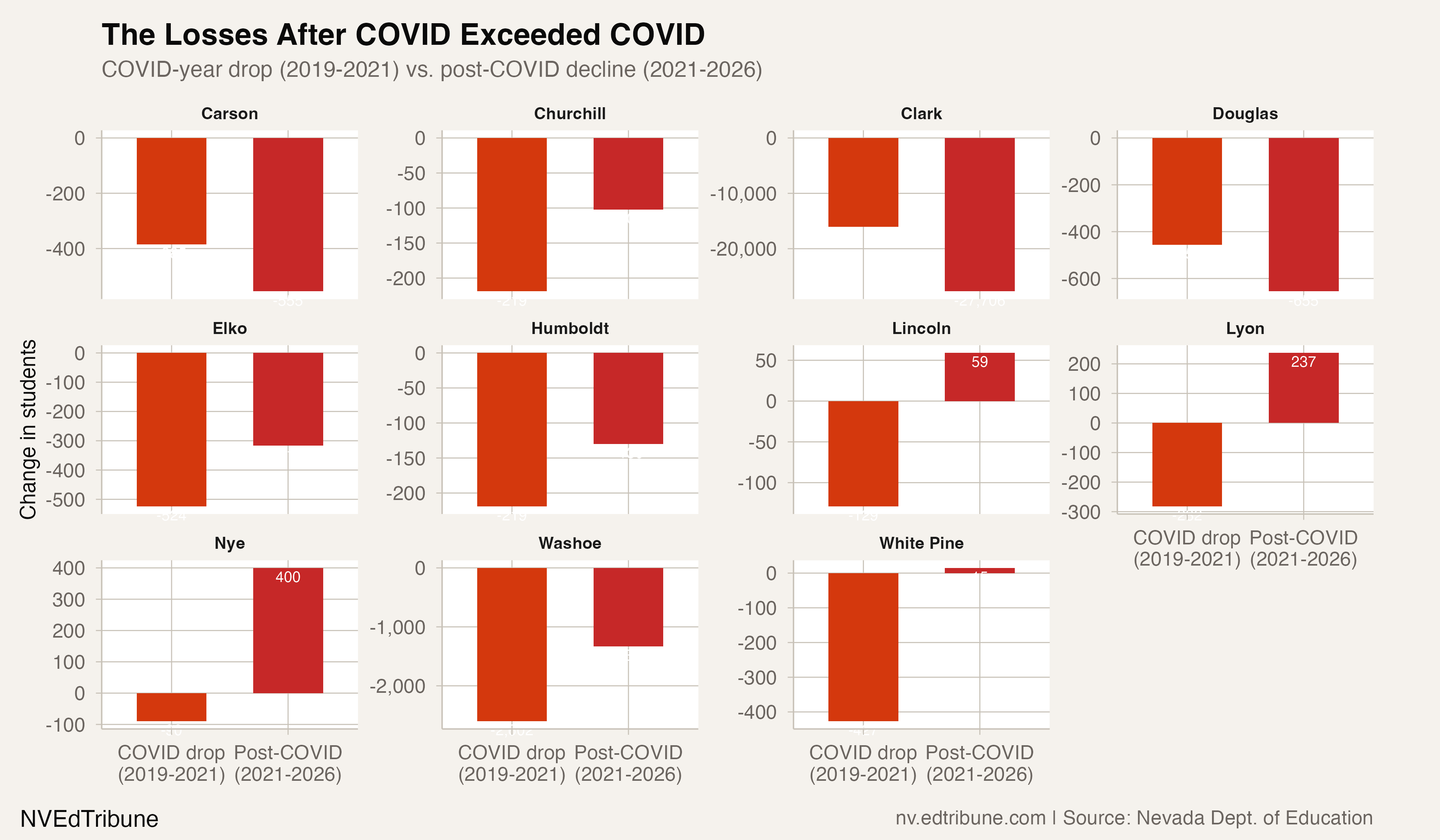
This pattern distinguishes Nevada from states where pandemic losses stabilized. The traditional sector's aggregate post-COVID loss of 30,287 is 1.3 times the initial COVID drop of 22,873. Five years after the disruption, the rate of loss is accelerating, not decelerating.
Where the students went
Three forces are pulling students out of traditional districts simultaneously, and the data cannot fully distinguish their relative contributions.
The most measurable is charter growth. The State Public Charter School Authority, which had grown from overseeing 11,000 students at its founding in 2011 to more than 70,000 by early 2026, now operates the second-largest school system in Nevada after Clark County. Among existing charter entities, Pinecrest Academy of Nevada grew by 4,052 students (91.6%) since 2019, Mater Academy of Nevada by 3,335 (170.0%), and Coral Academy of Science Las Vegas by 1,870 (50.8%). In January 2025, Clark County transferred responsibility for six county-run charter schools to the SPCSA, shifting roughly 5,550 students.
The second is demographic: declining birth rates. Clark County's kindergarten cohort of 17,618 is nearly 30% smaller than its current senior class of 24,505. Smaller cohorts entering at the bottom of the pipeline while larger ones exit at the top guarantee continued losses even without any family choosing to leave.
The third is housing affordability. Clark County's median home price has roughly quadrupled over 13 years to approximately $480,000, with typical monthly mortgage payments exceeding $2,800. Population projections from UNLV's Center for Business and Economic Research show Clark County's population growth rate declining as birth rates fall and in-migration slows, while the population ages faster than the national average.
One factor the data cannot capture: how much of the traditional-to-charter shift represents families actively choosing charters versus families who would have enrolled in traditional schools but found charter seats available in their neighborhoods. The nine charter entities that lost enrollment since 2019, including Nevada Connections Academy (down 1,964, or 60.5%) and Nevada Virtual Charter School (down 438, or 23.8%), were predominantly virtual programs, suggesting that the pandemic's virtual school boom has reversed even as brick-and-mortar charters expand.
Every county, the same direction
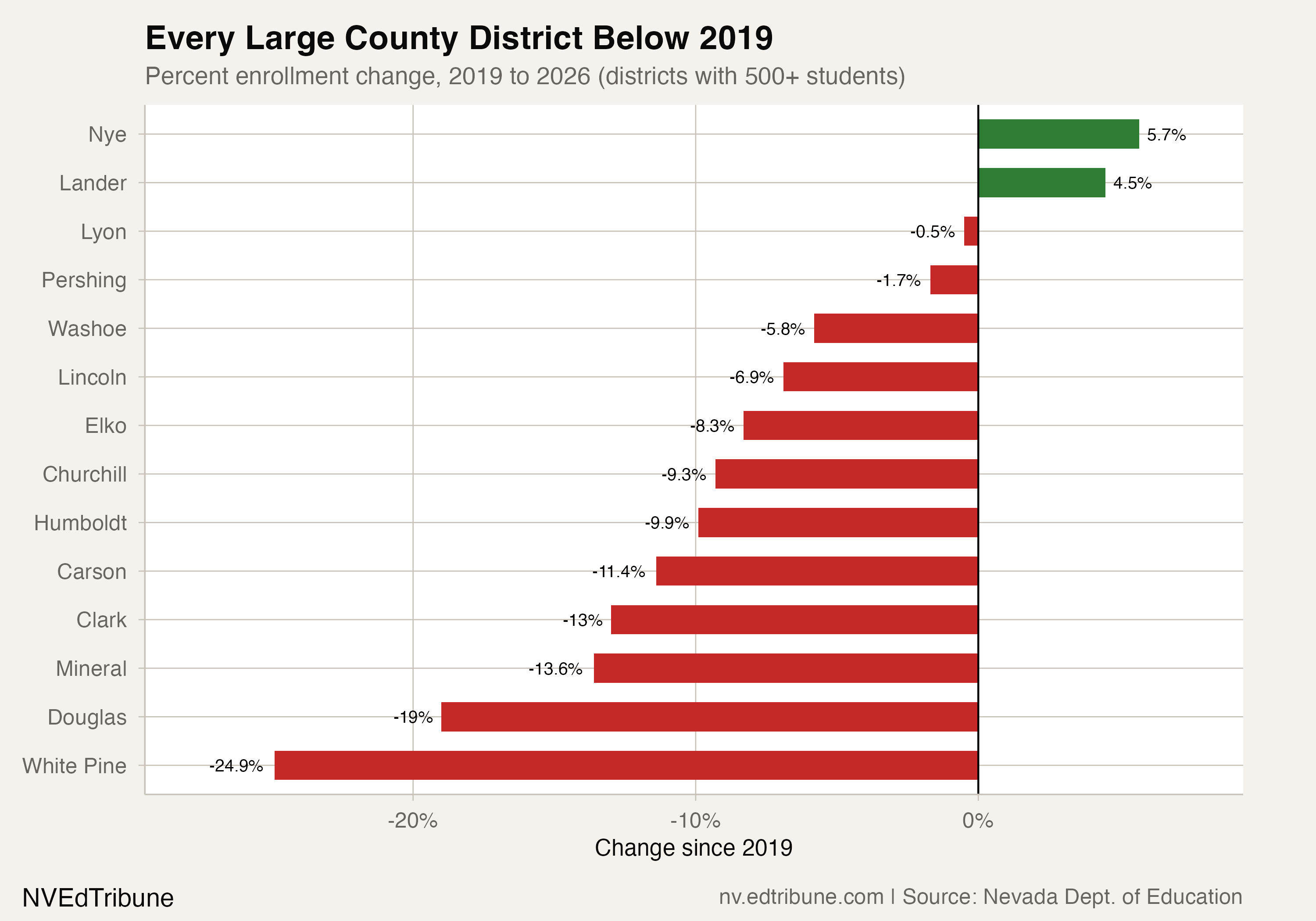
Among traditional districts with at least 500 students, not one has escaped. White Pine County has lost 24.9% of its enrollment, Douglas County↗ET 19.0%, Clark 13.0%, Carson City 11.4%. Even Lyon County↗ET, down just 0.5%, sits below its 2019 level.
The only traditional outliers are Nye County↗ET, which gained 310 students (5.7%) and Lander County, up 45 (4.5%). Nye's growth may reflect population shifts in the Pahrump area, though the data does not break out the mechanism.
Chris Daly of the Nevada State Education Association has cautioned against reading charter growth as a simple quality signal: "Charter schools love to compare themselves and never correct for demographic differences." Traditional districts serve a substantially higher share of students qualifying for free and reduced-price lunch, 86% compared to 64% for charter schools.
What next year's kindergarten class foretells
The structural forces driving this decline show no sign of reversing. Clark County expects to lose another 5,151 students by fall 2026, and the kindergarten-to-senior gap means the pipeline will keep shrinking. Nevada's charter sector added 6,925 students in 2025-26 alone, its largest single-year gain, and new municipal charter authorizers in Henderson and North Las Vegas are preparing to sponsor additional schools.
Recovery is no longer the right word. Clark County's per-pupil funding is rising by just 0.7% next year, from $9,501 to $9,572, while its enrollment drops by thousands. The district is now reviewing its facilities master plan, weighing school closures and K-8 conversions for buildings designed for enrollments that are not coming back.
Detailed code that reproduces the analysis and figures in this article is available exclusively to EdTribune subscribers.
Discussion
Sign in to join the discussion.
Loading comments...