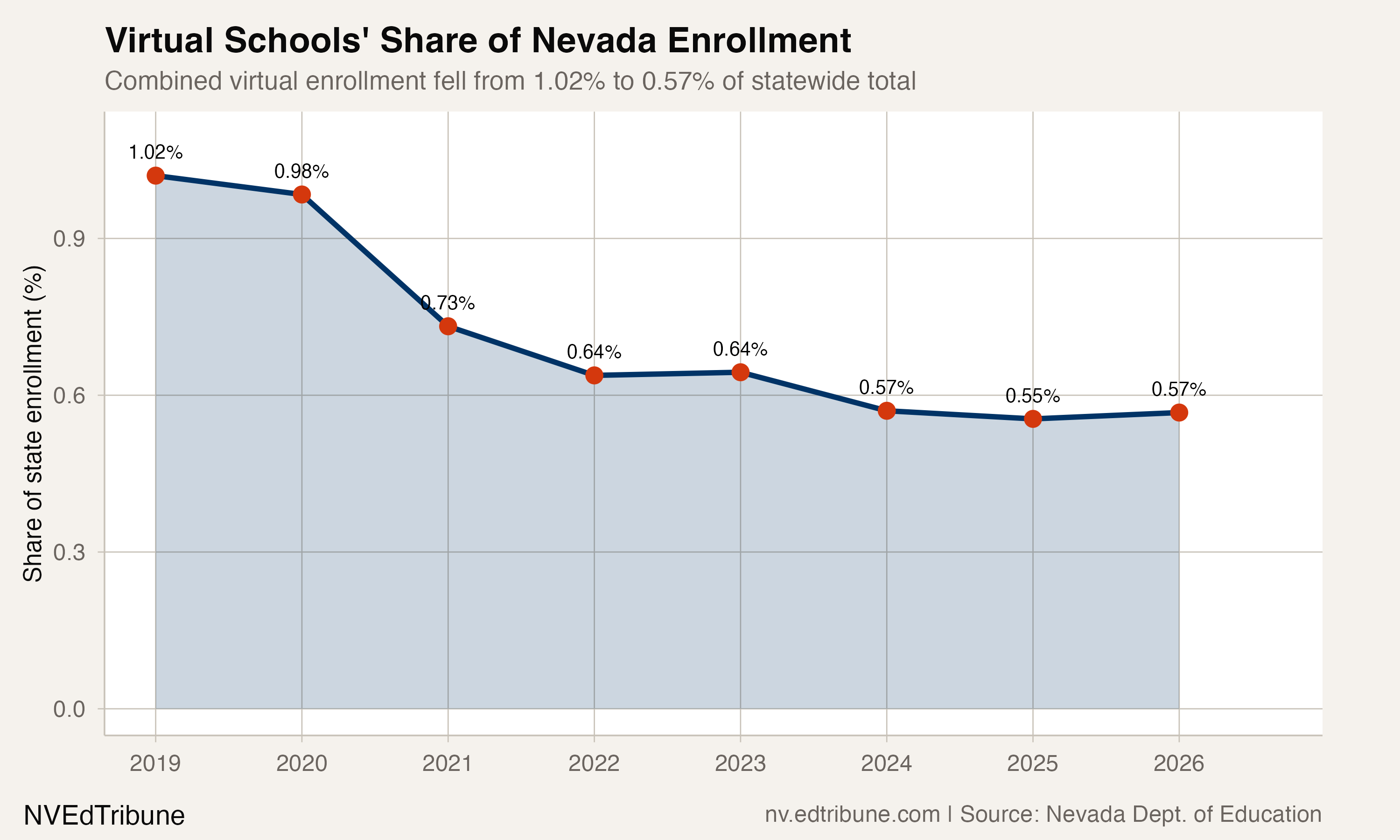
Nevada has two full-time virtual charter schools. Together they serve 2,685 students in 2025-26, down from 5,087 seven years ago. That is a 47.2% decline, cutting their share of statewide enrollment nearly in half, from 1.02% to 0.57%.
The headline number looks like a single story of post-pandemic virtual school retreat. It is not. One school was nearly shut down by regulators and is now growing. The other rode a COVID enrollment surge that has largely unwound.
The forced collapse
Nevada Connections Academy enrolled 3,247 students across grades K-12 in 2018-19. It was the state's largest virtual school by a wide margin. By the following fall, enrollment had grown to 3,468.
Then the State Public Charter School Authority intervened. In January 2020, the SPCSA board voted to deny Connections Academy's contract renewal, citing persistently low academic performance. SPCSA Executive Director Rebecca Feiden framed the decision bluntly:
"When we say one in 10 kids is proficient, that means the program is working for one of those 10 kids. But unfortunately it's not working for enough." — Pahrump Valley Times, Feb. 2020
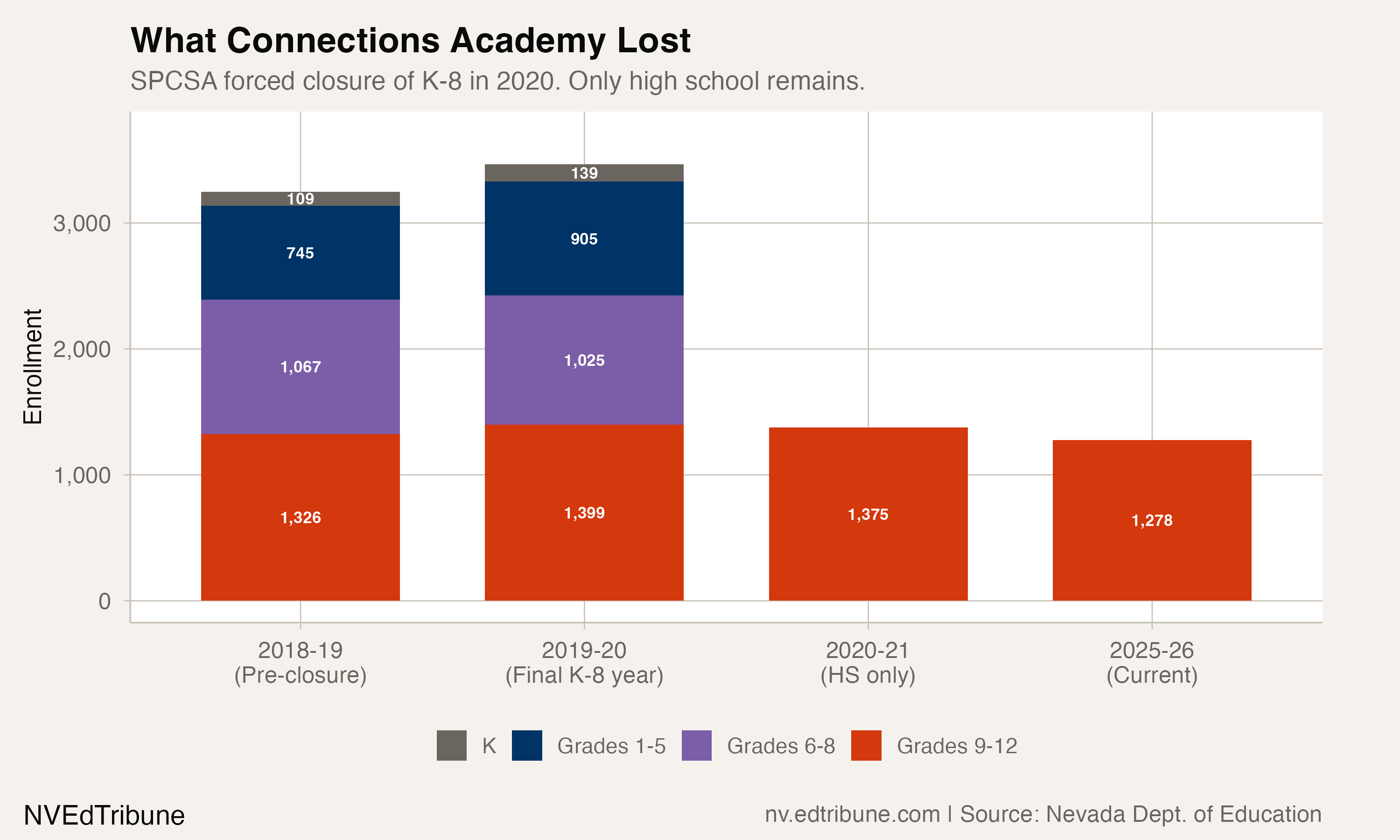
The school sued. In May 2020, the two sides reached a settlement: Connections Academy's elementary and middle school programs would close permanently. Only the high school would survive, under a three-year contract, with enrollment capped at 850 students in grades nine and 10 and no new admissions in grades 11 and 12.
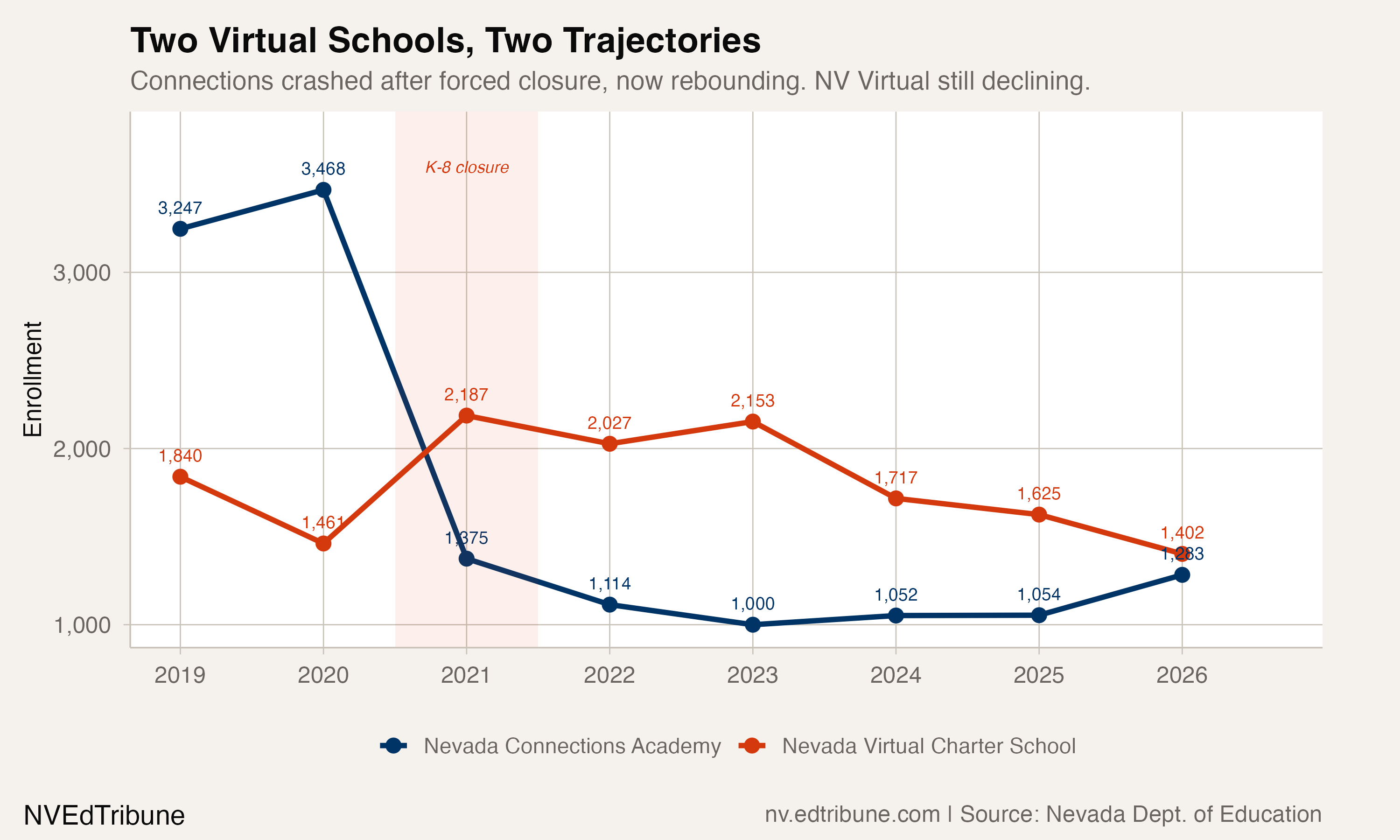
The effect was immediate. In 2020-21, Connections Academy enrolled 1,375 students, down 60.4% from the prior year. Of the school's 3,468 students in 2019-20, 2,069 had been in grades K-8. Those students had no Connections Academy to return to.
A different kind of decline
Nevada Virtual Charter School, operated by K12 Inc. (now Stride), followed an opposite arc. The school had already lost its own K-5 program after failing to meet academic benchmarks set by the SPCSA. It sued the authority over performance stipulations in its renewal contract, but the elementary program closed nonetheless, and enrollment dropped from 1,840 students in 2018-19 to 1,461 in 2019-20.
Then COVID arrived. With brick-and-mortar charter schools limited to 25% in-person capacity under SPCSA guidance, Nevada Virtual's 6-12 program surged to 2,187 students in 2020-21, a 49.7% jump. Families who needed a functioning virtual option found one.
The surge did not last. Nevada Virtual fell to 2,027 in 2021-22, rebounded slightly to 2,153 in 2022-23, then entered a sustained decline: 1,717, 1,625, and now 1,402. Peak to present, the school has lost 785 students, a 35.9% decline over five years.

The rebound no one expected
The surprise in the 2025-26 data is Connections Academy. After bottoming out at 1,000 students in 2022-23, the school has added 283 students over three years, reaching 1,283 in 2025-26. The 21.7% growth from 2024-25 to 2025-26 ranks fifth among all charter entities with at least 100 students.
The school hired a new principal from another Connections Academy campus before the 2024-25 school year, and a March 2025 SPCSA site evaluation noted improved academic performance and staff morale. The school has been preparing for its next charter renewal, this time with a stronger hand.
The growth is broad-based. Connections Academy added 91 Hispanic students and 90 white students from 2024-25 to 2025-26. Its ninth-grade class nearly doubled, from 127 to 203.
The national pattern
Nevada's virtual school decline is not an isolated phenomenon. Nationally, virtual school enrollment nearly doubled during the pandemic, from 0.7% of public school students in 2019-20 to 1.2% in 2020-21, then declined as families returned to in-person instruction. The pattern played out across Connections Academy programs in dozens of states. Pearson, which acquired Connections Education in 2011 when it served roughly 40,000 students in 21 states, has faced persistent questions about student retention and academic outcomes in its virtual programs.
What sets Nevada apart is regulatory enforcement. Both virtual schools faced closure proceedings from the SPCSA for academic underperformance. Both lost grade bands. Both survived through legal action and settlement agreements. The academic performance that prompted those closures, not the pandemic, is the primary driver of the combined 47.2% enrollment loss.
The charter sector without virtual schools
The virtual school collapse obscures a different story in Nevada's charter sector. Brick-and-mortar charter schools grew from 37,246 students to 67,849 over the same seven years, an 82.2% increase. The number of brick-and-mortar charter entities nearly doubled, from 27 to 49.
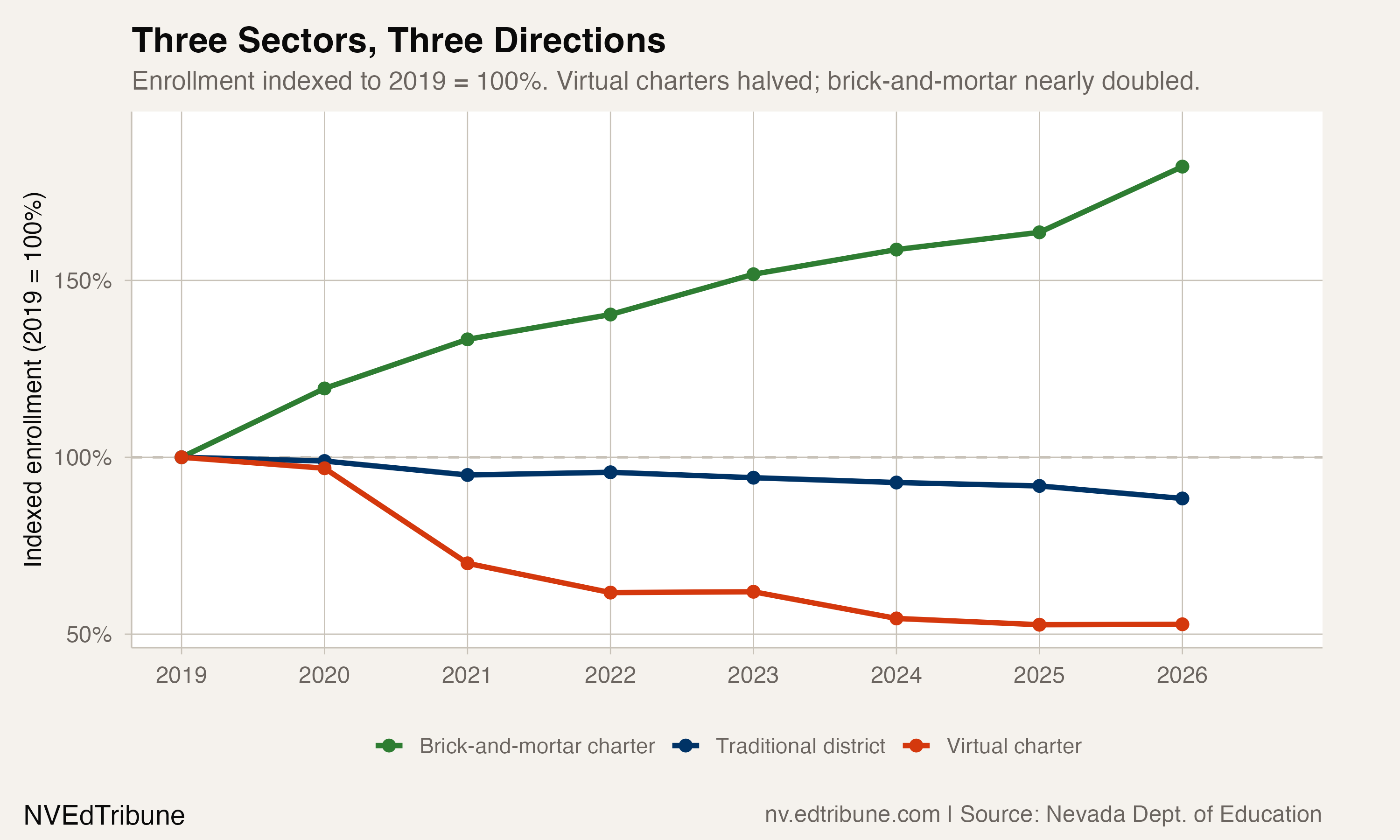
Indexed to 2019, brick-and-mortar charters now operate at 182% of their starting enrollment. Traditional districts are at 88.3%. Virtual charters are at 52.8%.
The divergence means that Nevada's charter sector is increasingly a brick-and-mortar story. In 2018-19, virtual schools accounted for 12.0% of all charter enrollment. In 2025-26, they account for 3.8%. Mater Academy of Nevada alone added 2,034 students since 2020-21, nearly matching the entire combined virtual enrollment of 2,685.
Who enrolls in virtual school
The 2,685 students who remain in Nevada's virtual schools are demographically distinct from the state's student body. White students make up 33.0% of virtual enrollment but only 25.9% of statewide enrollment. Hispanic students are underrepresented in virtual schools at 35.6%, compared to 45.9% statewide. Black students are overrepresented at 16.8%, versus 12.4% statewide.
The gap has narrowed. In 2018-19, white students made up 46.5% of virtual enrollment, nearly 15 percentage points above their statewide share of 31.7%. That spread has compressed to seven points.
Separately, students receiving special education services now represent 14.5% of virtual enrollment, up from 10.6% in 2020-21. This may reflect a genuine shift in which families find virtual instruction most useful, though the enrollment data alone cannot distinguish whether the rate increase reflects new special education students choosing virtual schools or the departure of general education students concentrating the existing special education population.
What comes next
The question for Nevada's virtual sector is whether Connections Academy's rebound represents a sustainable model or a temporary bounce from a very low floor. A school that served 3,468 students across K-12 now serves 1,283 in grades nine through 12 only. Even with 21.7% growth, it remains 63.0% below its 2019-20 peak.
Nevada Virtual Charter School faces the opposite problem: a school with no growth story to tell. Three consecutive years of decline have brought enrollment to 1,402, approaching the level that preceded its own elementary school closure in 2019.
The SPCSA's next round of charter reviews will determine whether both schools remain open. The authority has shown it will close programs that do not perform. Whether 2,685 students is a floor or a waypoint depends on whether these schools can demonstrate academic results that regulators, and families, find acceptable.
Detailed code that reproduces the analysis and figures in this article is available exclusively to EdTribune subscribers.
Discussion
Sign in to join the discussion.
Loading comments...