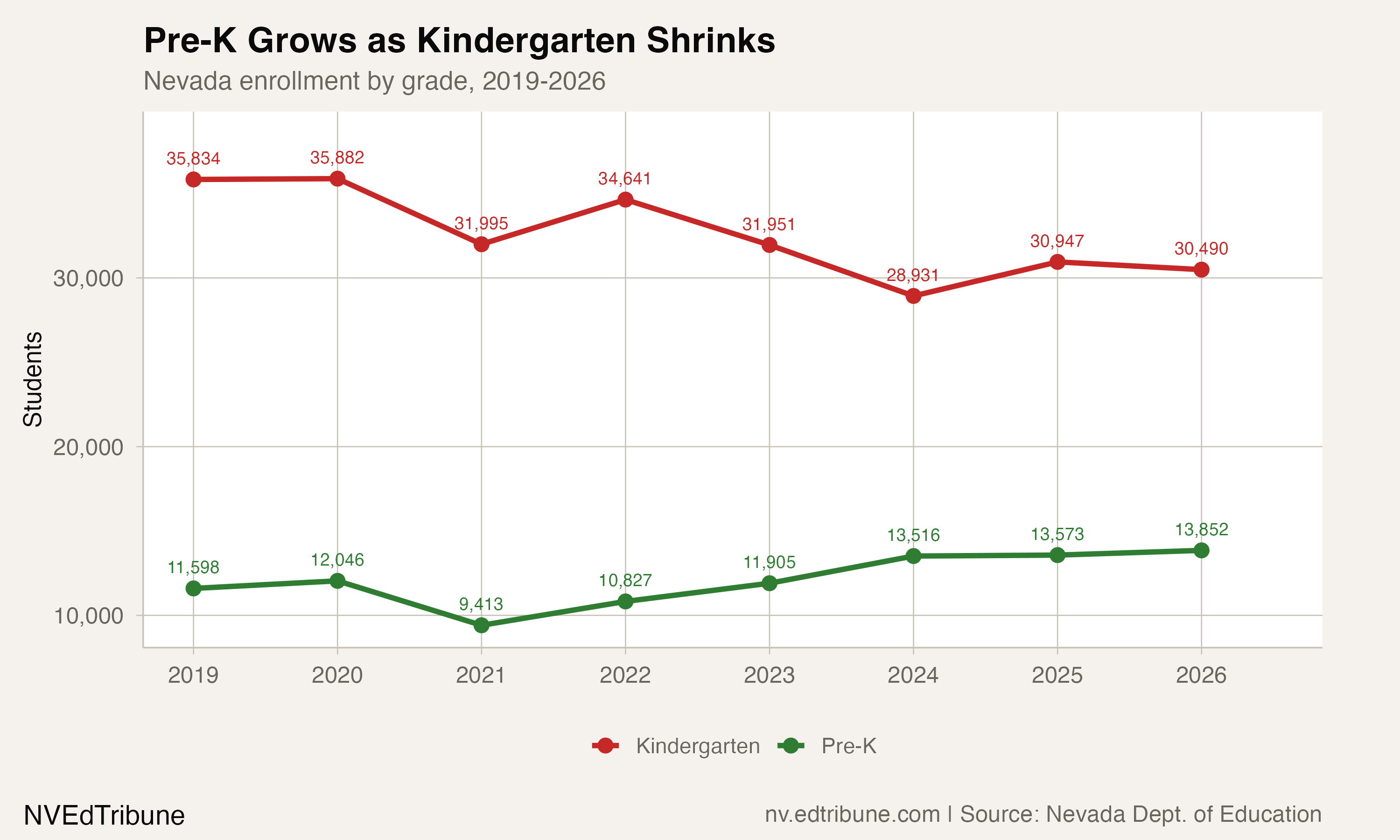
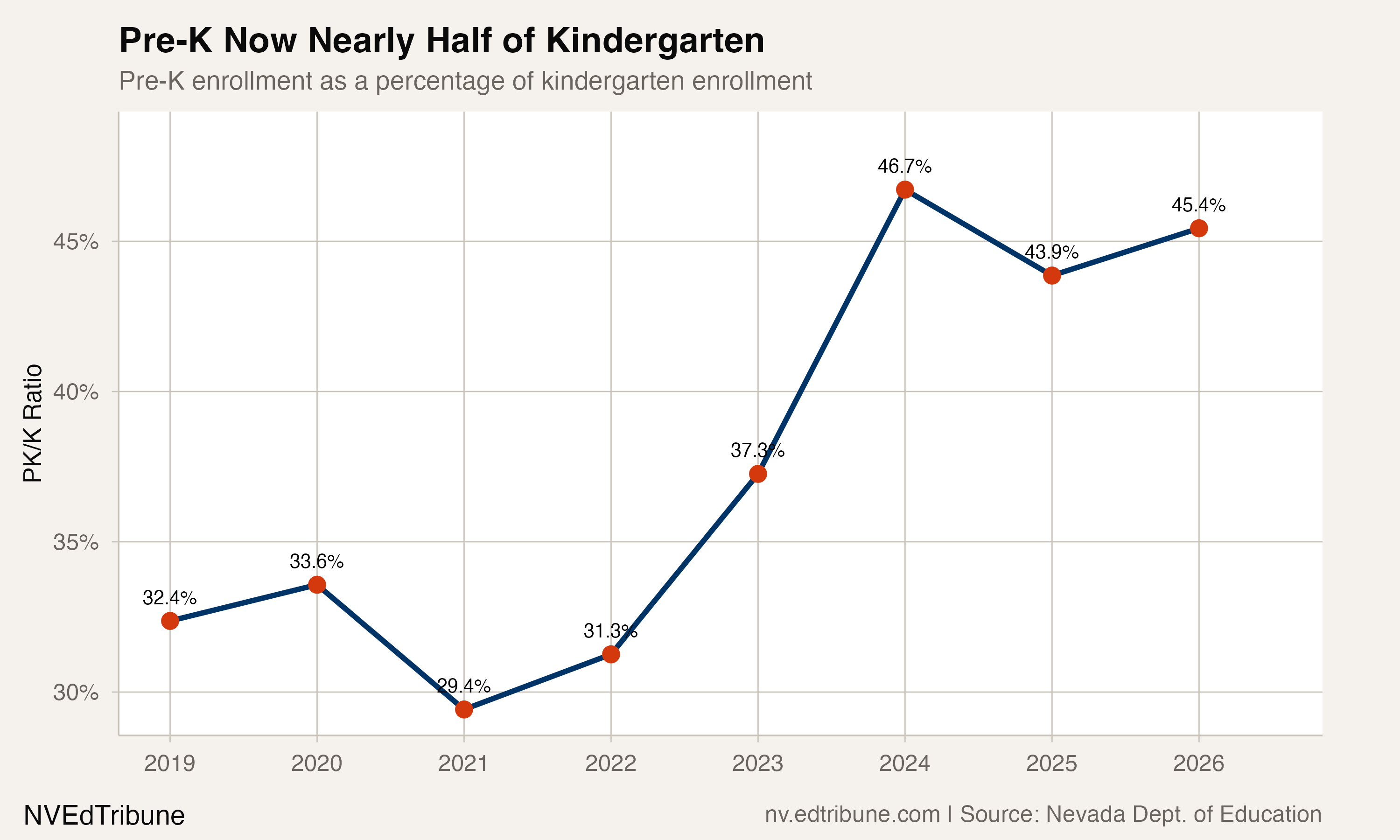
For every 100 kindergartners in Nevada, there are now 45 pre-K students. Seven years ago, there were 32. That shift, from roughly one-in-three to nearly one-in-two, reflects a deliberate state investment in early childhood education that has produced the only growing grade band in a system losing students everywhere else.
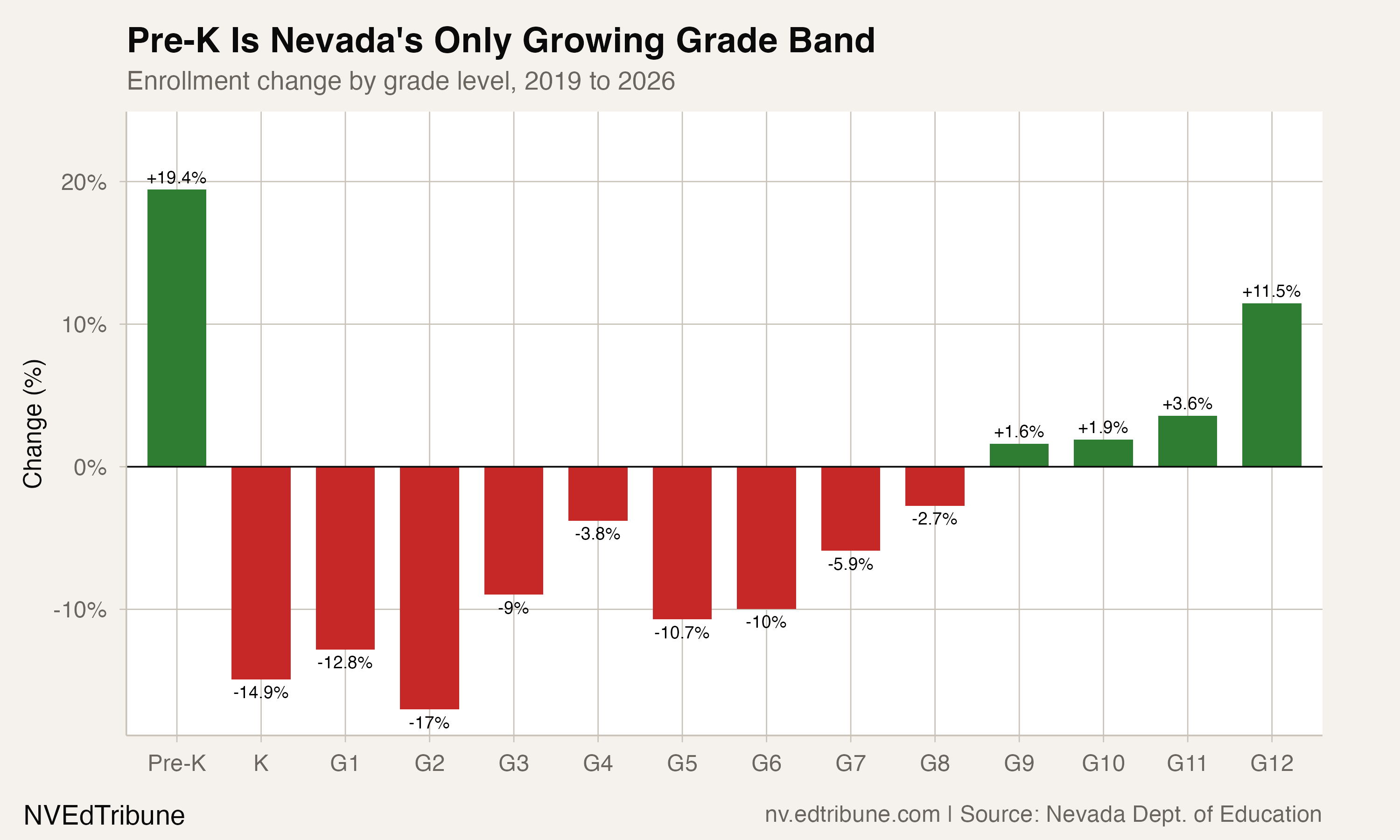
Nevada's pre-K enrollment rose from 11,598 in 2019 to 13,852 in 2026, a 19.4% increase of 2,254 students. Over the same period, kindergarten fell 14.9%, grades 1 through 8 each declined between 2.7% and 17.0%, and statewide enrollment dropped from 500,860 at its 2020 peak to 473,657, a loss of 27,203 students. Pre-K grew against the current.
One grade band, two directions
The divergence between pre-K and kindergarten is the starkest version of a broader pattern. Nevada's early grades are shrinking while its upper grades are still flushing through larger cohorts born before the state's birth rate decline accelerated. The early band (pre-K through second grade) lost 13,928 students since 2019, an 11.6% decline. The late band (grades 9 through 12) gained 6,452, a 4.5% increase.
Pre-K is the sole exception in the early pipeline. Every grade from kindergarten through eighth lost students since 2019. Second grade posted the largest decline at 17.0%, followed by kindergarten at 14.9% and first grade at 12.8%.
The pre-K-to-kindergarten ratio captures the shift in a single number. In 2019, pre-K enrollment equaled 32.4% of kindergarten enrollment. By 2024, that ratio hit 46.7%, its highest point. It settled at 45.4% in 2026, still 13 percentage points above where it started.
The funding behind the growth
The expansion is not organic. It is the product of state legislation that has doubled Nevada's investment in early childhood education over two legislative cycles.
The 2023 Legislature approved $76 million over two years for the Nevada Ready! State Pre-K program, a $30 million increase from the prior authorization. The program raised its income eligibility threshold from 200% to 250% of the federal poverty level and expanded access to children in rural areas, foster care, single-parent households, and asylum-seeking or refugee families.
The result: state-funded pre-K seats nearly doubled from approximately 3,200 in 2024-25 to 5,900 in 2025-26, according to the Nevada Independent. The Nevada Department of Education proposed expanding further to approximately 8,500 seats by 2027.
Senate Majority Leader Nicole Cannizzaro has pushed even further, introducing a bill that would establish universal pre-K for all four-year-olds, at an estimated cost of $500 million. Nevada reaches about one-sixth of its approximately 35,000 four-year-olds with state-funded programs.
A bright spot with a caveat
Pre-K's recovery from COVID was faster and more complete than any other grade's. Enrollment dropped 21.9% in 2021, from 12,046 to 9,413. It then surged 43.6% over the next three years, reaching 13,516 by 2024 and exceeding pre-COVID levels by 1,470 students. Kindergarten, by contrast, has never recovered to its 2019 level.
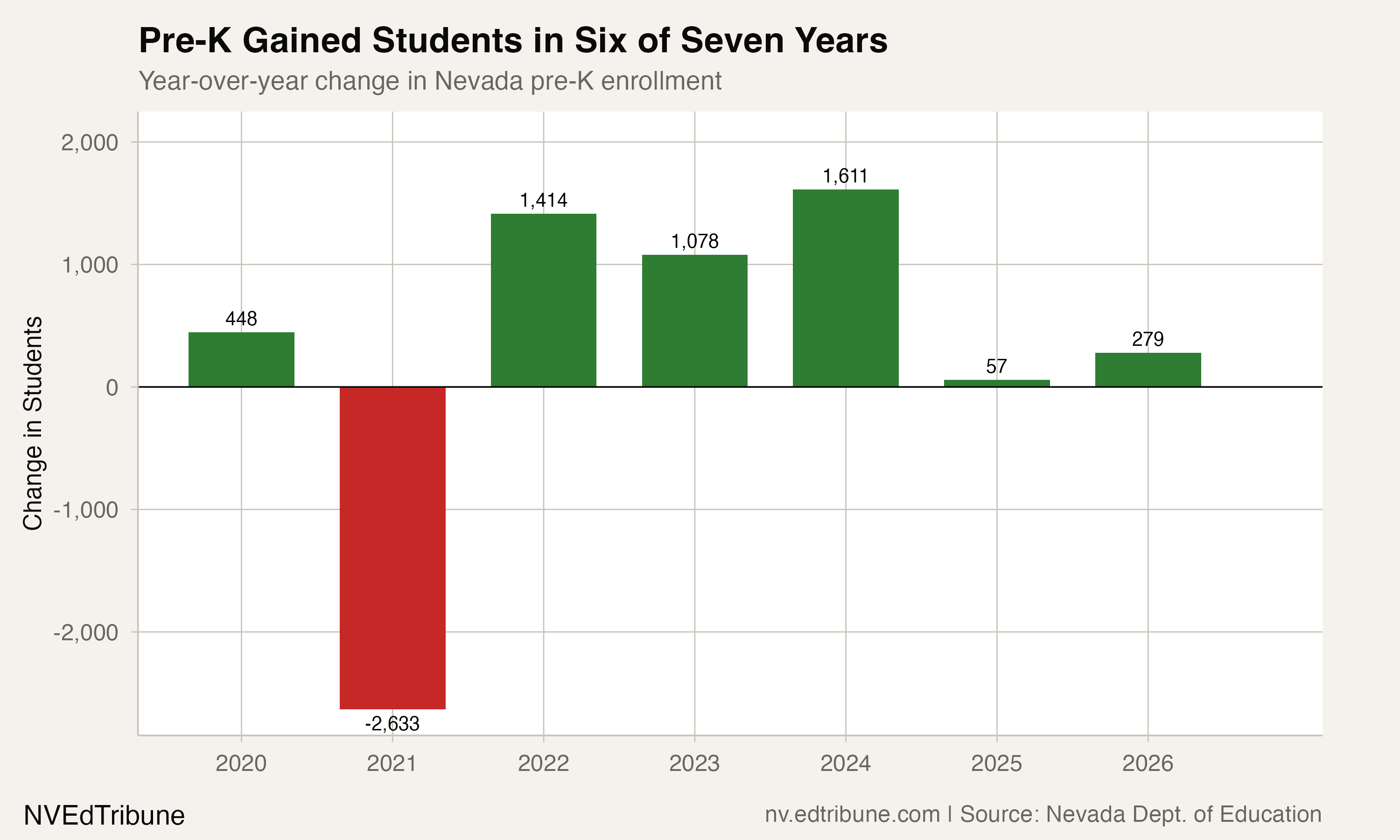
Growth has slowed noticeably in the last two years: 57 students added in 2025 and 279 in 2026, compared to 1,611 in 2024. This deceleration coincides with reports of a 9% vacancy rate in state-funded pre-K seats, up from 3% the prior year. Program leaders attributed the empty seats to late funding releases and insufficient time for outreach, not lack of demand. Clark County School District alone reported approximately 6,000 children on waitlists for pre-K programs.
Clark County carries the weight
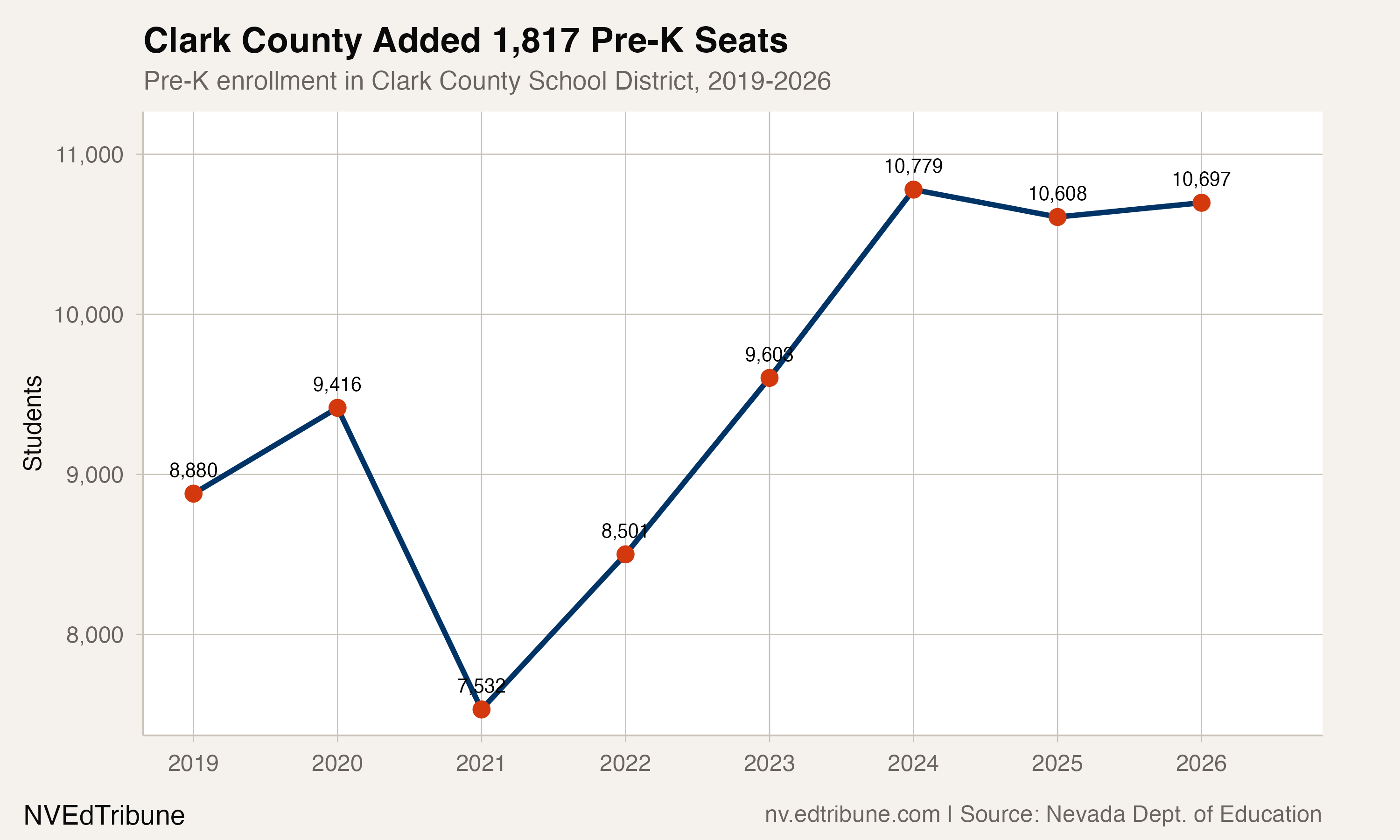
Clark County School District↗ET accounts for 77.2% of Nevada's pre-K enrollment, with 10,697 students in 229 schools in 2026. The district added 1,817 pre-K seats since 2019, a 20.5% increase, and has added 500 more seats at 33 schools through the Nevada Ready! program.
Washoe County School District↗ET posted the steepest percentage growth among large providers, rising from 865 to 1,161 pre-K students, a 34.2% increase. The number of Washoe schools offering pre-K grew from 55 to 58.
Across the state, 21 districts now offer pre-K, up from 19 in 2019, and 347 schools host programs, up from 336. Charter schools have also entered the space: five charter entities enrolled 503 pre-K students in 2026, up from zero in 2019.
Who pre-K serves
The demographic profile of pre-K students is more heavily Hispanic than the K-12 population overall. In 2026, Hispanic students made up 50.4% of pre-K enrollment, compared to 45.9% of statewide K-12 enrollment. White students made up 21.6% of pre-K, compared to 25.9% of K-12.
Both shifts have widened since 2019, when Hispanic students were 45.8% and white students 31.5% of pre-K enrollment. Black students grew from 12.0% to 13.9% of pre-K, and Asian students from 3.1% to 4.2%.
The composition gap between pre-K and the broader student body is consistent with the program's eligibility criteria, which target lower-income families and underserved communities. It also reflects Nevada's broader demographic trajectory: the state's fertility rate fell 17.2% from 2011 to 2023, with the steepest declines among Hispanic and teenage mothers, according to the Nevada Independent.
The federal funding cliff
The growth trajectory faces a structural threat. A $30 million federal Preschool Development Grant expired December 30, 2025, with officials acknowledging a no-cost extension was unlikely. Separately, Child Care and Development Fund awards to Nevada have declined from $11.3 million in fiscal year 2024 to an estimated $8.0 million in fiscal year 2026.
"Free and accessible pre-K is valuable ... early learning should not depend on a family's income." — Nevada Department of Education, via the Nevada Independent
The per-pupil funding for state pre-K stands at $8,410, unchanged since 2021, while the K-12 base allocation has risen to approximately $9,400, according to the National Institute for Early Education Research. Program leaders have reported budget deficits when costs exceed what per-pupil allocations cover.
Whether the state Legislature replaces the lost federal dollars or adopts the $500 million universal pre-K proposal will determine whether this growth continues or stalls. The 6,000-child waitlist in Clark County alone suggests that demand is not the constraint. Funding is.
Detailed code that reproduces the analysis and figures in this article is available exclusively to EdTribune subscribers.
Discussion
Sign in to join the discussion.
Loading comments...