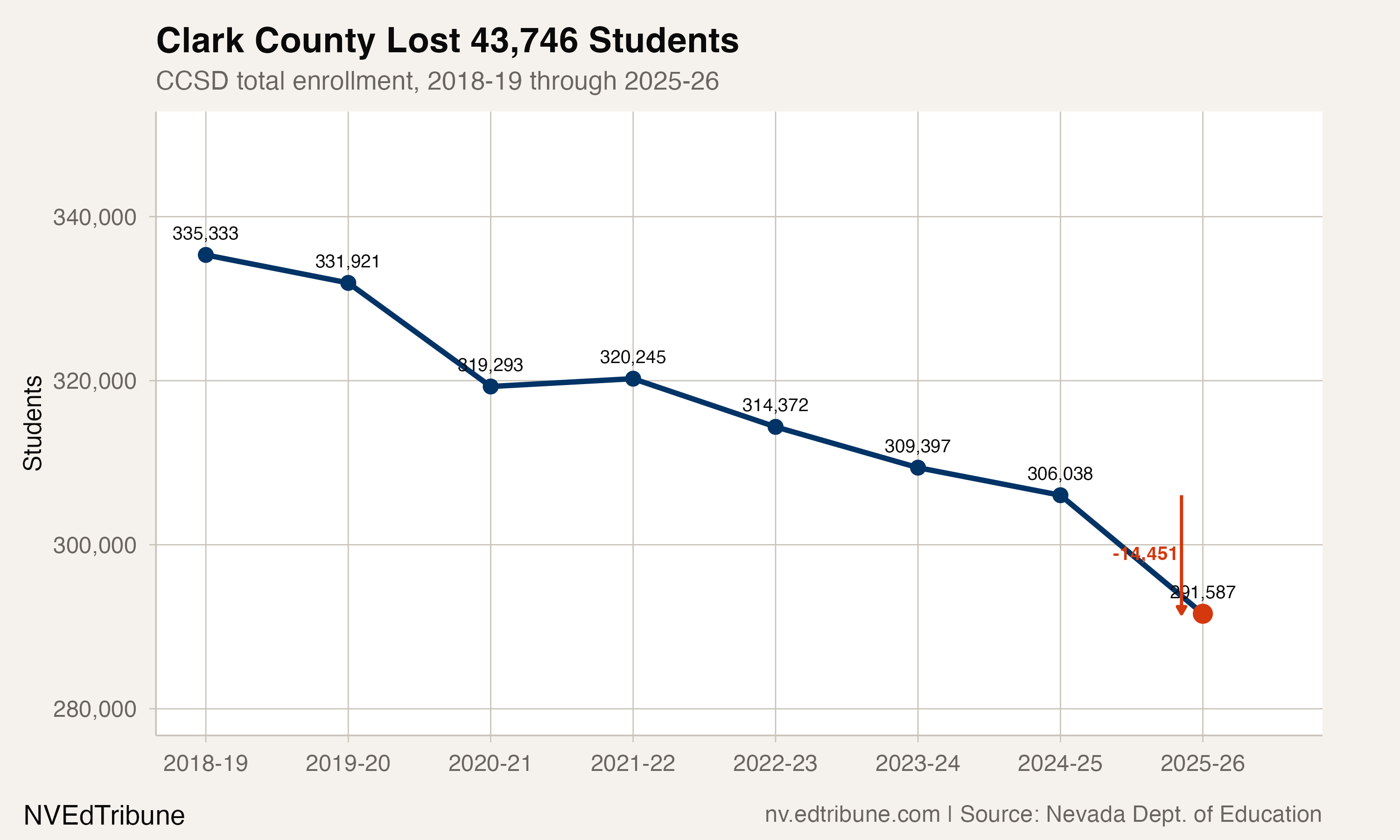
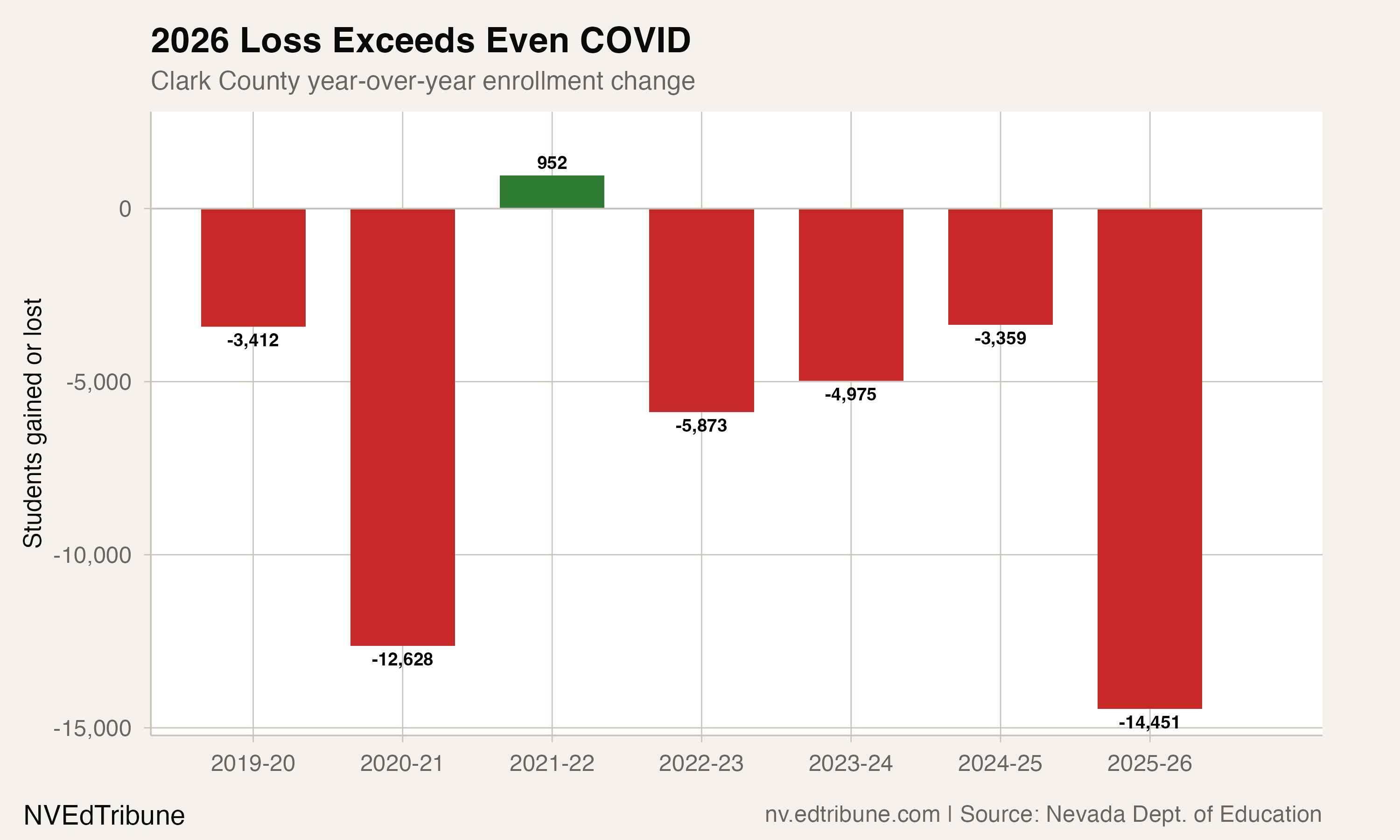
The nation's fifth-largest school district just posted its worst enrollment year on record, and it was not close. Clark County School District↗ET lost 14,451 students between 2024-25 and 2025-26, dropping from 306,038 to 291,587. That single-year loss exceeds the 12,628 students the district lost during the COVID disruption of 2020-21 and is more than four times the 3,359 it lost the year before.
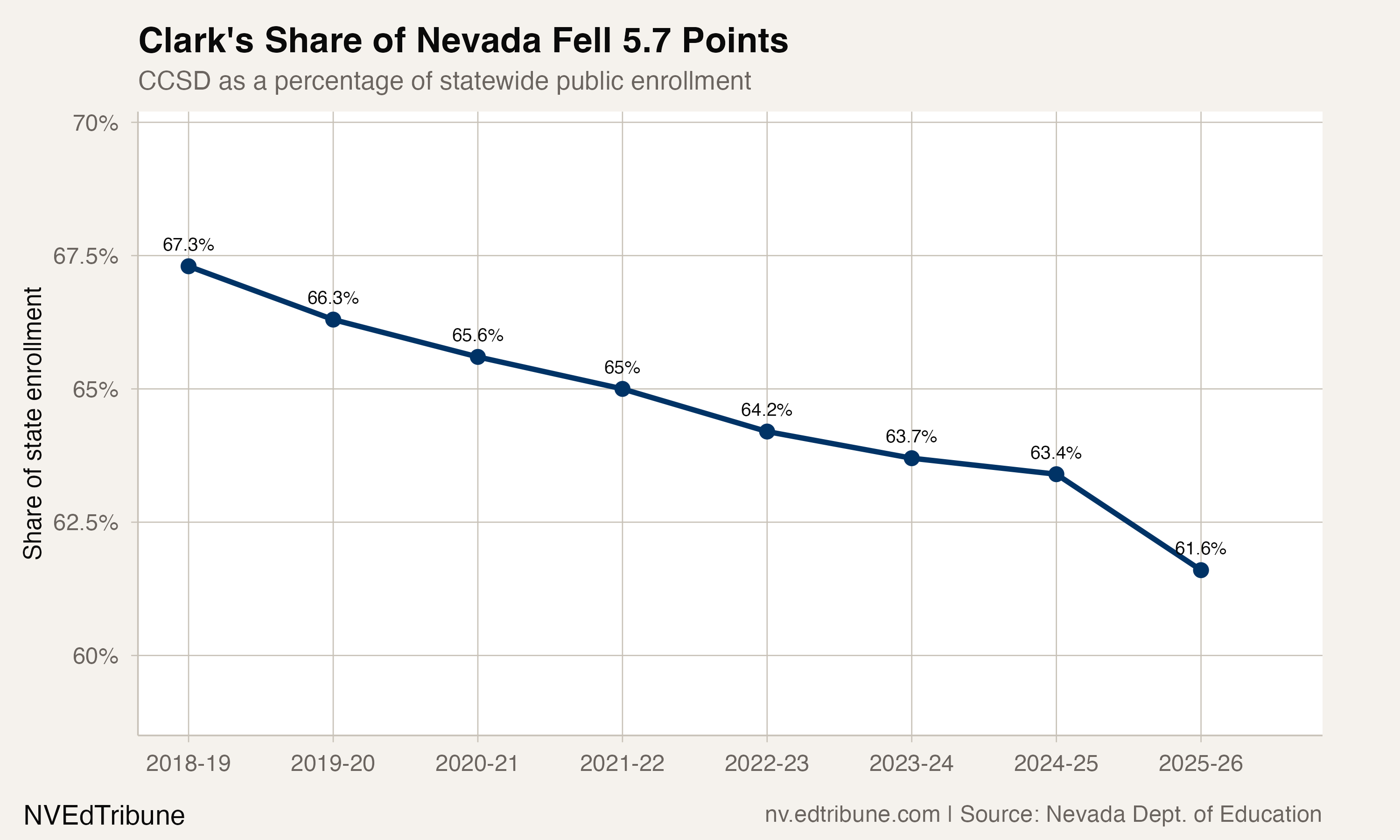
The loss is so large it distorts statewide totals. Nevada as a whole lost 9,251 students in 2025-26, which means the rest of the state's public school system actually grew by more than 5,000 students while Clark County contracted. The district now accounts for 61.6% of Nevada's public school enrollment, down from 67.3% eight years ago.
The shape of the fall
Seven of the past eight years have been losses. The sole exception was 2021-22, when a modest rebound of 952 students briefly suggested recovery from COVID. That rebound lasted one year. By 2022-23, losses resumed.
What distinguishes 2025-26 from prior years is not just the magnitude but the acceleration. From 2022-23 through 2024-25, annual losses ran between 3,000 and 6,000, a painful but manageable pace. The jump to 14,451 represents a new order of decline.
Since 2018-19, the district has lost 43,746 students total, a 13.0% decline. To put that in proportion: the students CCSD lost in eight years would fill two-thirds of Washoe County School District, which currently enrolls 63,655.
Where are the students going?
Fewer children are entering the system, and more of those who do are choosing charter schools over CCSD.
Nevada's charter sector enrolled 70,534 students in 2025-26, up 10.9% from the prior year and up 66.6% from 42,333 in 2018-19. The sector grew from 29 to 51 entities over that span and now surpasses Washoe County as the state's second-largest enrollment system. Charter schools' share of statewide enrollment nearly doubled from 8.5% to 14.9%.
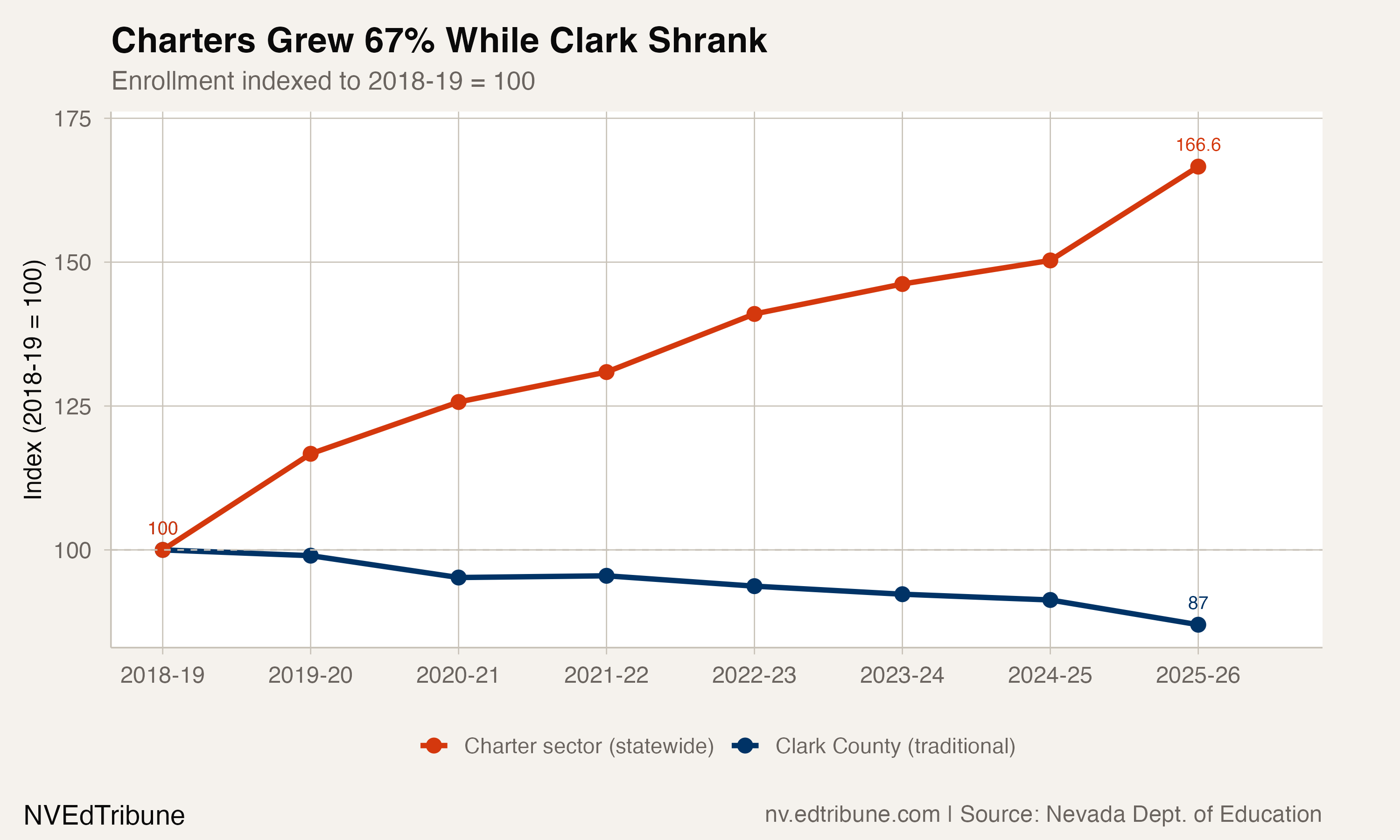
The charter sector's single-year gain of 6,925 students in 2025-26 was its second-largest on record. Some of that growth reflects the State Public Charter School Authority absorbing six charter schools previously overseen by CCSD, which shifts students between sectors in the data without any family making a new choice. New and expanding schools account for the rest. Twenty-three charter entities operating in 2025-26 did not exist in the 2018-19 data, enrolling a combined 13,373 students.
The other force is demographic. Clark County births fell from over 30,000 in 2007 to roughly 24,000 in 2024, a 20% decline that is now visible in the kindergarten pipeline. CCSD's current kindergarten cohort of 17,618 students is nearly 30% smaller than its current senior class of 24,505. Every year, a large graduating class exits and a smaller kindergarten class enters, creating structural decline that compounds annually.
Clark County added an estimated 44,000 residents in the past year alone, growing at 1.8% annually. The county is growing. Its school district is not. New residents are disproportionately adults without school-age children, families with children are choosing alternatives to CCSD at rising rates, or both.
No demographic group was spared
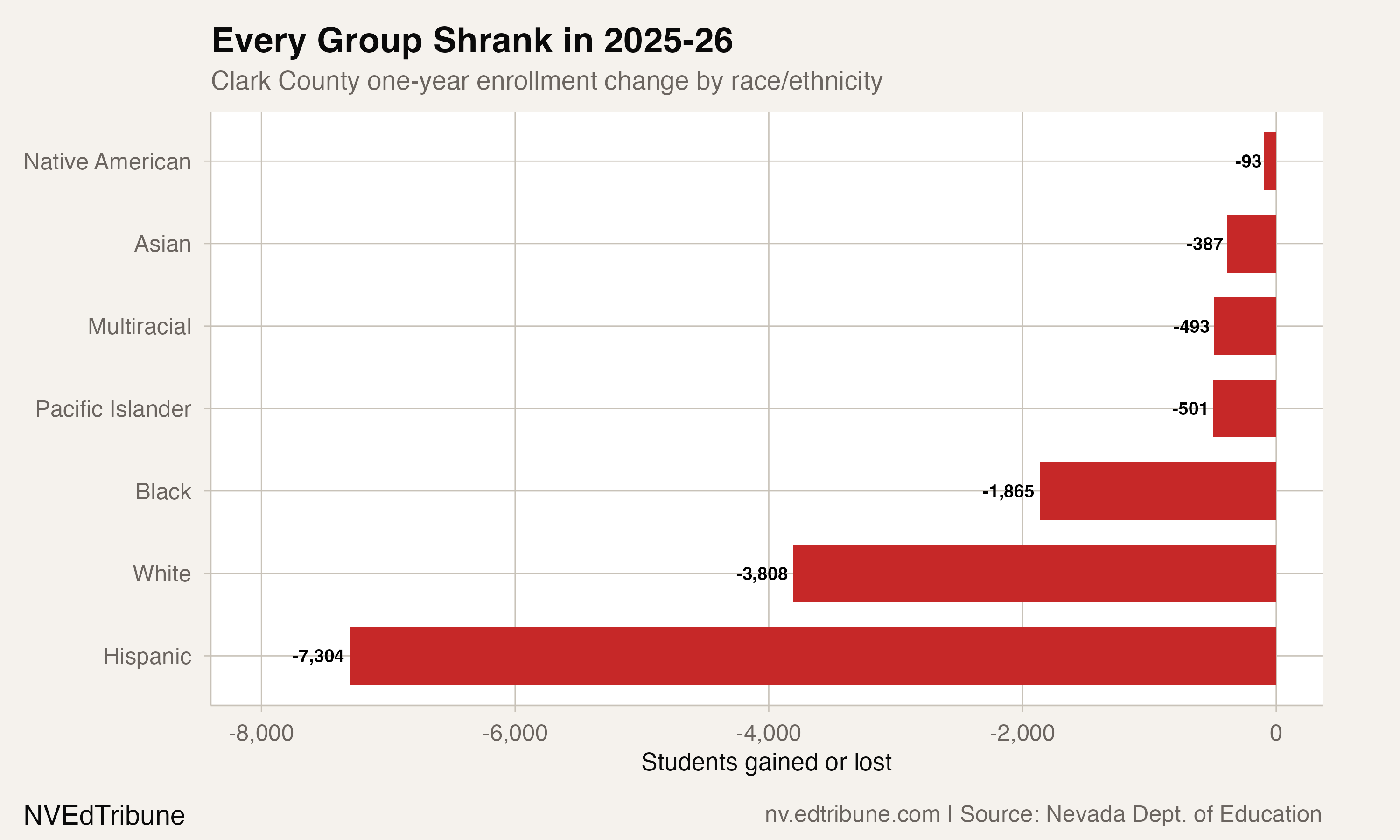
The 2025-26 loss cut across every racial and ethnic group in CCSD. Hispanic students, who make up nearly half the district, accounted for 7,304 of the 14,451-student loss, or 50.5%. White students accounted for 3,808 (26.4%), Black students for 1,865 (12.9%), and every remaining group declined as well.
White enrollment has fallen steadily from 24.0% of CCSD in 2018-19 to 18.7% in 2025-26, a loss of 26,172 students over eight years. Whether white families are leaving the public system entirely or shifting to charter schools that serve a more affluent student body is a question the enrollment data alone cannot answer. Charter schools statewide report that 64% of their students qualify for free or reduced-price lunch, compared with 86% in traditional public schools, a gap that suggests charter families skew wealthier on average.
$50 million and 1,200 positions
The fiscal consequences are arriving fast. CCSD announced in February that schools will have $50 million less in available funding for the 2026-27 school year. 284 of 375 schools face budget reductions.
The district identified more than 1,200 positions for surplus: 682 licensed employees, 500 support professionals, and 64 administrators. Salaries account for 84% of the district's budget, leaving little room to cut elsewhere. The district noted that more than 3,300 employees left after the 2024-25 school year, and roughly 4,000 positions are expected to open through attrition, so most surplused employees should find placement elsewhere in the system.
That statistical reassurance has not calmed anxiety on the ground.
"That's a lot of people that potentially may not have a job for next year, and that concerns me." -- Vicki Kreidel, 13-year CCSD educator, News3 Las Vegas
"There are a surprising number of schools that are cutting 10-plus staff positions, and in some cases, that's close to 10% of their staff." -- Rebecca Dirks Garcia, Nevada PTA president-elect, Fox 5 Vegas
The PTA president-elect also reported conversations with parents at elementary schools bracing for 39 students in a single fifth-grade classroom.
A shrinking share of the state
Clark County's dominance of Nevada public education is eroding year by year. In 2018-19, CCSD enrolled 67.3% of every public school student in the state. By 2025-26, that figure was 61.6%, a decline of 5.7 percentage points in eight years.
The rest of Nevada's traditional districts lost a combined 1,725 students in 2025-26. That is one-eighth of Clark's loss. Washoe County, the state's second-largest traditional district, lost 589, or 0.9%. The charter sector gained 6,925. Clark County is not just shrinking; it is shrinking faster than every other part of the state system combined.
What comes next
CCSD projects an enrollment loss of 27,000 to 33,000 students by 2030-31, approximately 10% of its current enrollment. That projection has already prompted a facilities review that includes possible school closures, conversions of elementary and middle schools into pre-K through eighth-grade campuses, and the addition of early childhood programs at high schools.
"We can no longer afford to spread our resources thin across underutilized buildings, simply because that's how we've always done it." -- Felicia Gonzales, CCSD Deputy Superintendent for Business Operations, News3 Las Vegas
The district faces an estimated $15 billion in building repairs and replacements with only $3.7 billion available. The gap between maintenance needs and the revenue to meet them will only widen if enrollment continues to fall at this pace.
Meanwhile, the Nevada Legislature passed a statewide open enrollment bill in June 2025, expanding both intradistrict and interdistrict transfers starting in 2026-27. If that policy accelerates families' movement out of CCSD and into charter or neighboring districts, the 2025-26 cliff may not be the floor. Whether it is depends on a question Clark County has not yet answered: what would make families choose to stay?
Detailed code that reproduces the analysis and figures in this article is available exclusively to EdTribune subscribers.
Discussion
Sign in to join the discussion.
Loading comments...