Three K-8 schools. Six teachers. Four days a week. Sixty-nine students spread across 3,589 square miles of desert.
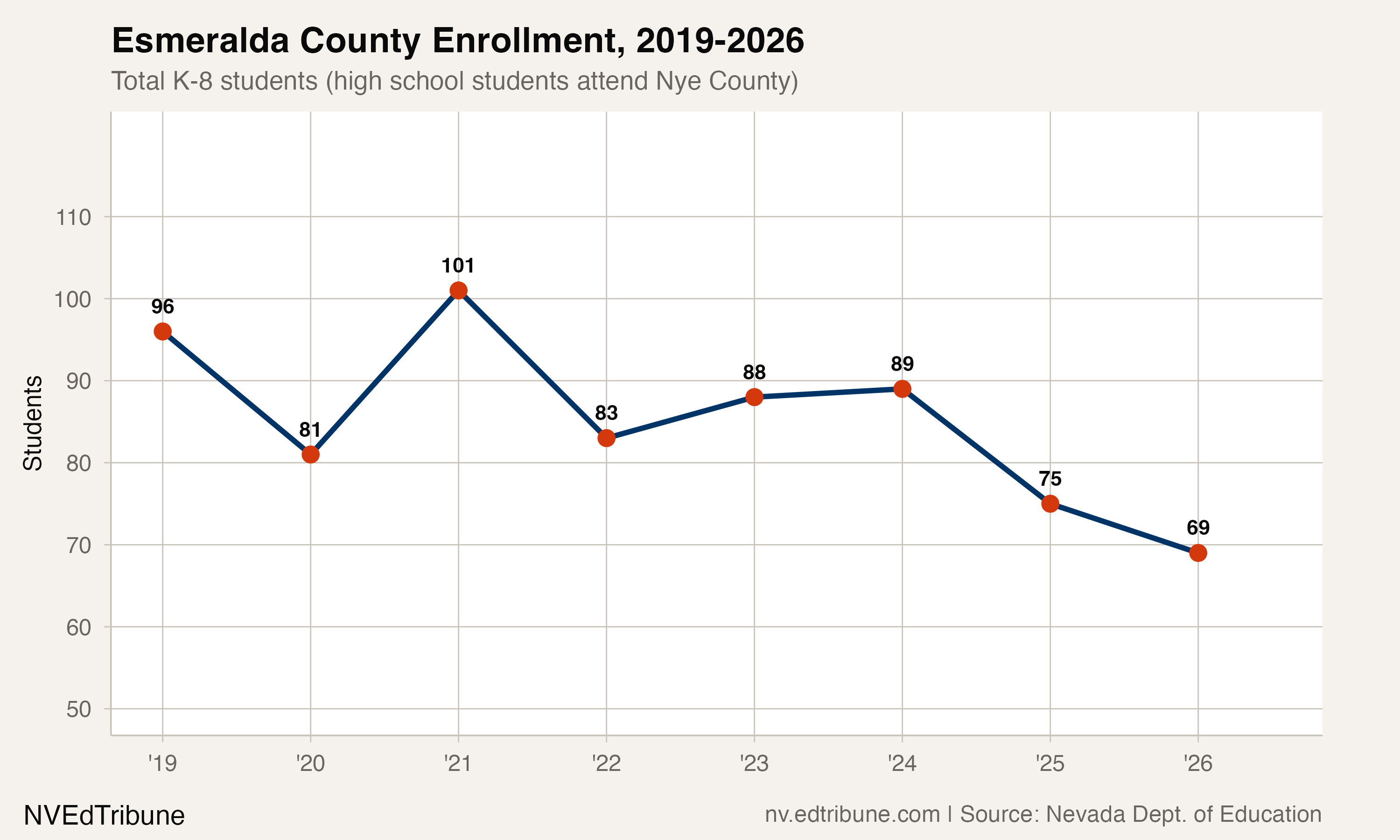
Esmeralda County School District↗ET enrolled 69 students in 2025-26, a new low in eight years of state data. That is 27 fewer students than seven years ago, a 28.1% decline, and it places Esmeralda so far below every other county district in Nevada that the comparison is almost nonsensical. The next-smallest county, Eureka, enrolls more than four times as many.
Where statistics stop and families begin
In a district of 69, enrollment data behaves differently than it does anywhere else in Nevada. A single family moving in or out of Goldfield, Dyer, or Silver Peak can shift enrollment by 5% or more. That volatility is visible in the year-over-year record: a 15-student drop in 2019-20, a 20-student surge in 2020-21, an 18-student collapse the following year. Swings of 15% to 25% in a single year are not anomalies in Esmeralda. They are the district's permanent condition.
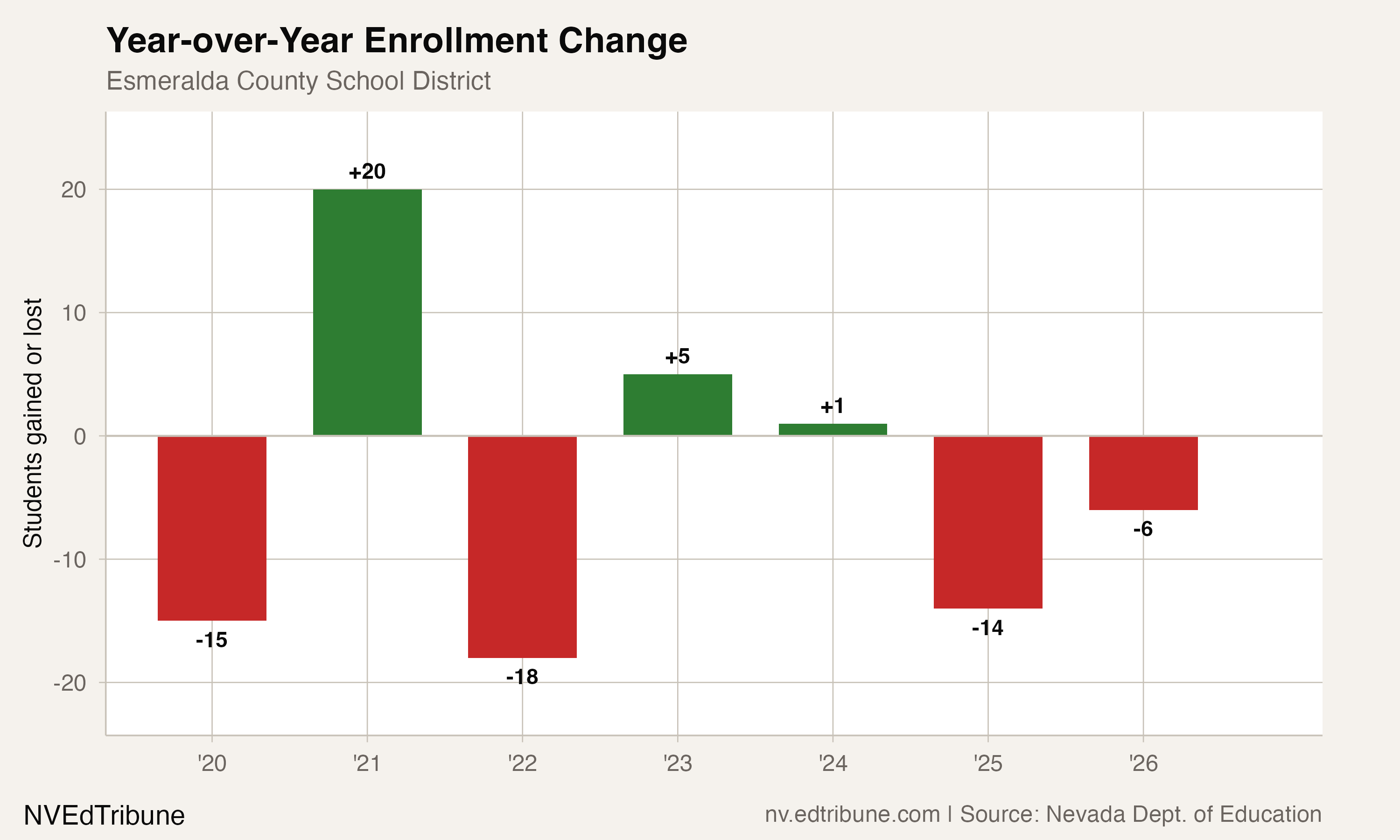
The 2020-21 bounce to 101 students, the highest point in the dataset, coincided with pandemic-era relocations to rural areas. That number proved unsustainable. Enrollment has fallen in three of the five years since, landing at a new floor of 69.
Statewide, Esmeralda accounts for 0.015% of Nevada's 473,657 students. It is a district that exists on the margin of statistical visibility.
The infrastructure of isolation
Esmeralda County's three K-8 schools sit in communities separated by long stretches of desert highway. The district operates on a four-day week to reduce transportation and utility costs. Teachers instruct multiple grades simultaneously; with six full-time-equivalent teachers serving 69 students, classrooms contain an average of roughly 12 students across several grade levels. Staff members routinely fill multiple roles, substituting as bus drivers when needed.
Students who reach ninth grade face a choice: enroll in the district's virtual high school or travel to Tonopah High School, operated by Nye County, roughly 25 miles from Goldfield and farther from other Esmeralda communities.
The per-pupil economics are inverted. At 69 students, fixed costs for administration, facilities, and transportation are distributed across so few heads that spending per student reached $34,011, nearly triple the state median of $12,245. Nevada's Pupil-Centered Funding Plan adjusts base funding upward for rural counties. In neighboring Eureka County, which enrolls about 300 students, the adjusted per-pupil amount reaches $35,764, compared to $9,501 in Clark County. Esmeralda's adjustment is likely comparable or higher. The funding formula recognizes the structural reality: it costs more per student to operate schools in places where the nearest grocery store may be in another county.
The steepest decline in rural Nevada
Among Nevada's 14 rural county districts, Esmeralda's 28.1% enrollment decline since 2019 is the worst by a wide margin. White Pine County, the next-steepest, lost 24.9%. Douglas lost 19.0%. Only two rural counties, Lander and Nye, gained enrollment over this period.
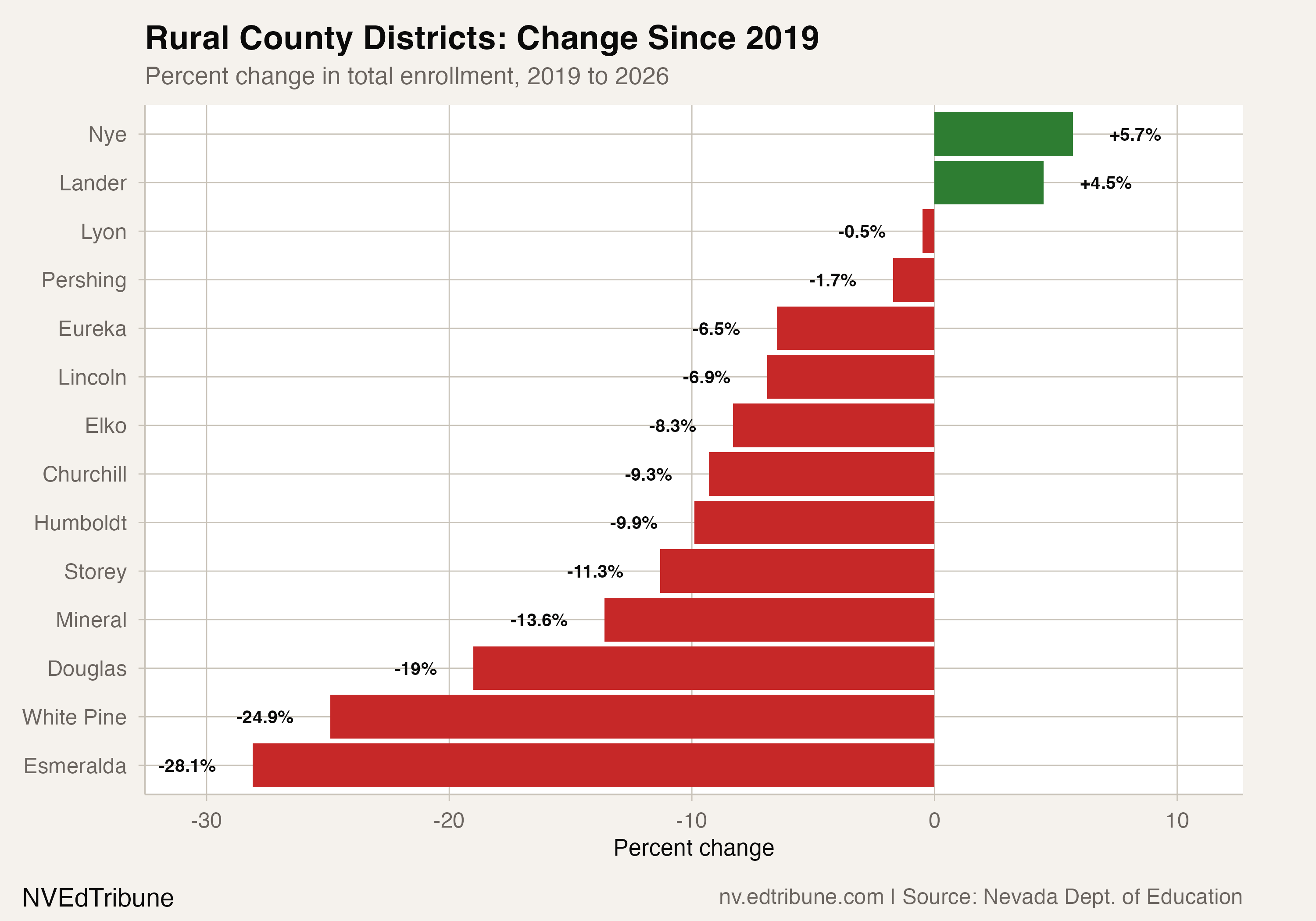
Twelve of Nevada's 14 rural county districts have shrunk since 2019. The pattern is consistent with broader enrollment pressure across Nevada, where statewide enrollment fell from 500,860 in 2019-20 to 473,657 in 2025-26, a 5.4% decline. But rural counties are absorbing those losses on much smaller bases, where a few hundred departures can represent a generation.
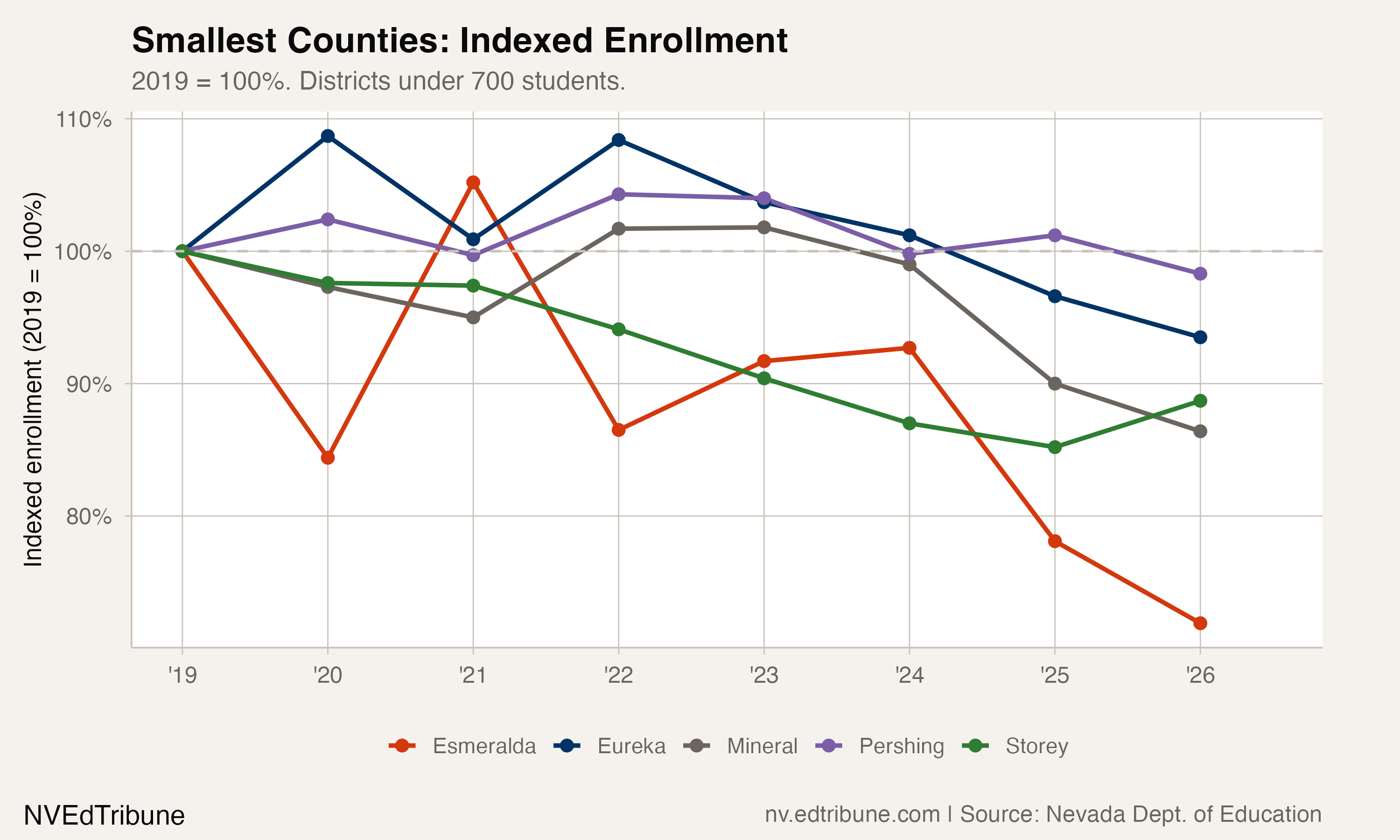
Among the five county districts with fewer than 700 students, Esmeralda has fallen the farthest and fastest. Eureka (300 students), Storey (408), Mineral (520), and Pershing (647) have all lost ground since 2019, but none has dropped below 85% of its starting point. Esmeralda is at 71.9%.
A county running out of people
The population dynamics behind Esmeralda's enrollment losses have no obvious remedy. The county's estimated population of 710 makes it the least populous county in Nevada. Goldfield, the county seat, once held an estimated 40,000 people at the peak of its gold rush in 1910. The county's population has declined 9.3% since 2010.
No major employer. The mining operations that built Goldfield ended more than a century ago. No hospital, no chain restaurant, no highway interchange drawing commercial traffic. The county's economic development page lists education as a community asset, but the school system and the population it serves are contracting in tandem.
"We're going to see more and more school districts become insolvent" without increased state revenue for education. — Former Humboldt County Superintendent Dave Jensen, The Nevada Independent, Feb 2026
Jensen was speaking about larger rural districts like Elko (9,293 students) and Douglas (4,745), where enrollment declines are already forcing multimillion-dollar budget cuts. The fiscal math is more forgiving for those districts: they have enough students that per-pupil funding still covers core operations, even as the margins tighten. Esmeralda has long since passed the point where enrollment decline translates directly into program viability.
Demographic profile: stable, not diversifying
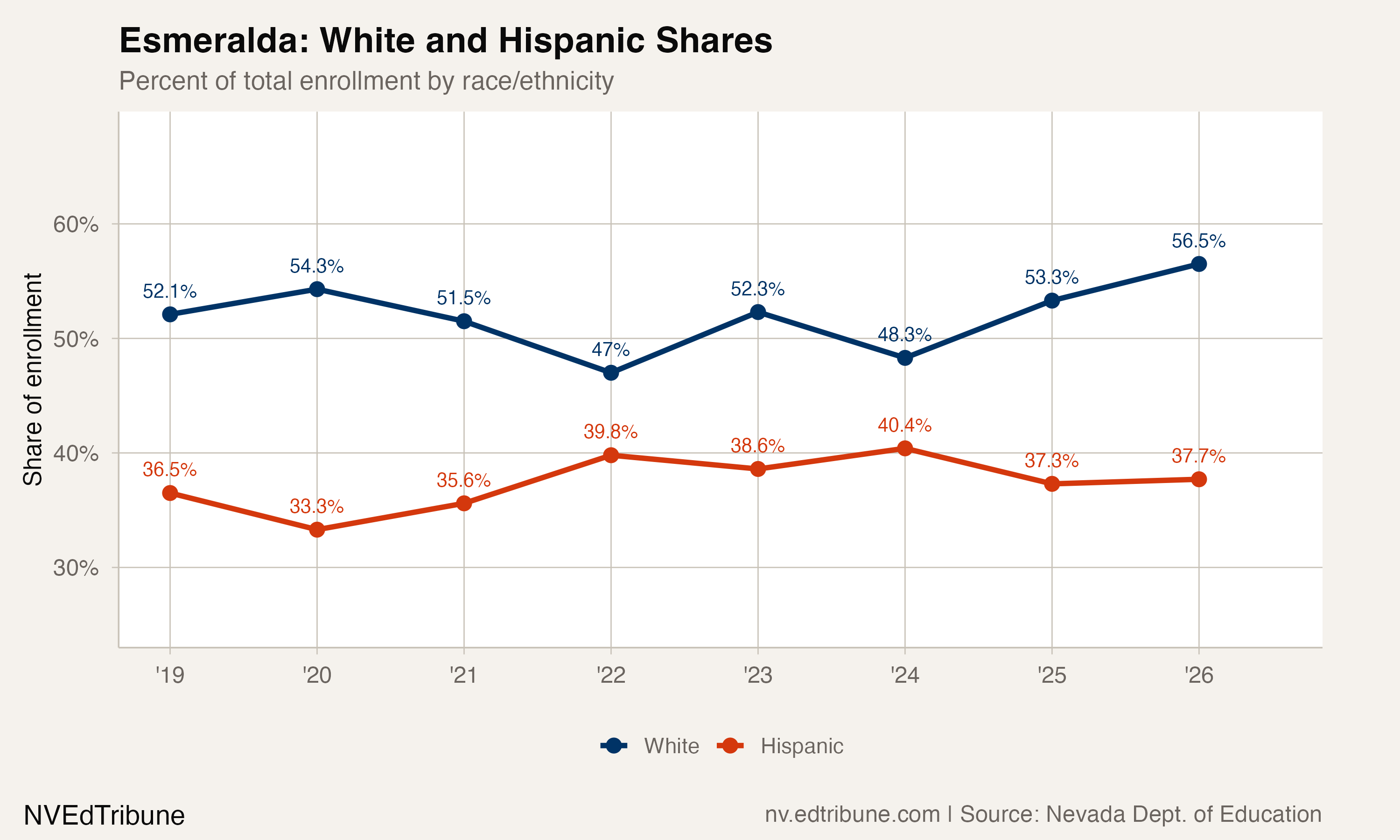
Esmeralda's racial composition has held roughly constant while the state diversified. In 2025-26, white students made up 56.5% of Esmeralda enrollment and Hispanic students 37.7%. In 2018-19, the split was 52.1% white and 36.5% Hispanic. Statewide, Nevada's white enrollment share has fallen from 31.7% to 25.9% over a similar period. Esmeralda's demographic stability reflects the absence of the migration and immigration patterns reshaping Clark and Washoe counties.
Separately, 13 of the district's 69 students, or 18.8%, receive special education services. This is above the statewide average and means the district must provide specialized instructional programs for nearly one in five students across a multi-grade, multi-site structure with six teachers.
What 50 students looks like
Nevada statute NRS 386.353 authorizes the study of consolidation or sharing of services between school districts. No public discussion of consolidating Esmeralda with a neighboring county has surfaced, but the math is narrowing. At the current trajectory, enrollment could fall below 50 within three to four years. At that point, the district would be operating three school buildings for fewer students than a single urban classroom.
The four-day week, multi-grade instruction, and virtual high school are all adaptations that have already been made. There is no next adaptation that addresses the underlying population decline. Rural school districts in Nevada cannot independently fund new infrastructure because they are at their property tax caps. Esmeralda's issue is not aging buildings. It is that Goldfield, a town that once held 40,000 people, now produces so few school-age children that a single family moving to Tonopah can shift enrollment by 5%.
In fall 2026, six teachers will return to three desert schoolhouses and count heads again. The number will be somewhere near 69. It will matter to every one of them.
Detailed code that reproduces the analysis and figures in this article is available exclusively to EdTribune subscribers.
Discussion
Sign in to join the discussion.
Loading comments...