Nye County's schools were 59.5% white seven years ago. In 2025-26, that figure fell to 48.5%, making it the latest Nevada county to cross below the majority-minority threshold. A district that sits an hour northwest of Las Vegas, with 5,794 students spread across desert communities like Pahrump and Tonopah, is now demographically unrecognizable from the school system that existed less than a decade ago.
Nye is not an outlier. It is the newest member of a growing majority. In 2025-26, 49 of Nevada's 70 school districts enroll student bodies where white students make up less than half of total enrollment, a share of 70.0%. That is up from 57.7% in 2018-19, when 30 of 52 districts had crossed the threshold.
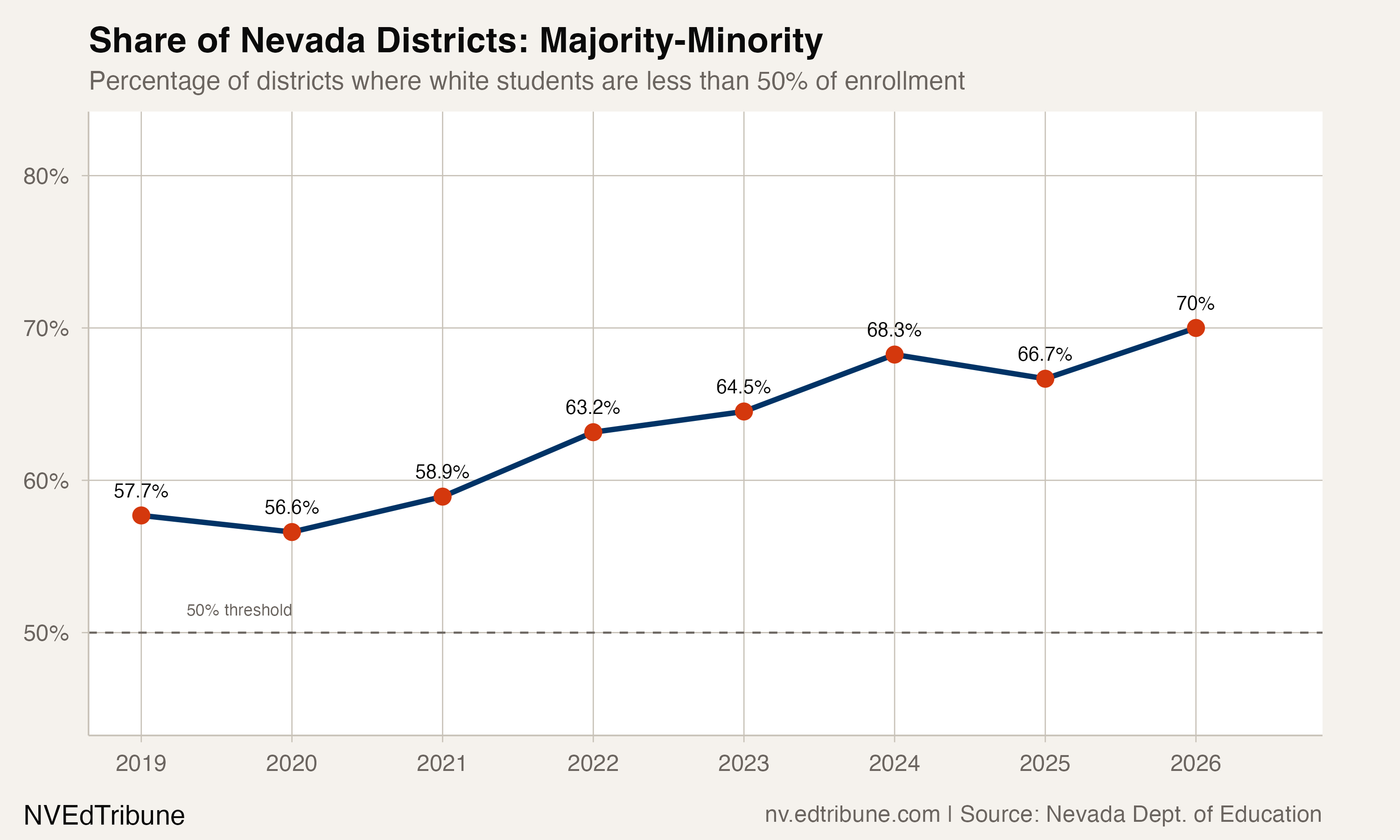
The 70% figure overstates what changed on the ground
The headline number deserves immediate context. Nevada had 52 school districts in 2018-19 and has 70 in 2025-26. Nineteen new charter entities appeared in the data between those two years (one existing entity dropped out), and nearly all of them opened as majority-minority from day one. Most of those 19 new schools serve diverse communities in Clark County. CIVICA Academy (2.9% white), Mater Academy of Northern Nevada (9.3% white), and The Delta Academy (21.6% white) were born majority-minority. Their addition to the denominator mechanically inflates the share.
Strip away the charter sector entirely and the picture looks different. Among Nevada's 19 county-based districts, seven are majority-minority in 2025-26, a rate of 36.8%. Among the 51 charter entities, 42 are majority-minority, a rate of 82.4%.
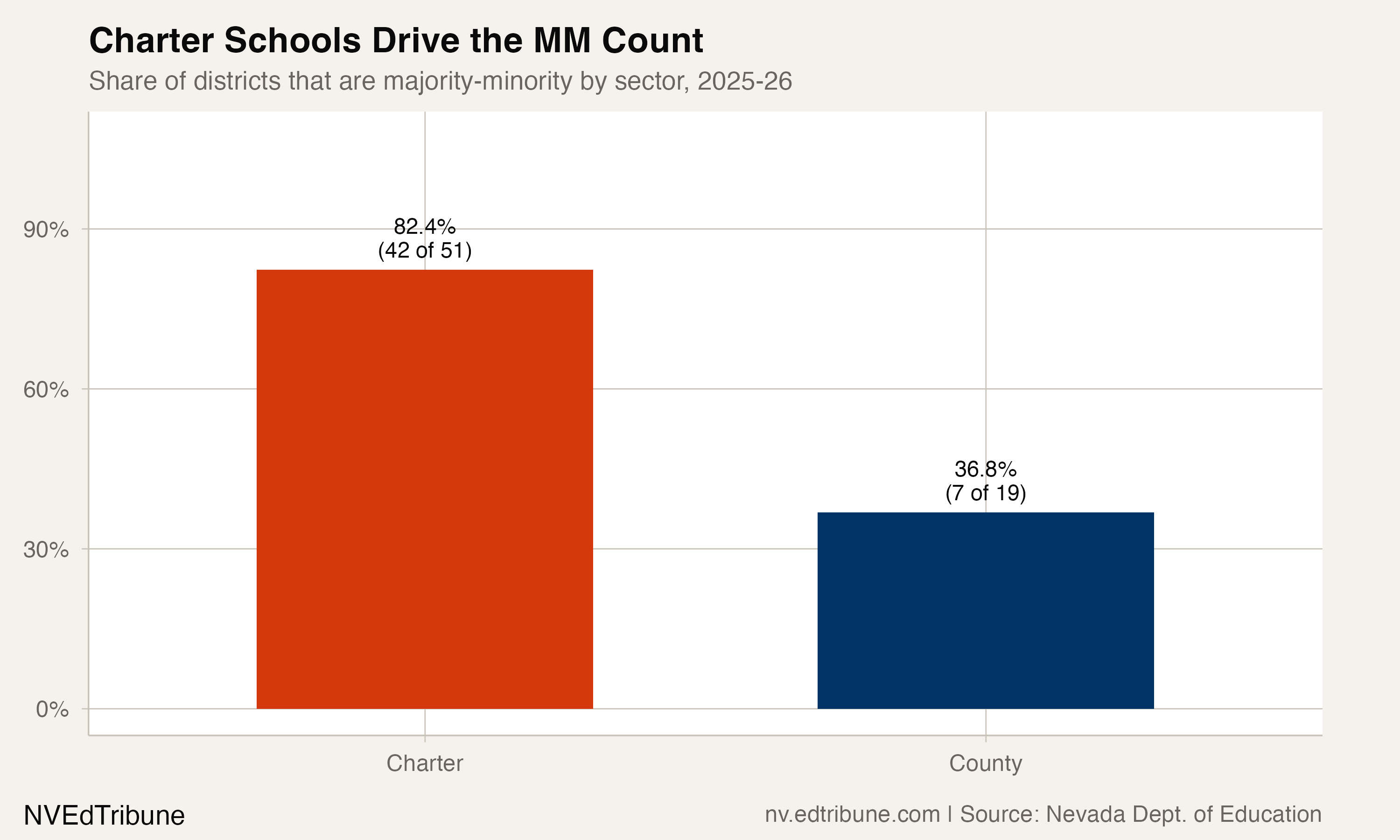
The charter sector's high majority-minority rate reflects two overlapping forces. Charter schools in Nevada are overwhelmingly located in Clark County, where the district itself is just 18.7% white. Schools that open in Las Vegas and its suburbs naturally draw from a student population that is predominantly Hispanic, Black, and multiracial. At the same time, charter schools serve a somewhat different demographic mix than traditional public schools: white students make up 27.2% of Clark County charter enrollment compared to 20.6% of CCSD enrollment, according to a February 2026 analysis of state data by KVIG.
Where the real shift is happening
The more consequential trend is what is happening inside the county districts themselves.
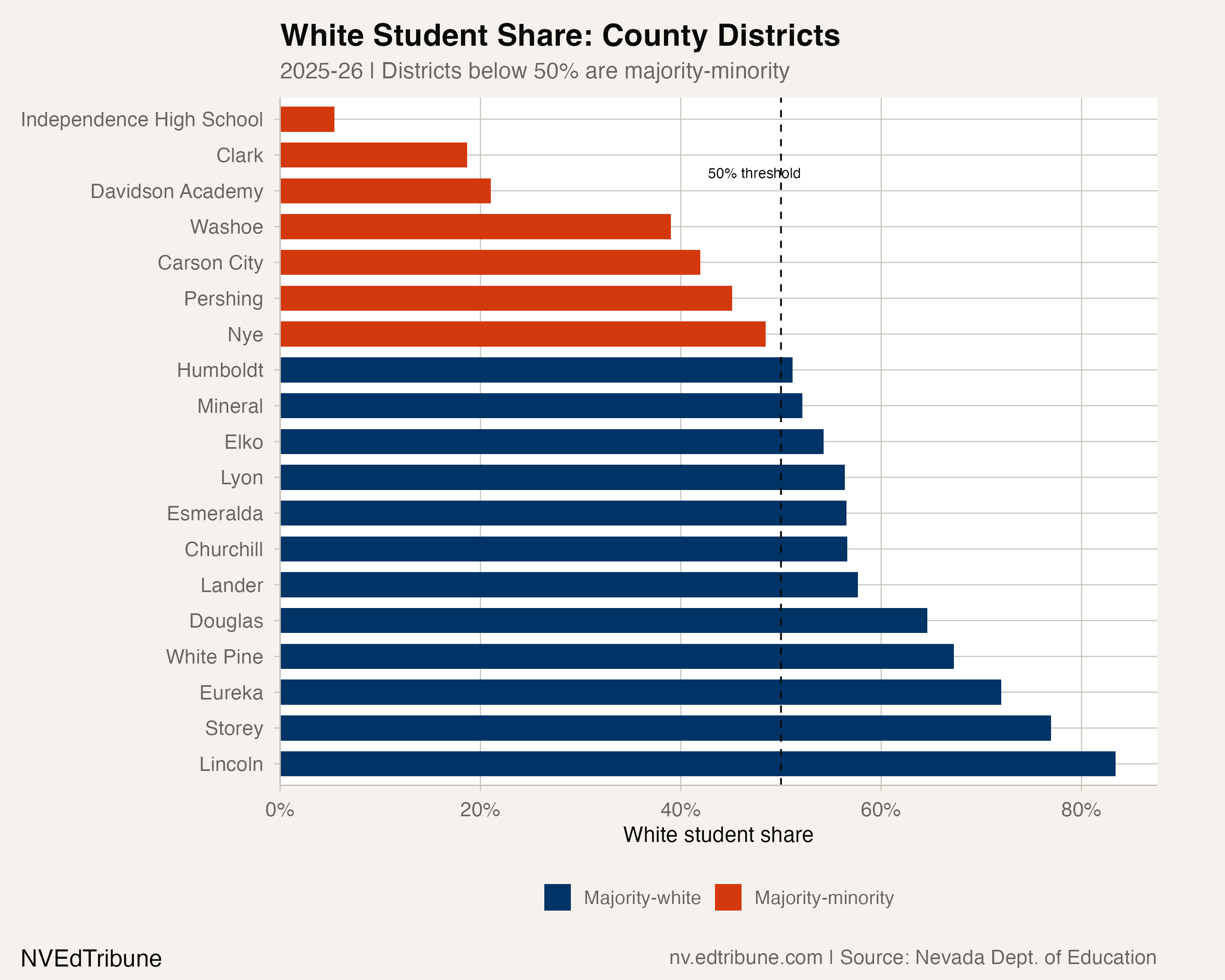
Clark County School District↗ET, the state's largest with 291,587 students, saw its white student share fall from 24.0% to 18.7% between 2018-19 and 2025-26. The district lost 26,172 white students during that period, a decline of 32.5%. Washoe County School District↗ET in Reno dropped from 43.6% to 39.0% white, losing 4,662 white students, a 15.8% decline. Carson City fell from 47.6% to 42.0%. Even in rural counties far from the metro areas, the direction is consistent: Douglas County dropped from 66.5% to 64.6% white, Elko from 58.5% to 54.2%, and Lyon from 62.3% to 56.4%.
Statewide, white enrollment fell from 157,899 to 122,852 between 2018-19 and 2025-26, a loss of 35,047 students, or 22.2%. Over the same period, Hispanic enrollment stayed relatively stable in absolute terms (212,746 to 217,320) while its share grew from 42.7% to 45.9% as the overall enrollment base shrank from 498,616 to 473,657.
Nye County: eight years of steady erosion
Nye County's crossing is worth examining because it happened slowly. This was not a COVID shock or a charter school opening. White student share in Nye County↗ET fell by roughly 1.5 percentage points per year, every year, from 59.5% in 2018-19 to 48.5% in 2025-26. The trajectory was remarkably linear.
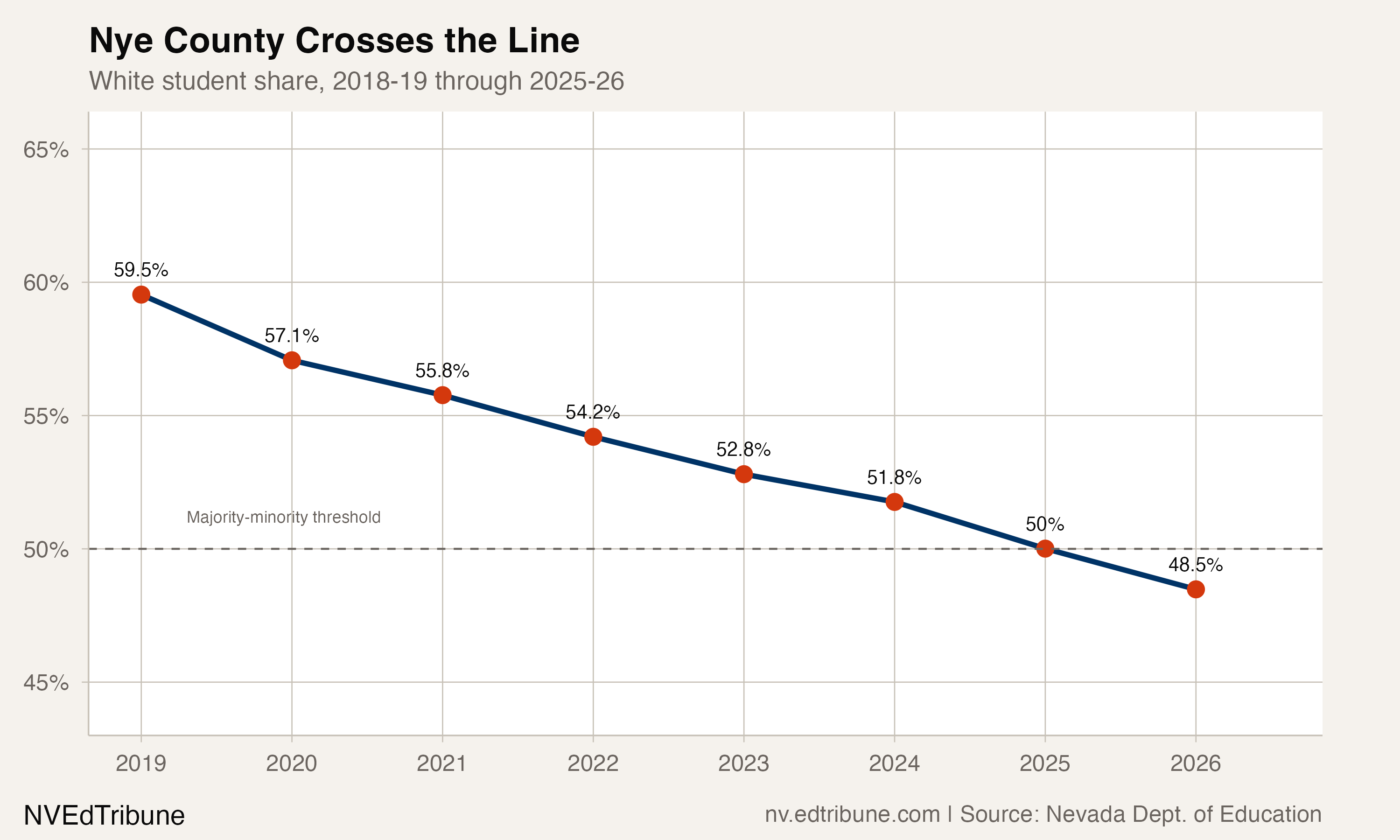
The county's total enrollment actually grew slightly over this period, from 5,484 to 5,794 students. White enrollment fell from 3,265 to 2,809, a loss of 456 students (14.0%). The growth came from Hispanic and other non-white groups. Nye County's overall population has also been growing steadily, driven by Pahrump's expansion, which benefits from its proximity to Las Vegas. That in-migration appears to be more diverse than the county's existing population.
The next counties to watch
Three county districts sit within five percentage points of the threshold on the majority-white side. Humboldt County is at 51.2% white with 3,176 students. Mineral County is at 52.1% with just 520 students. Elko County↗ET, the largest rural district in the state with 9,293 students and a mining-driven economy, is at 54.2%. Just beyond that range, Lyon County sits at 56.4% and Churchill County at 56.6%.
At Nye County's recent pace of roughly 1.5 points per year, Humboldt could cross the threshold within a year. Elko, with its larger and more economically anchored population, may take longer. Its white share fell 4.3 points in seven years, a pace that would put it at the threshold around 2032 if it held steady.
The 12 county districts that remain majority-white are overwhelmingly rural, with a combined enrollment of 33,951 students and an aggregate white share of 58.0%. They range from Lincoln County (83.4% white, 945 students) to Humboldt County (51.2% white), a span that suggests the demographic transformation happening in metro Nevada will eventually reach even the most remote districts.
By student count, this is not new
The 70% statistic measures districts, not students. By headcount, Nevada's demographic reality has been settled for years. In 2025-26, 92.0% of Nevada's students attend a majority-minority district, up only slightly from 90.9% in 2018-19. Clark County alone accounts for 291,587 students, more than 61% of the state total, and it has been majority-minority for far longer than the enrollment data available here.
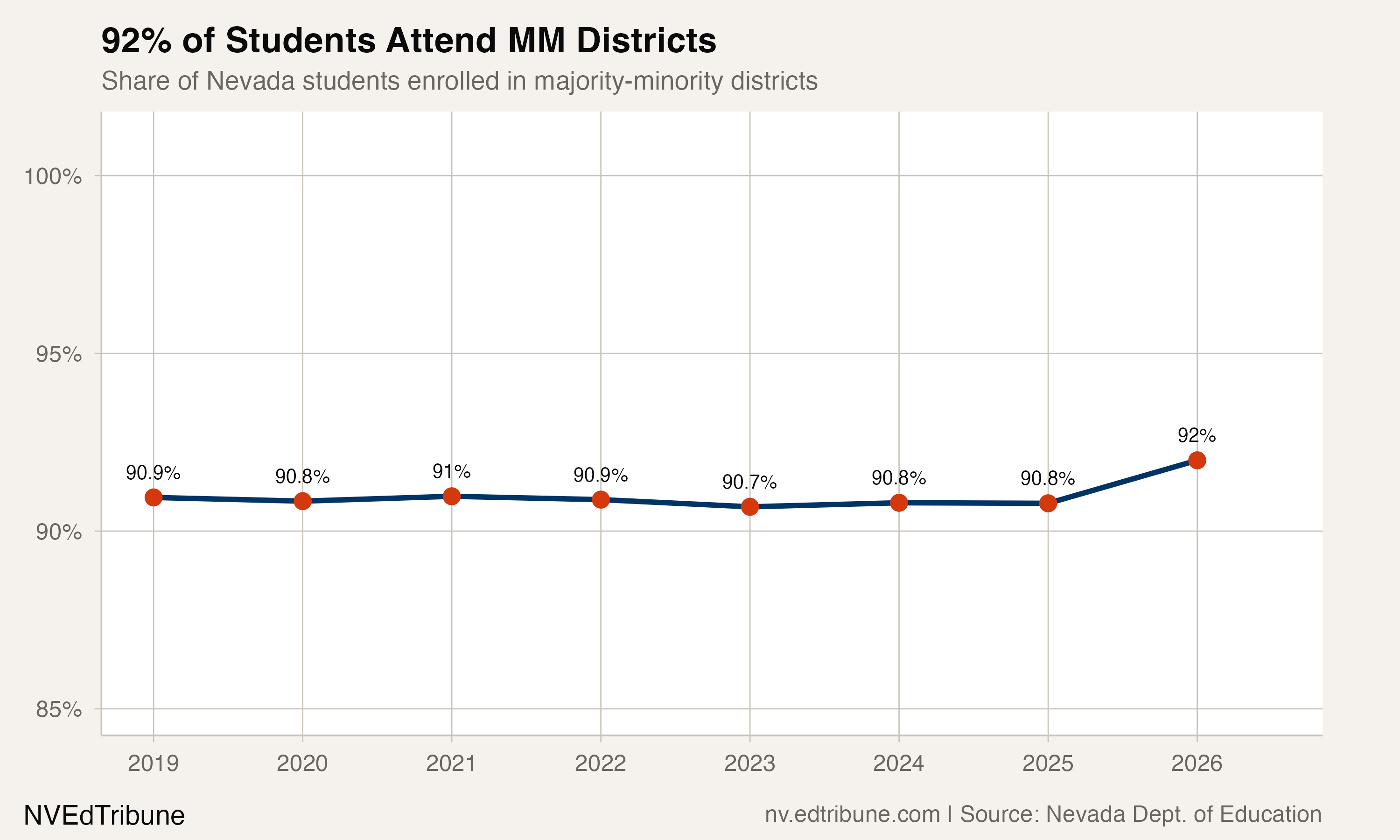
The steadiness of the student-weighted figure, hovering near 91% for seven years, exposes what the district-count statistic actually measures: the trailing edge of a transformation, not its leading edge. When a rural county of 3,000 students crosses 50%, it moves the district percentage but adds negligibly to the student share. The students who live in majority-minority school systems were already the overwhelming norm.
What the label obscures
The majority-minority label treats "white" as one coherent group and everyone else as a collective alternative. In practice, Nevada's non-white enrollment is itself deeply varied: 45.9% Hispanic, 12.4% Black, 7.9% multiracial, 5.7% Asian, 1.4% Pacific Islander, and 0.7% Native American. A district that is 49% white and 48% Hispanic has a different educational profile than one that is 20% white with a mix of Black, Hispanic, Asian, and multiracial students.
In Nye County, the crossing happened through Pahrump's steady population growth bringing in more diverse families over eight years. In Clark County, it happened a generation ago. In Elko, the mining economy still anchors a white majority at 54.2%, but the trend line runs in one direction. Each of these districts is absorbing the same demographic shift at different speeds, with different resources, and with staffing pools that were built for the student body of a decade ago.
Detailed code that reproduces the analysis and figures in this article is available exclusively to EdTribune subscribers.
Discussion
Sign in to join the discussion.
Loading comments...