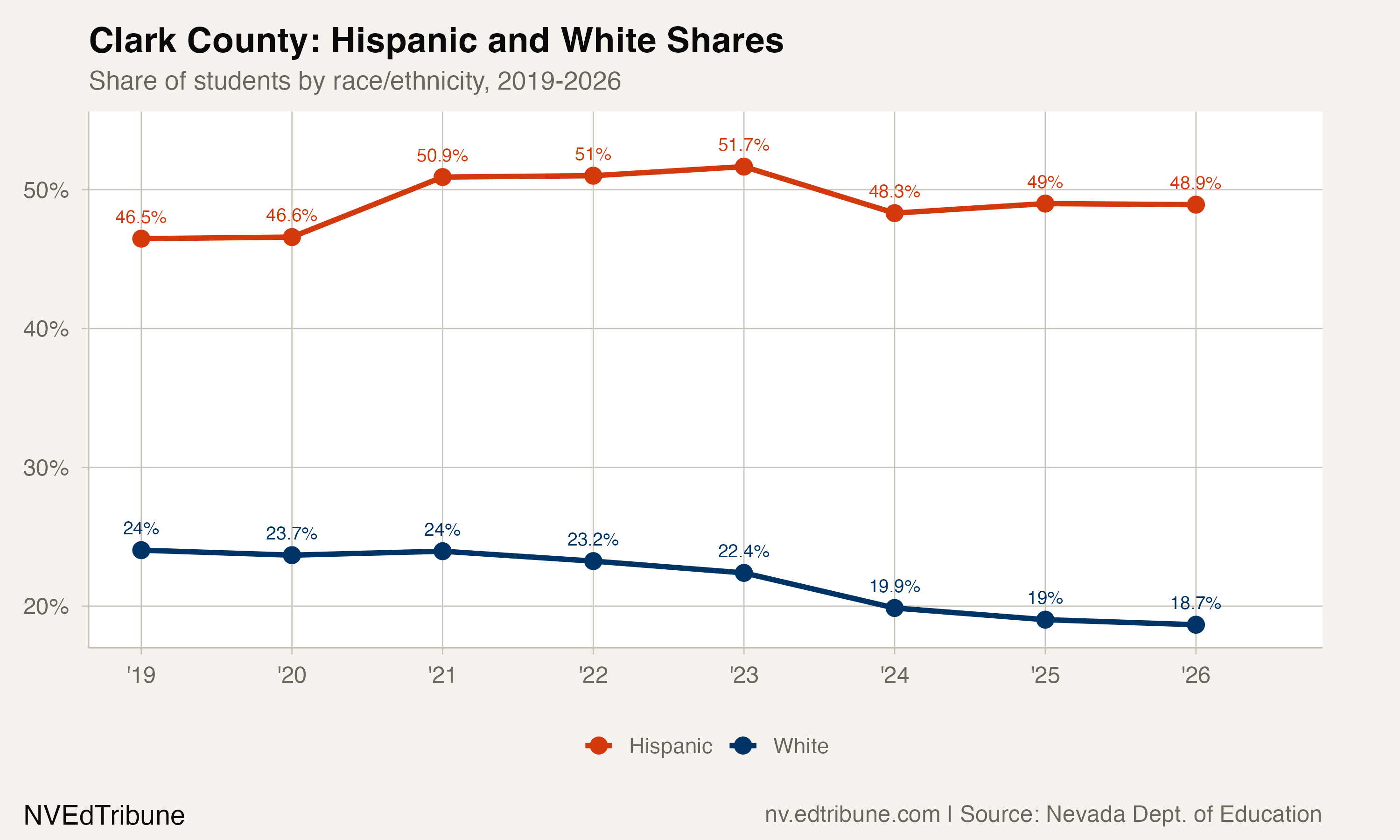
Seven years ago, roughly one in four students in Clark County School District↗ET was white. By 2025-26, it was fewer than one in five.
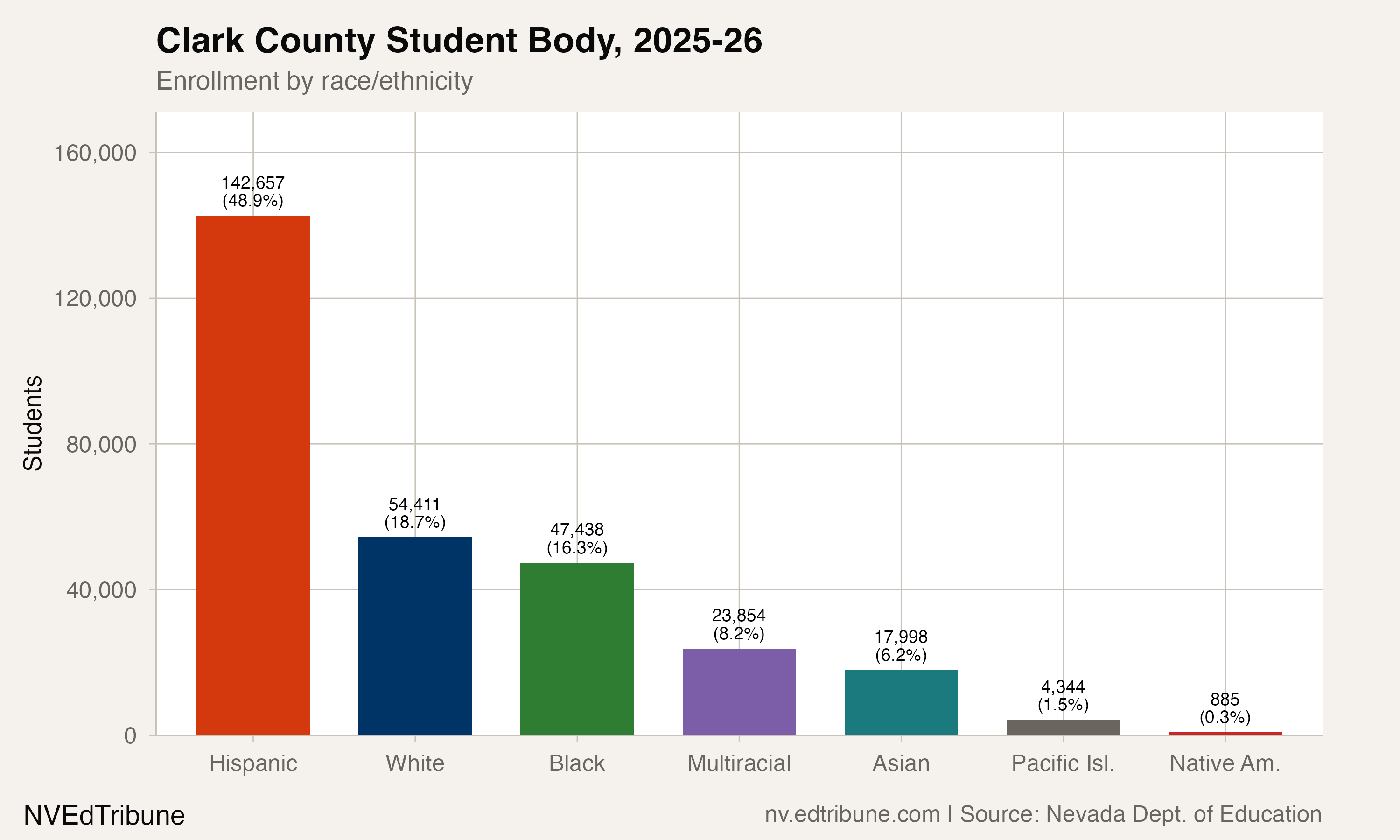
The fifth-largest school district in the United States enrolled 54,411 white students in 2025-26, down from 80,583 in 2018-19. That is a loss of 26,172 white students, a 32.5% decline, in a district that still educates 61.6% of all Nevada schoolchildren. Hispanic students now outnumber white students 2.6-to-1, with 142,657 Hispanic students composing 48.9% of Clark County's enrollment. White students, at 18.7%, have fallen behind Black students' 16.3% share by just 2.4 percentage points.
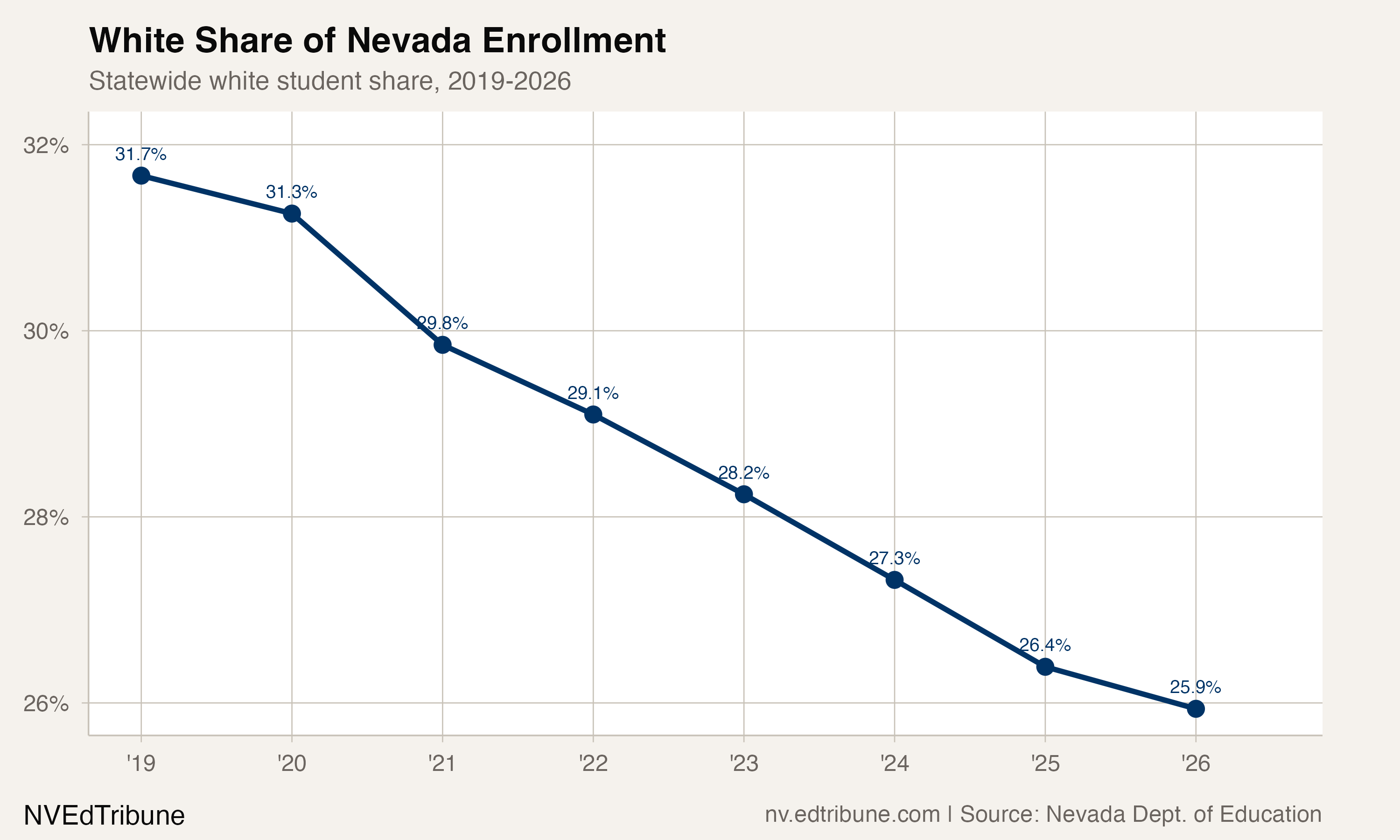
This is not just a Clark County story. Statewide, white students account for 25.9% of enrollment, down from 31.7% in 2019. Seven in 10 Nevada school districts and charter networks are now majority-minority. And in Washoe County↗ET, the state's second-largest district, Hispanic students quietly overtook white students as the largest group in 2022.
The arithmetic of decline
The speed of the shift in Clark County is notable. White enrollment did not plateau and then dip. It fell every single year from 2019 through 2026, accelerating after the pandemic: -2.5% in 2020, -9.6% in 2021, then a sustained -3.0% to -6.5% annual pace through 2026. The 2021 drop alone, 7,576 white students, wiped out a cohort larger than many Nevada districts' total enrollment.
Hispanic enrollment, by contrast, held relatively steady through most of this period. Clark County enrolled 155,841 Hispanic students in 2019 and 149,961 as recently as 2025, a modest 3.8% decline spread over six years. The sharper drop to 142,657 in 2026 tracks with the district's overall enrollment collapse of 14,451 students in 2025-26, not a demographic-specific exodus.
The result is a student body where no single group constitutes a majority, but one group is far larger than any other. Clark County's 2025-26 demographic profile: Hispanic 48.9%, white 18.7%, Black 16.3%, multiracial 8.2%, Asian 6.2%, Pacific Islander 1.5%, Native American 0.3%.
Where the white students went
The most likely explanation is a combination of three forces, none of which enrollment data can isolate cleanly.
Birth rates are falling across Nevada. The state's fertility rate dropped 17.2% from 2011 to 2023, reaching a 30-year low of roughly 51 births per 1,000 women. A Pew Research Center analysis cited in The Nevada Independent identified "steep declines in teenage pregnancies and Hispanic fertility rates" as contributing factors, but white birth cohorts appear to have shrunk faster in the school-age pipeline. Clark County's current kindergarten class has 17,618 students, nearly 30% smaller than the senior class of 24,505. That pipeline contraction hits hardest in the demographic groups that were already shrinking.
Charter school enrollment is another piece. Statewide, white students make up 25.1% of charter enrollment versus 26.1% of traditional district enrollment. That gap is small, but the trajectory matters. Charter networks held roughly steady at 17,000-18,000 white students from 2019 through 2026 while traditional districts lost 35,777 white students over the same period. The Nevada State Education Association's Chris Daly told The Nevada Independent that "charter schools love to compare themselves and never correct for demographic differences," pointing to the gap between the 86% free-or-reduced-lunch rate in traditional schools and 64% in charters.
A third possibility, harder to measure, is out-migration from the Las Vegas metro area. Clark County's overall population continues to grow, but population growth and public school enrollment have decoupled. The district enrolled 335,333 students in 2019 and 291,587 in 2026, a decline of 43,746 even as the county added residents. Some families, particularly those with school-age children, may be leaving for neighboring states or opting out of public schools entirely through homeschooling or private education. No public data cleanly separates these factors.
The statewide picture
Nevada has lost 35,047 white students since 2019, a decline of 22.2%. The white share of statewide enrollment fell from 31.7% to 25.9% in seven years, a pace of roughly 0.8 percentage points per year. At that rate, white students would constitute fewer than one in five Nevada students before 2035.
Seventy percent of Nevada's districts and charter networks, 49 out of 70, are now majority-minority, up from 57.7% (30 of 52) in 2019. Part of this increase reflects new charter entities entering the count, but existing districts have also crossed the threshold. Nye County School District↗ET, a rural district of 5,794 students, was 59.5% white in 2019. By 2026, it had fallen to 48.5%, crossing the majority-minority line for the first time.
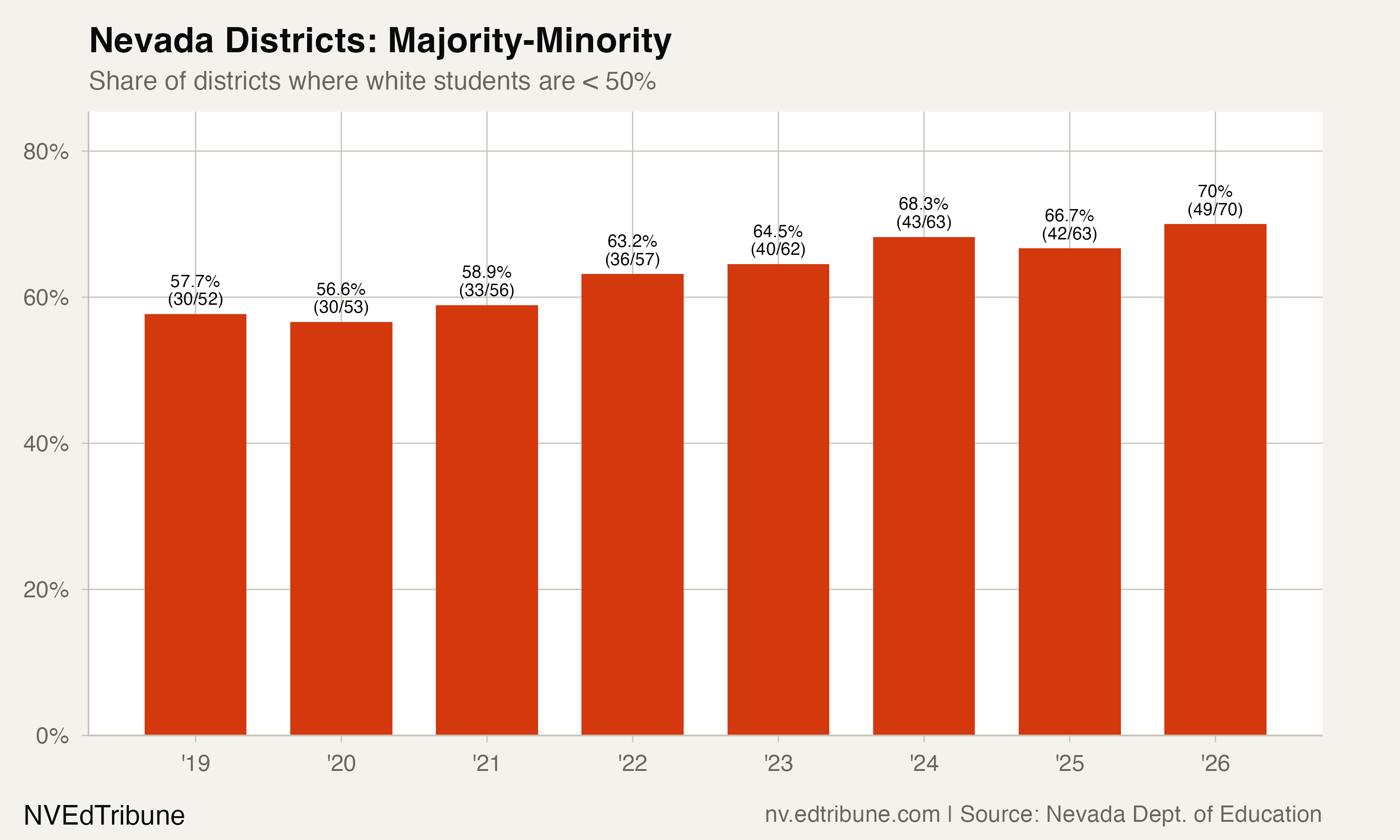
Only 21 of Nevada's 70 districts remain majority-white. Most are small: Lincoln County (945 students, 83.4% white), Storey County (408 students, 77.0%), Eureka County (300 students, 72.0%). The largest majority-white districts are Lyon County (9,060 students, 56.4%) and Elko County (9,293 students, 54.2%), both of which are trending toward the threshold.
Washoe's quiet crossover
In Washoe County↗ET, the demographic shift happened with less fanfare. Hispanic students edged past white students in 2022, 42.1% to 42.0%, a margin of 101 students out of 66,541. By 2026, the gap had widened to 5.8 percentage points: 44.8% Hispanic, 39.0% white.
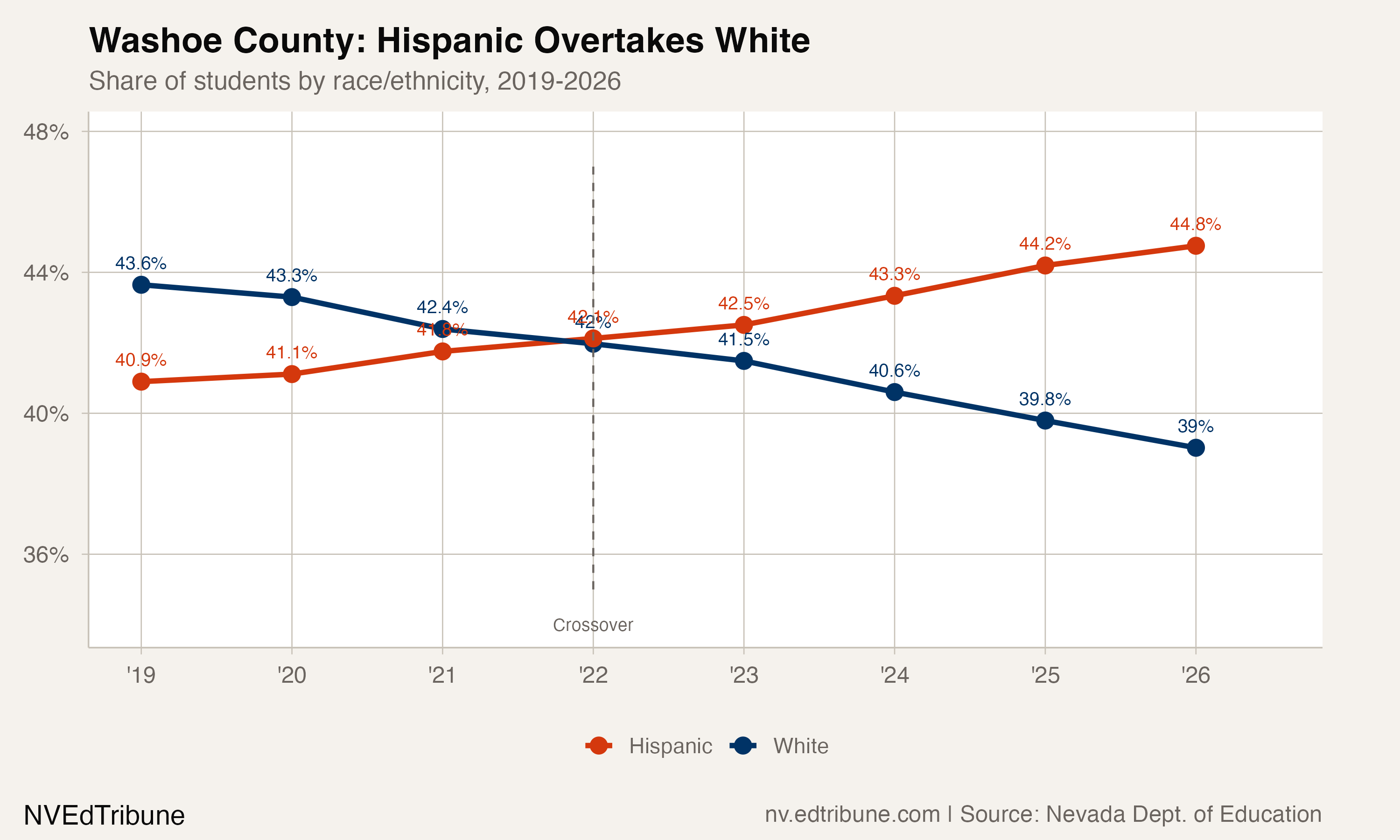
Washoe lost 4,662 white students from 2019 to 2026, a 15.8% decline. Hispanic enrollment grew by 845 students, or 3.1%, over the same period. The crossover was driven more by white attrition than by Hispanic growth.
What the budget sees
Demographic transformation and enrollment decline are not the same phenomenon, but in Clark County they are happening simultaneously, and the fiscal consequences land on the same balance sheet.
CCSD faces $50 million less in available school funding for 2026-27. At Nevada's per-pupil funding rate of $9,051, every student who leaves takes resources with them. The district has identified nearly 1,200 positions for surplus, including 682 teachers, 500 support staff, and 64 administrators, and 284 of the district's 375 schools face budget reductions.
"There are a surprising number of schools that are cutting 10-plus staff positions, and in some cases, that's close to 10% of their staff. That's a huge impact." — Rebecca Dirks Garcia, Nevada PTA president-elect, Fox 5 Vegas, Feb. 2026
The demographic composition of the student body matters for how the district allocates those shrinking resources. Nearly half of Clark County's students are Hispanic, a population with higher rates of English learner classification, which requires specialized staffing that per-pupil formulas do not fully cover. A district that is losing total enrollment but maintaining or growing its share of students whose instructional programs carry higher costs faces a structural mismatch between revenue and need.
What to watch
The 30% gap between Clark County's kindergarten class and its senior class suggests the enrollment decline has years to run. As those smaller cohorts move through the pipeline, each graduating class will be replaced by a smaller incoming one, compounding the annual losses.
Clark County's student body will continue becoming more Hispanic. That much is arithmetic. What is not arithmetic is whether a district built for 335,000 students can restructure itself fast enough — closing underenrolled buildings in the western valley, hiring bilingual staff for east Las Vegas elementary schools, and absorbing $50 million in annual budget cuts — while the demographic transformation and the enrollment contraction happen simultaneously, on the same campuses, to the same teachers.
Detailed code that reproduces the analysis and figures in this article is available exclusively to EdTribune subscribers.
Discussion
Sign in to join the discussion.
Loading comments...