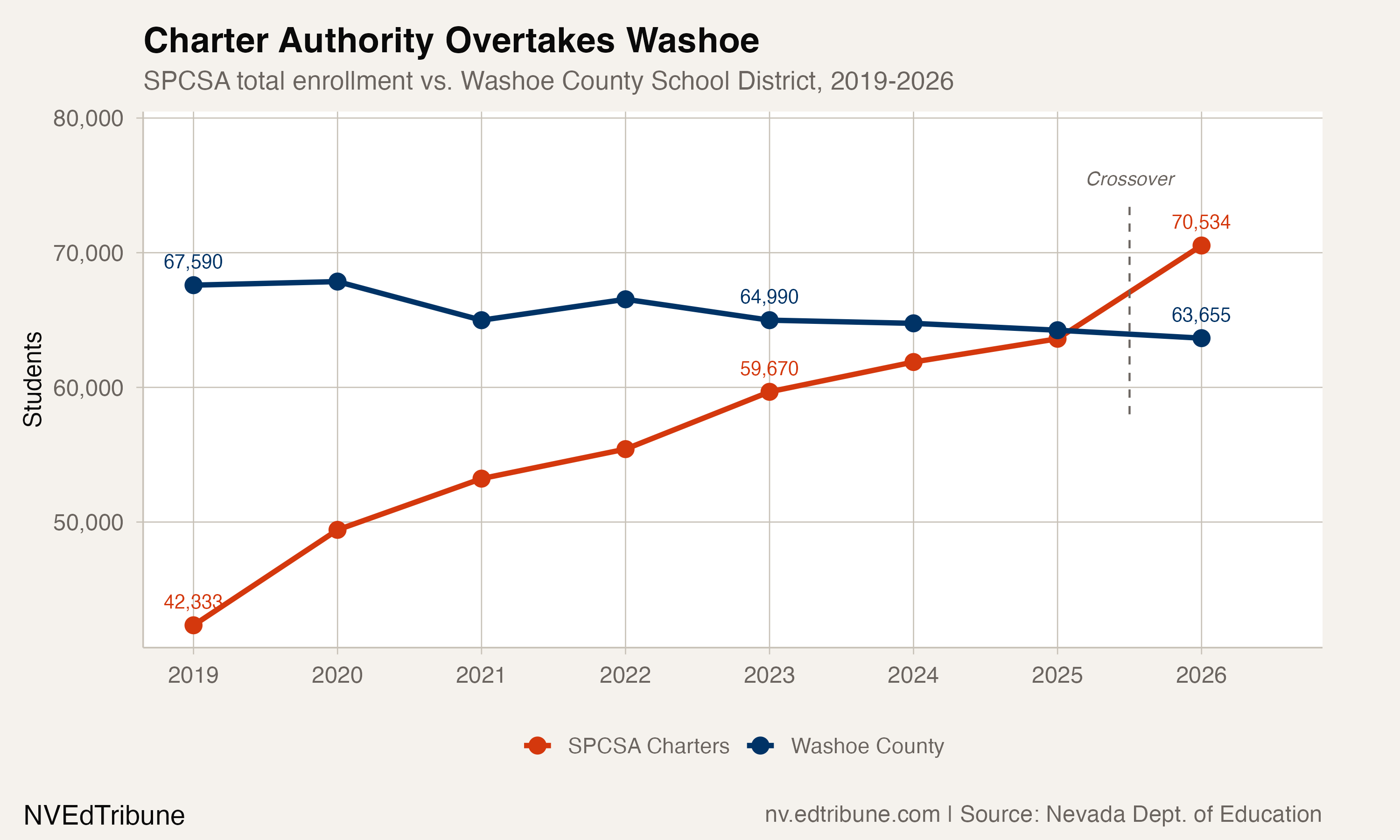
A year ago, the State Public Charter School Authority trailed Washoe County School District↗ET by 635 students. As of October 2025, SPCSA enrolls 70,534 students across 51 charter entities, while Washoe has fallen to 63,655. The gap did not close gradually. It blew open by 6,879 students in a single year, driven largely by Clark County's decision to hand six of its charter schools to the state authority.
The crossover makes SPCSA the second-largest public school system in Nevada, behind only Clark County School District↗ET. It also makes Nevada one of the few states where a charter authorizer, not a school district, holds that position.
Seven years, two opposite trajectories
In 2018-19, SPCSA's 29 charter entities enrolled 42,333 students. Washoe enrolled 67,590. The gap was 25,257 students in Washoe's favor.
Every year since, SPCSA grew and Washoe shrank. Charter enrollment rose 66.6% over that span, adding 28,201 students. Washoe lost 3,935, a 5.8% decline. By 2024-25, the two systems were nearly equal: 63,609 to 64,244.
Then 2025-26 happened. SPCSA surged by 6,925 students, its second-largest single-year gain on record. Washoe dropped another 589.
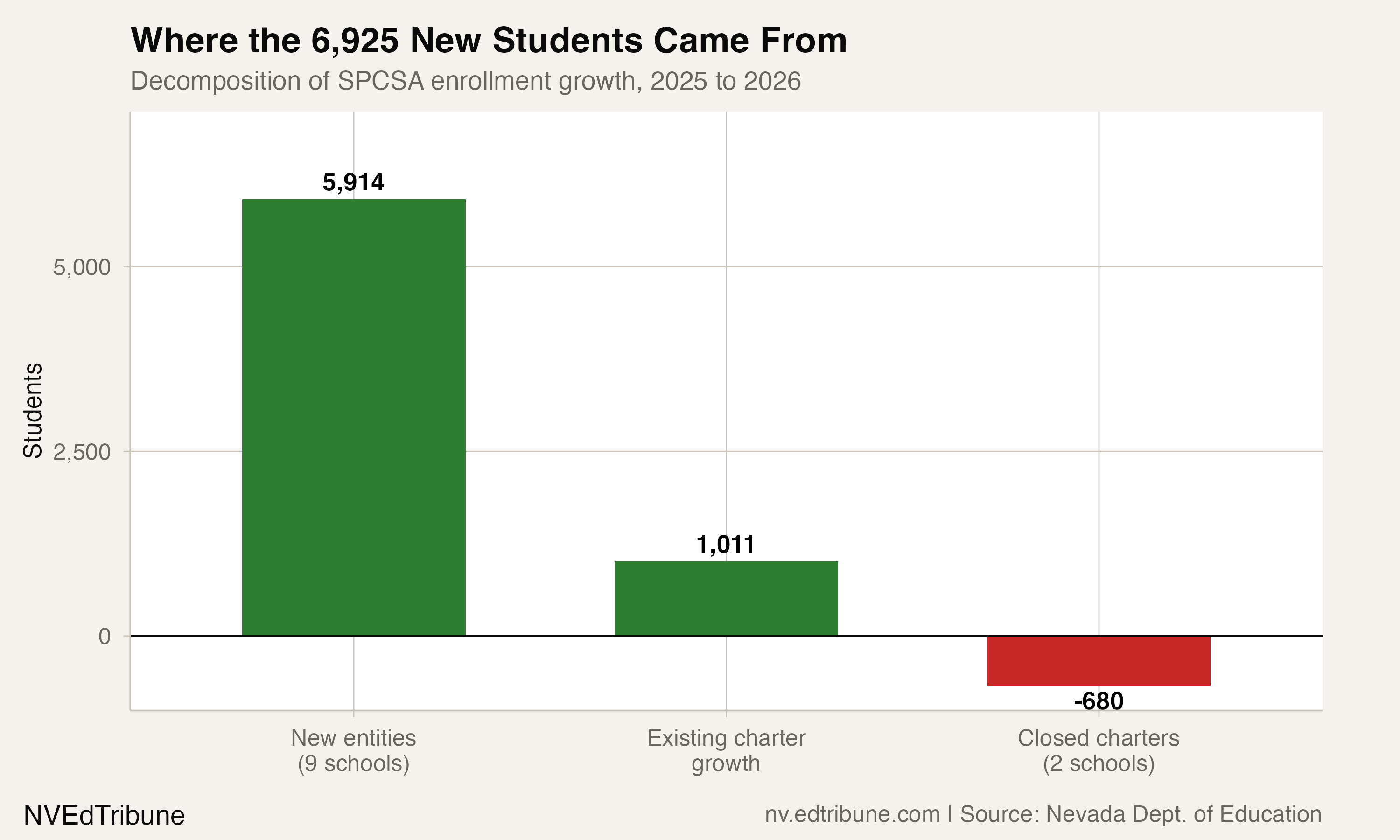
The growth was not evenly distributed across the charter sector. Of the 6,925-student increase, 5,914 came from nine charter entities that appeared in SPCSA's enrollment data for the first time in 2025-26. Organic growth across the 44 existing charters accounted for just 1,011 additional students. Two charter schools, pilotED Schools of Nevada and Battle Born Academy, closed entirely, removing 680 students from the tally.
The CCSD charter transfer
The largest single driver of the crossover was administrative, not demographic. In January 2025, Clark County School District transferred oversight of its six remaining charter schools to SPCSA, exiting charter sponsorship entirely. The six schools brought roughly 5,550 students under the state authority's umbrella.
The transfer was not a vote of confidence in every school. Only Odyssey Charter School, with 2,391 students, received a six-year contract from SPCSA. Four schools received three-year contracts due to recent one- or two-star ratings on Nevada's School Performance Framework. The distinction matters: those schools now operate under a performance clock that CCSD had not imposed.
The remaining new entities in the data include schools like The Delta Academy (1,315 students), Innovations International Charter School (619), and Explore Knowledge Academy (581). Some of these may be existing schools that previously reported under different structures rather than entirely new operations.
A 15-cent share of every dollar
Charter enrollment has not just grown in absolute terms. Its share of statewide enrollment nearly doubled, from 8.5% in 2018-19 to 14.9% in 2025-26. Nearly one in six Nevada public school students now attends an SPCSA charter.
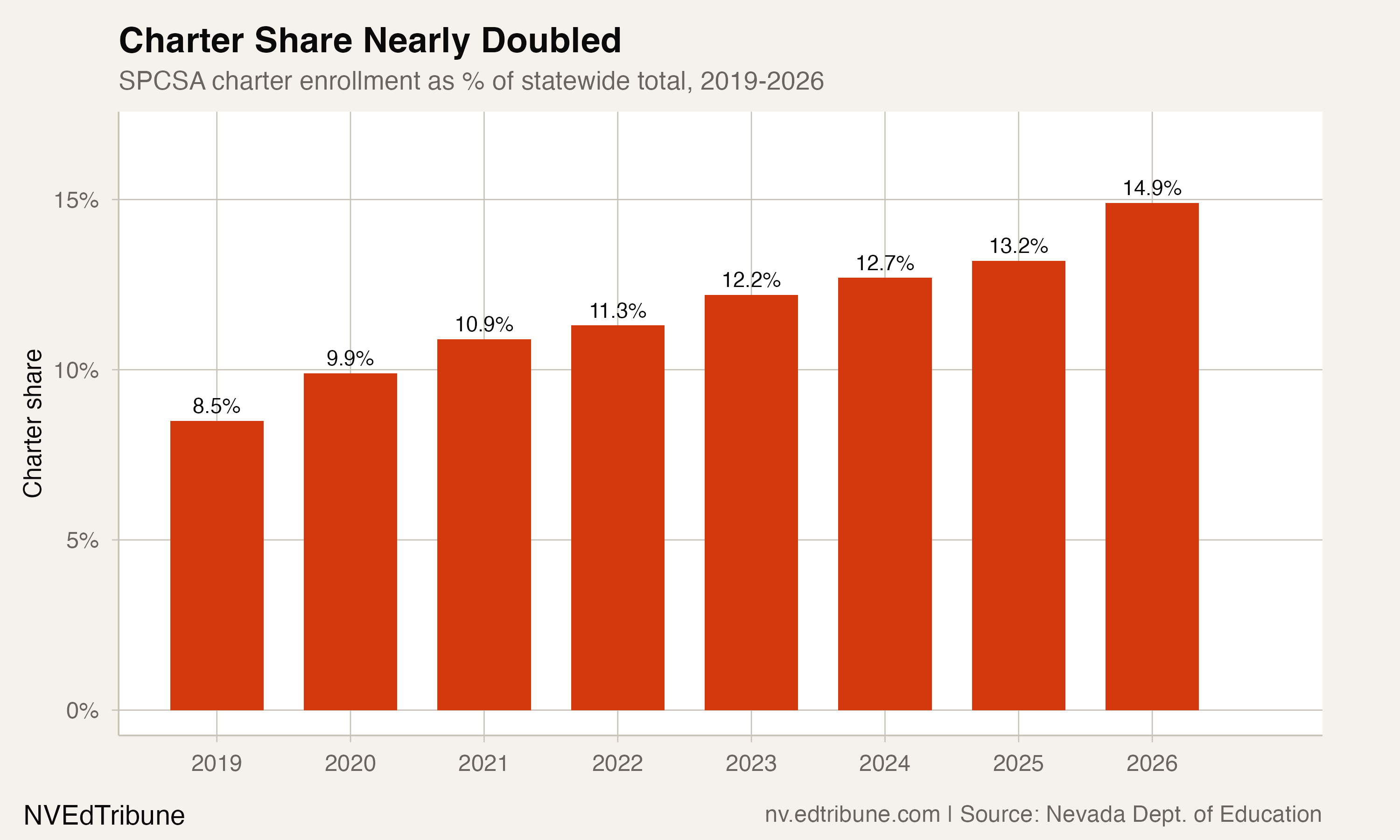
That growth came while statewide enrollment was falling. Nevada enrolled 498,616 students in 2018-19 and 473,657 in 2025-26, a net loss of 24,959. Traditional districts absorbed the full decline and then some: their collective enrollment dropped by 53,160 students, or 11.7%. Charter schools added 28,201 over the same period, partially offsetting the statewide total.

The year-over-year pattern in 2025-26 was the starkest since the pandemic. Traditional districts lost 16,176 students, the second-worst year on record behind the 18,030-student COVID drop in 2020-21. Charters gained 6,925.
Who's driving the charter sector
SPCSA is not a monolith. It is 51 separate organizations, and enrollment is heavily concentrated at the top. Somerset Academy of Las Vegas alone enrolls 9,534 students, more than many Nevada school districts. Pinecrest Academy of Nevada follows at 8,474. Together, the top five charter entities (Somerset, Pinecrest, Doral Academy, Coral Academy, and Mater Academy) account for 35,299 students, half of the charter sector's total.
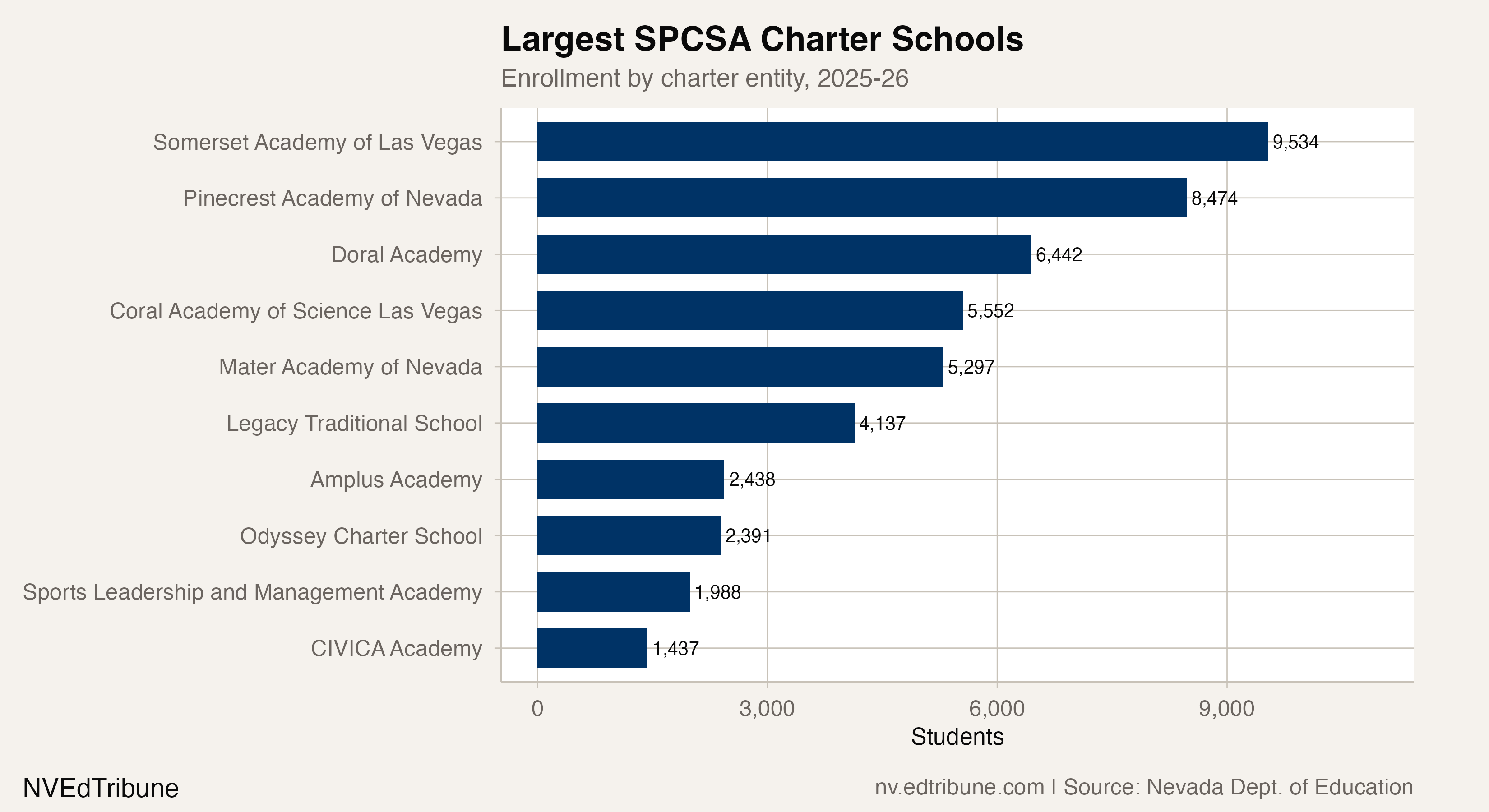
Mater Academy of Nevada was the fastest-growing established charter in 2025-26, adding 589 students to reach 5,297. It has grown 62% since 2020-21, when individual charter names first appeared in the data. CIVICA Academy grew by 363 students, and Pinecrest added 298. At the other end, Democracy Prep lost 278 students and Nevada Virtual Charter School lost 223.
The fiscal pressure on traditional districts
Per-pupil funding follows students in Nevada. Every student who moves from a traditional district to a charter school takes roughly $9,400 in base state funding with them. The building, the heating bill, and the bus route remain.
CCSD's 2025-26 enrollment of 291,587 represents a loss of 43,746 students, 13.0%, since 2018-19. The district's single-year decline of 14,451 students in 2025-26 was its worst on record, more than four times the 3,359-student loss the prior year. CCSD now faces a $50 million reduction in school-level funding for the 2026-27 school year, with 284 of its 375 schools facing budget cuts and 1,246 employees identified as surplus.
"There are a surprising number of schools that are cutting 10-plus staff positions, and in some cases, that's close to 10% of their staff." — Rebecca Dirks Garcia, Nevada PTA president-elect, Fox 5 Vegas, Feb. 2026
Washoe faces similar pressure at a smaller scale. The district initially projected an $18.4 million deficit for the 2026-27 fiscal year, then whittled it down to $5.7 million through program eliminations and position reductions before closing the gap entirely in January 2026 by cutting 39 positions. A separate school consolidation plan is expected to save $6.5 million annually.
School finance expert Dave Jensen put the trajectory bluntly: "We're going to see more and more school districts become insolvent."
The demographics question
Charter schools and traditional districts in Nevada serve meaningfully different student populations. SPCSA charters are 25.1% white, 42.5% Hispanic, and 12.7% Black. CCSD is 18.7% white, 48.9% Hispanic, and 16.3% Black. Washoe is 39.0% white and 44.8% Hispanic.
Critics of charter expansion have pointed to differences in economic composition as evidence that charter growth is not demographically neutral. Statewide, 64% of charter students qualify for free or reduced-price lunch, compared with 86% in traditional public schools. Nevada's FRL data is inflated by Community Eligibility Provision participation, which makes the 86% figure unreliable as a poverty measure. But even acknowledging that distortion, the gap between sectors is consistent enough to suggest that charter families skew somewhat less economically disadvantaged than the traditional district average.
The charter sector's supporters counter with academic performance. Charter school reading rates in 2024-25 were nearly 12 percentage points higher than the statewide public school average, though how much of that gap reflects selection effects versus instructional quality is impossible to determine from enrollment data alone.
What comes next
SPCSA's growth pipeline is not slowing. A $51 million federal grant, the largest U.S. Department of Education grant ever awarded to a Nevada nonprofit, will support 27 charter schools. Two new SPCSA charters are approved for the 2026-27 year.
CCSD's 2025-26 kindergarten cohort was 17,618 students, nearly 30% smaller than the current senior class of 24,505. That gap guarantees continued enrollment decline for years regardless of what charters do. Meanwhile, Pinecrest is converting a former Sears at Meadows Mall into a campus. Henderson and North Las Vegas are standing up their own charter authorizers. The SPCSA's lead over Washoe — 6,879 students and growing — looks less like an artifact of one administrative transfer and more like the new order of things.
Detailed code that reproduces the analysis and figures in this article is available exclusively to EdTribune subscribers.
Discussion
Sign in to join the discussion.
Loading comments...