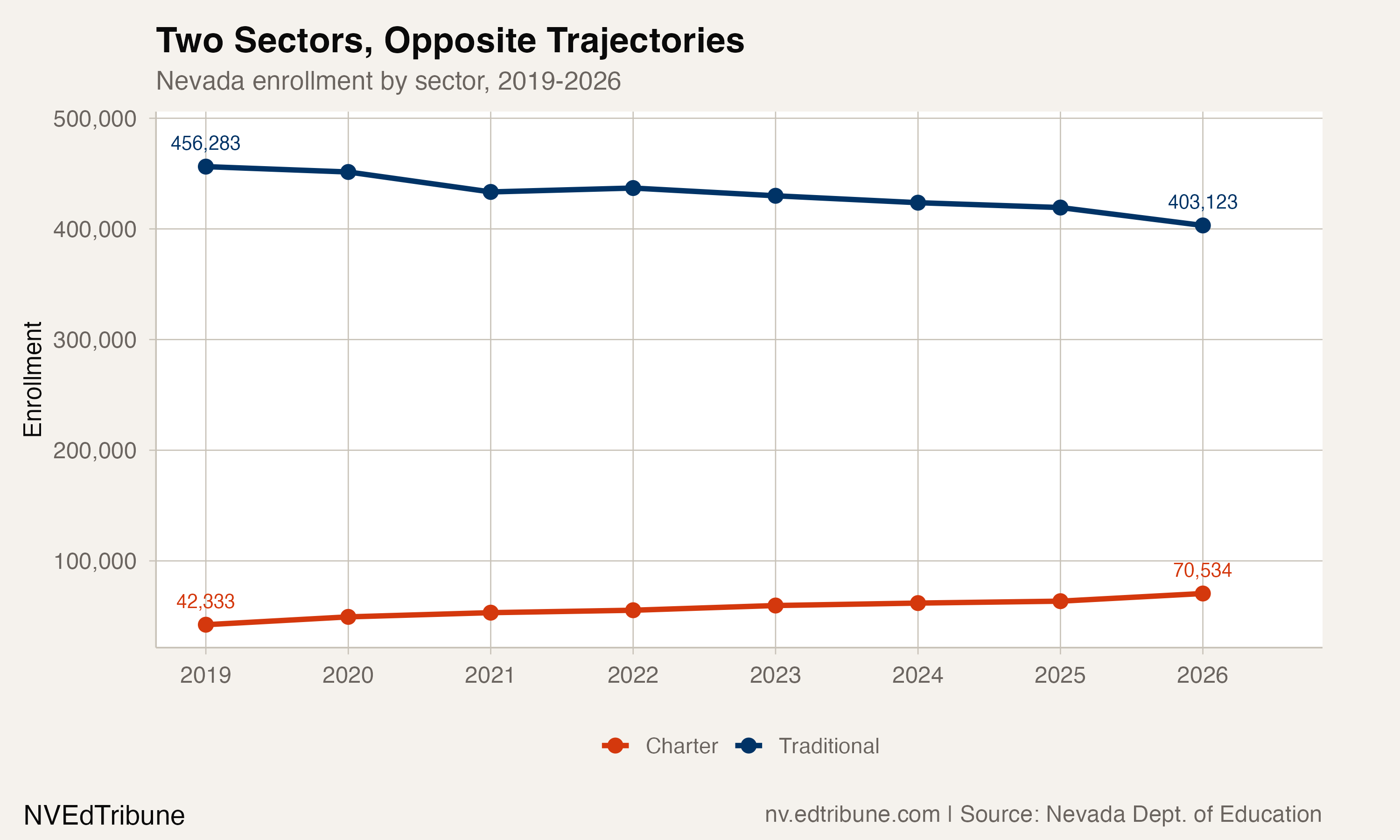
Nevada's public schools lost 9,251 students in 2025-26, the largest single-year drop outside of the pandemic. The decline was not a one-off: it was the sharpest acceleration in a six-year slide that has erased 27,203 students, or 5.4%, from the system since enrollment peaked at 500,860 in 2019-20. During that same period, the charter sector added 28,201 students and nearly doubled its share of total enrollment from 8.5% to 14.9%.
The state now has two public education systems moving in opposite directions. Traditional districts lost 53,160 students since 2019. Charter schools gained 28,201. The net result is 27,203 fewer children in Nevada's public schools, but the internal redistribution is twice as large as the headline number suggests.
The acceleration no one budgeted for
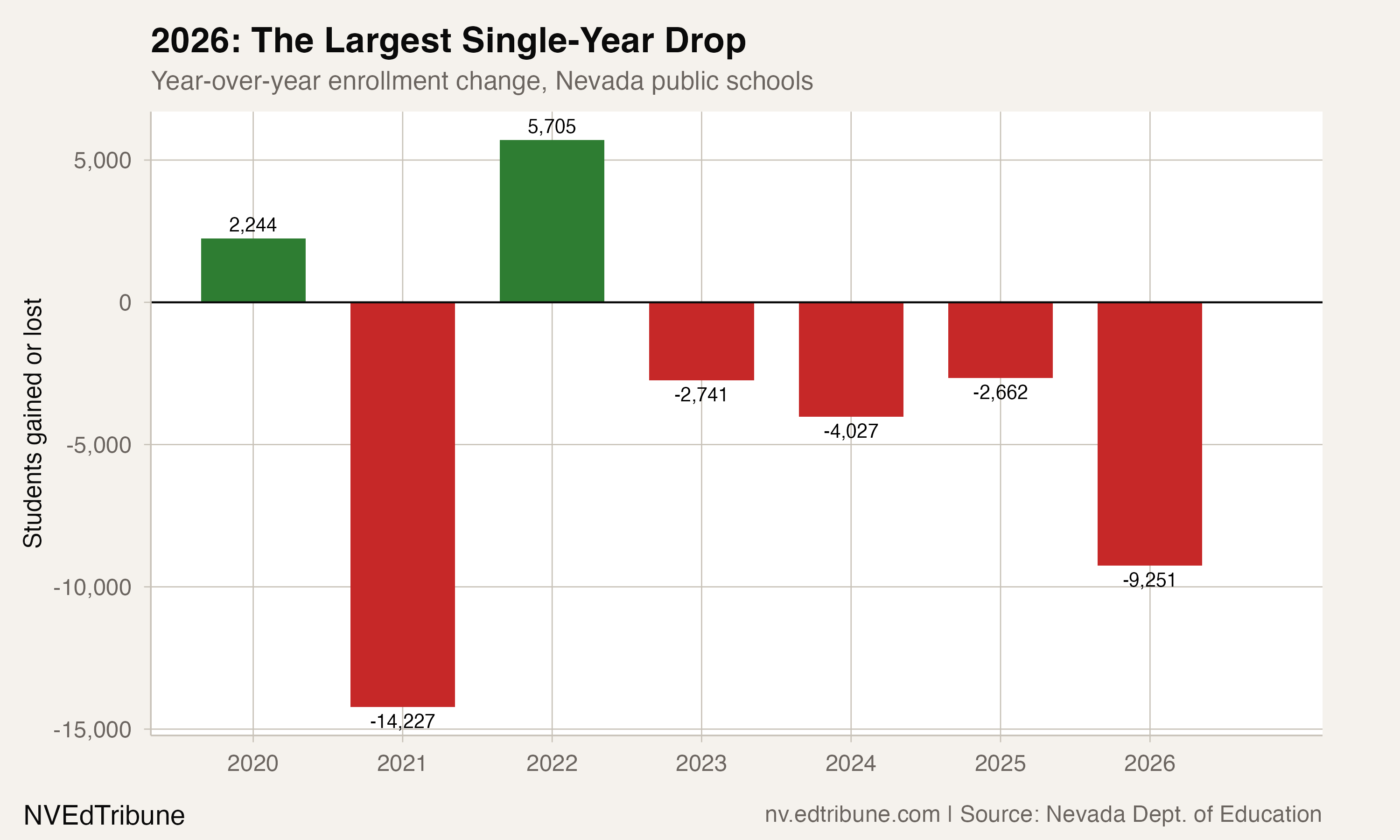
Nevada's enrollment trajectory looked manageable through 2025. Annual losses hovered between 2,700 and 4,100 students from 2023 through 2025. Then the floor dropped: 9,251 students vanished in a single year, more than triple the 2,662 lost the year before.
The 2026 drop is the second-largest in the dataset after the pandemic year of 2021, when 14,227 students disappeared. But the 2021 loss had a partial bounce-back in 2022 (5,705 returned). There is no pandemic to blame for 2026, and no reason to expect a rebound.
The traditional sector absorbed the full impact and then some. Traditional districts lost 16,176 students in 2025-26 alone, while charter schools gained 6,925. That means the traditional sector's losses were nearly 75% larger than the statewide total, masked only by charter growth.
One district, 82% of the damage
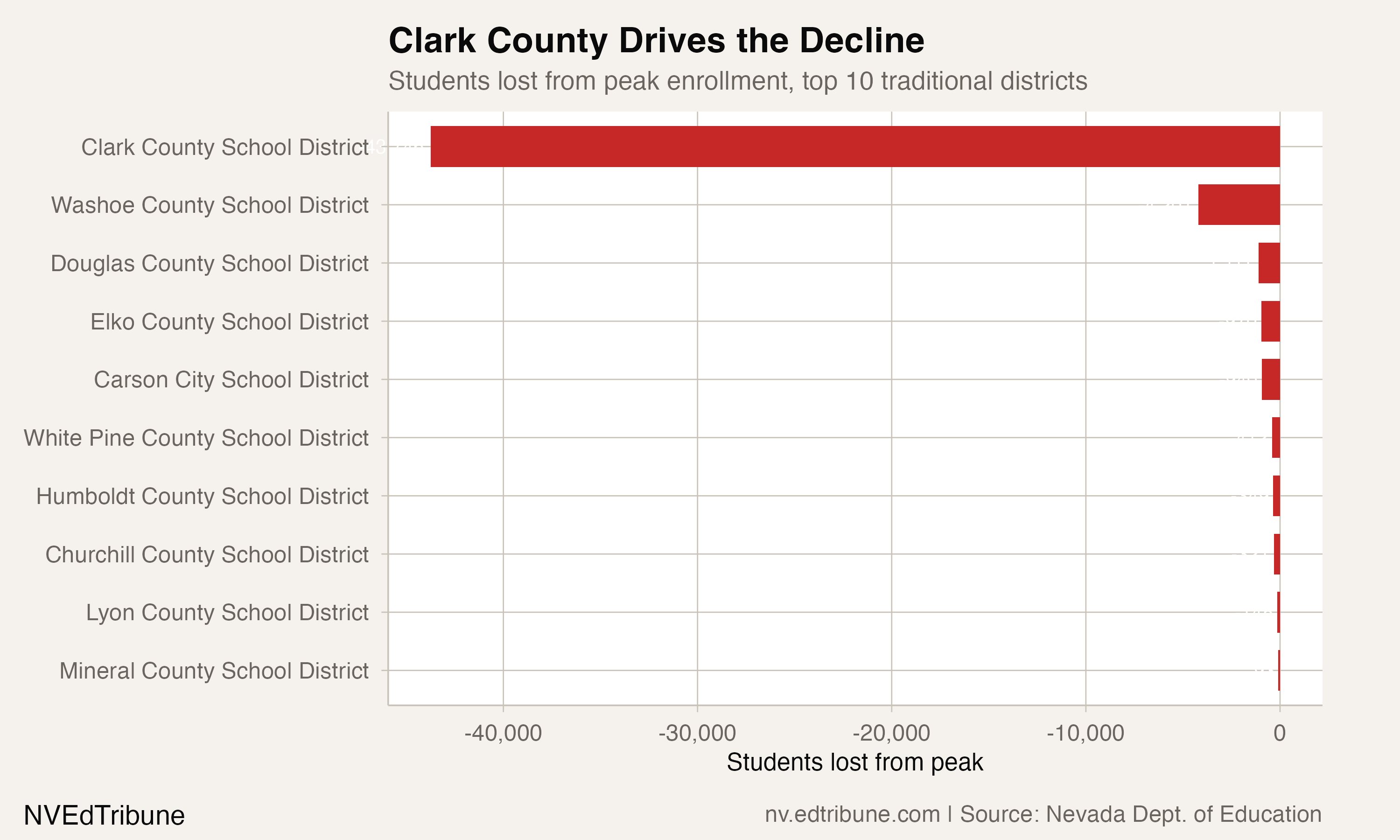
Clark County School District↗ET accounts for 43,746 of the 53,160 students lost from the traditional sector since 2019, or 82.3%. The district's enrollment has fallen from 335,333 to 291,587, a 13.0% decline that has triggered a fiscal crisis.
Clark County's 2026 loss alone was 14,451 students. That single-year drop accounted for 89.3% of all traditional district losses statewide. No other traditional district in Nevada lost more than 589 students (Washoe County).
The financial consequences are immediate. CCSD receives $9,051 per student from the state. At that rate, 14,451 fewer students translates to roughly $130 million in reduced funding. The district faces a $50 million budget shortfall for 2026-27, with 284 of its 375 schools facing budget reductions and more than 1,200 positions identified for elimination including 682 licensed staff, 500 support professionals, and 64 administrators.
"For decades, we were hiring thousands of educators. ... It is a shift." — CCSD Superintendent Jhone Ebert, Las Vegas Sun, Feb. 2026
Washoe County School District↗ET has followed a steadier decline: from a peak of 67,856 in 2020 to 63,655 in 2026, a loss of 4,201 students (6.2%). Every other county district in Nevada is also below its peak enrollment.
The charter sector's seven-year transformation
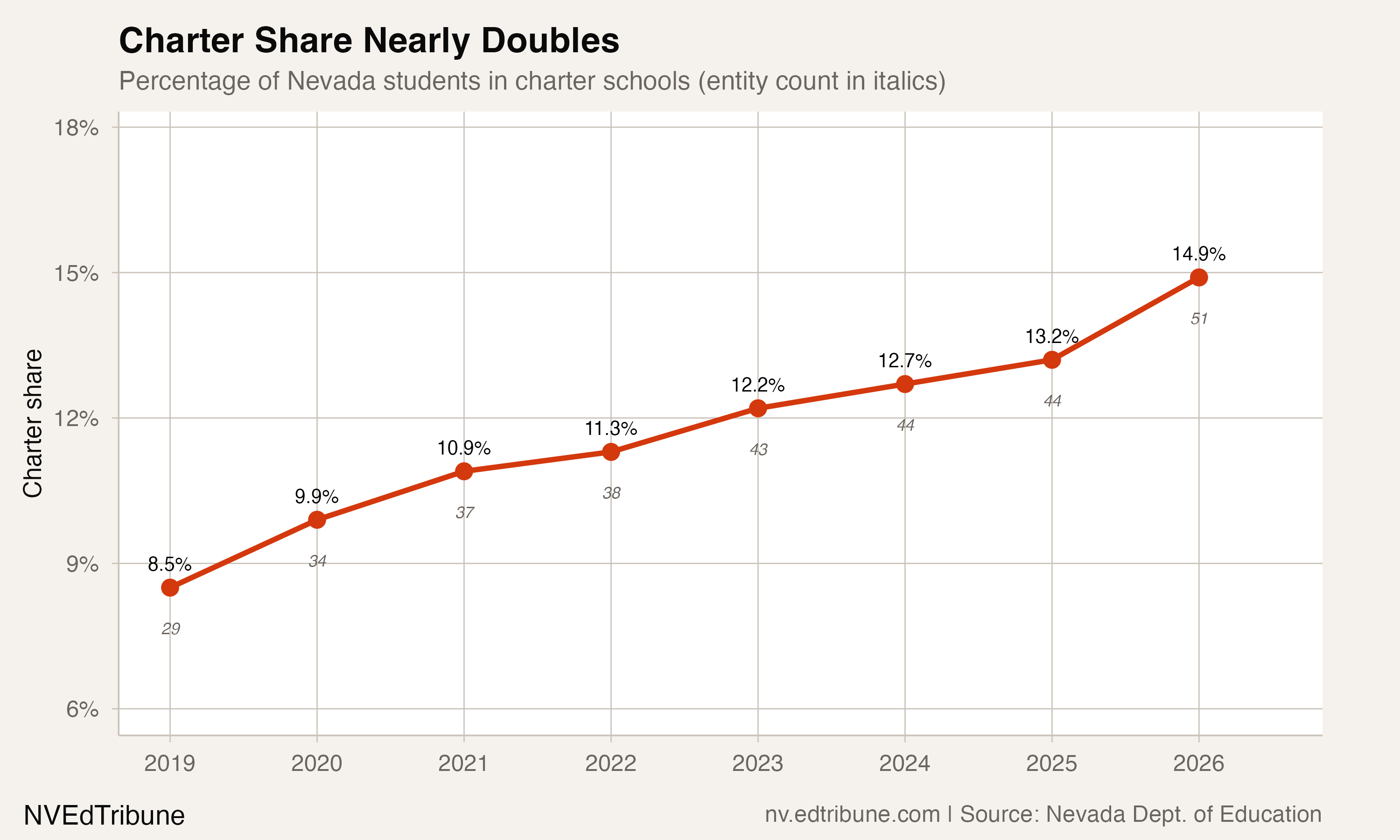
In 2019, Nevada had 29 charter entities serving 42,333 students, or 8.5% of total enrollment. By 2026, the sector had grown to 51 entities and 70,534 students, a 14.9% share. The growth came from two sources: existing schools expanding and new schools opening.
Nine new charter entities appeared in the 2025-26 data, enrolling 5,914 students. The largest was Odyssey Charter School (2,391 students) and The Delta Academy (1,315). Among existing schools, Mater Academy of Nevada added the most students in 2026, growing from 4,708 to 5,297 (12.5%), followed by CIVICA Academy, which grew 33.8% to 1,437 students.
Somerset Academy of Las Vegas remains the largest charter in the state at 9,534 students, followed by Pinecrest Academy of Nevada (8,474) and Doral Academy (6,442). The top three charters alone enroll 24,450 students, more than all but two county districts.
The charter sector as a whole now enrolls more students than Washoe County. At 70,534 students, the State Public Charter School Authority has overtaken the Washoe County School District (63,655) as the state's second-largest school system, trailing only Clark County.
What is driving the divergence
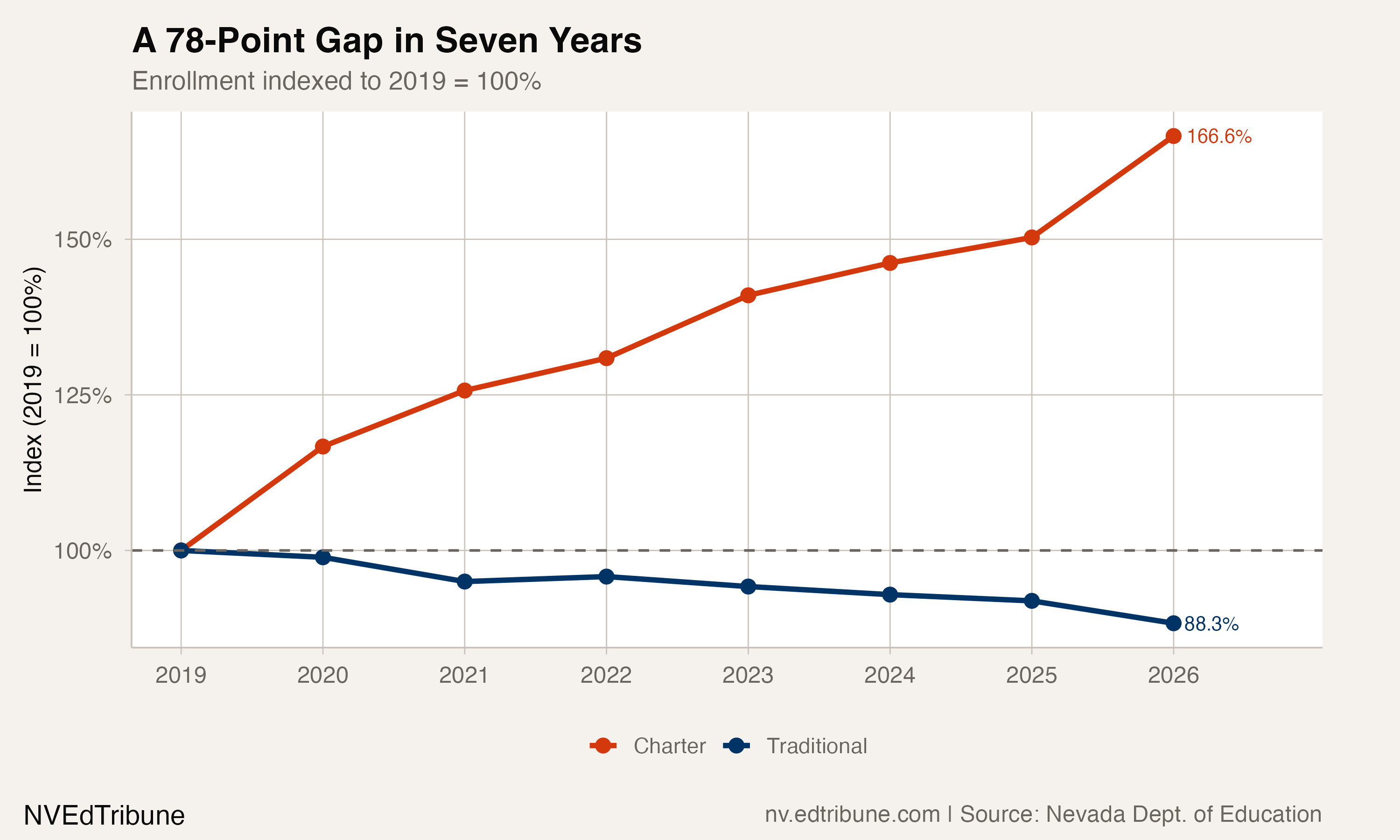
Indexed to 2019 levels, Nevada's charter sector has grown to 166.6% of its starting enrollment while the traditional sector has contracted to 88.3%. The 78-point gap reflects both push and pull forces operating simultaneously.
The most direct driver of charter growth is state and federal investment. A $51 million federal grant, the largest Education Department grant to a Nevada nonprofit, is supporting 27 new or existing charter schools. The 2025 legislature allocated $17 million for charter transportation and $38 million for charter teacher compensation. AB400, passed in 2023, allowed cities and counties to become charter authorizers, and both Henderson and North Las Vegas have moved to open city-sponsored charters.
On the traditional side, declining birth rates are shrinking the incoming pipeline. Nevada's fertility rate fell 17.2% from 2011 to 2023, the fifth-largest drop nationally and 6.6 percentage points steeper than the national average. The state recorded its lowest birth rate in 30 years in 2023. CCSD's current kindergarten class (17,618) is 30% smaller than its current senior class (24,505), a gap that foreshadows years of continued contraction as smaller cohorts advance through the grades.
Slowing migration to Las Vegas compounds the birth rate effect. Nevada's population growth fell from 1.7% to 0.9% between 2024 and 2025. For a state that historically relied on in-migration to keep schools full, the deceleration removes a key offset to natural decline.
A competing explanation for the scale of traditional losses is that charter growth is not just absorbing students who would otherwise be in county schools. Some portion of the 28,201 charter-sector gain may represent students who would have left the public system entirely, choosing private school or homeschool in the absence of a charter option. The data cannot distinguish between a student who transferred from Clark County to a charter and one who enrolled in a charter instead of leaving the public system. The Nevada State Education Association has also noted that charter schools serve lower shares of students who are English learners, entitled to special education services, or eligible for free and reduced-price lunch, suggesting the two sectors are not drawing from identical populations.
Two systems, one funding formula
Nevada funds schools on a per-pupil basis: dollars follow students. When a student moves from Clark County to a charter school, Clark County's budget shrinks by $9,051 and the charter's grows by approximately the same amount. The system is designed to be enrollment-neutral at the state level. It is not neutral at the district level.
Clark County's fixed costs do not decline at the same rate as its enrollment. A school that loses 30 students still needs a principal, a custodian, and utilities. The district has already announced it will surplus 1,246 employees, but only 595 vacant positions exist for them to fill. Christina Radosevich, a teacher at Thurman White Middle School facing displacement, told Fox 5 Vegas: "If all the schools are cutting and no one's adding, like, where are we all going to go?"
The structural mismatch will persist. Even if Nevada's charter sector held steady at its current share, the birth rate pipeline guarantees continued contraction in the total student population. Nevada's Pupil-Centered Funding Plan was designed for a Las Vegas that could not build schools fast enough. Now the fifth-largest district in the country is losing 14,000 students a year, and Christina Radosevich is still waiting to find out where she will teach in fall 2026.
Detailed code that reproduces the analysis and figures in this article is available exclusively to EdTribune subscribers.
Discussion
Sign in to join the discussion.
Loading comments...