Eleven of Nevada's 19 traditional county school districts just hit all-time enrollment lows. Together, those 11 account for 95.4% of all traditional public school enrollment in the state. Clark County↗ET, at 291,587 students, anchors the list. Washoe County↗ET, at 63,655, sits third. Esmeralda County↗ET, at 69, finishes it.
The scale varies wildly — Clark's single-year loss of 14,451 students is larger than most Nevada districts' entire enrollment — but the direction does not. From the state's urban core to its emptiest mining counties, traditional public schools are smaller than at any point in the last eight years.
Sixteen of 19 lost students
Of the 19 traditional districts operating in 2025-26, 16 lost students compared to the prior year. Only Nye County (+7), Storey County (+16), and Davidson Academy (+2) gained. The combined year-over-year loss across all traditional districts was 16,176 students, a 3.9% decline in a single year.
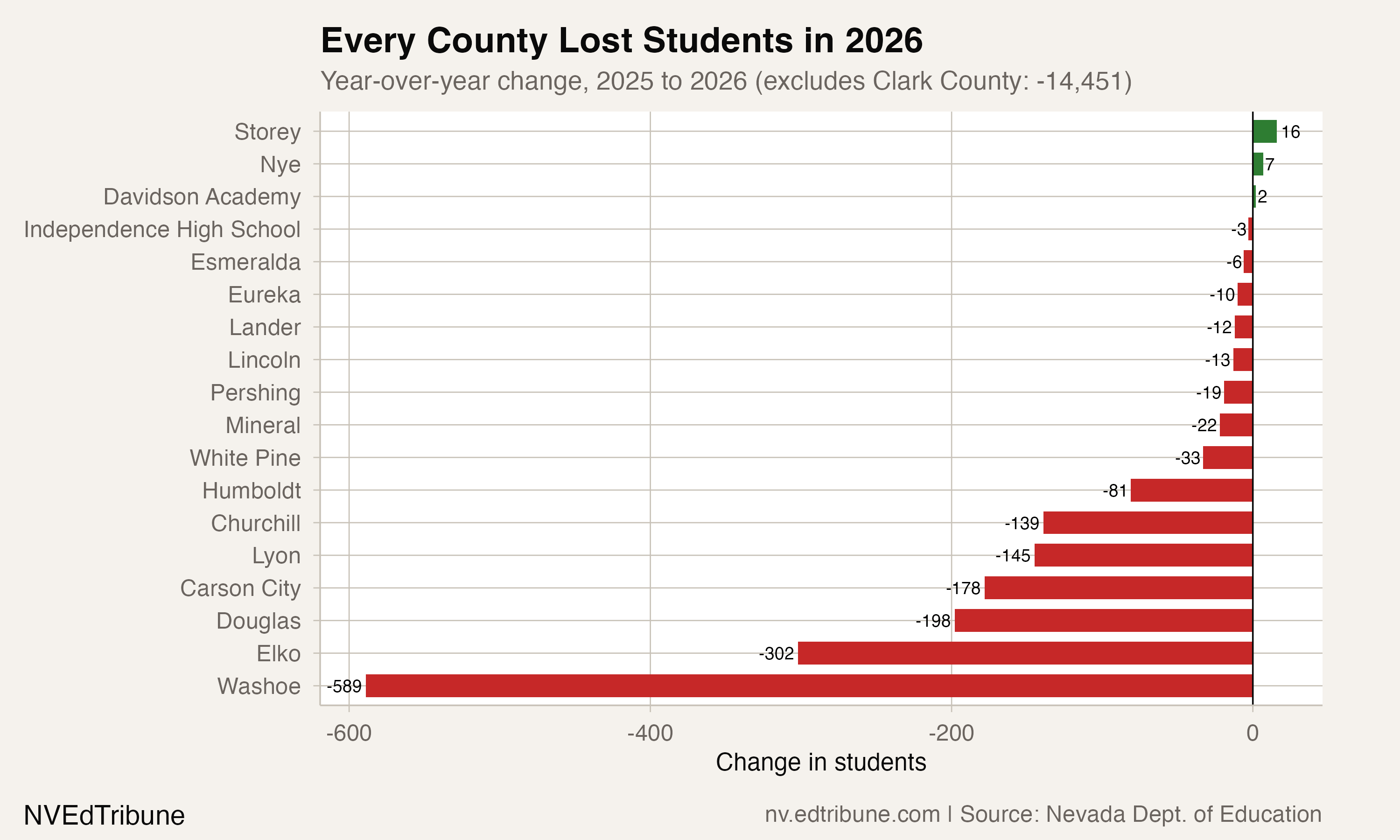
Clark County alone lost 14,451 students, a 4.7% drop that accounted for 89.3% of the traditional sector's total loss. But the breadth of decline matters as much as the depth. Douglas County↗ET lost 198 students (-4.0%). Carson City↗ET lost 178 (-2.4%). Elko County↗ET lost 302 (-3.1%). Churchill County lost 139 (-4.2%). Mineral County lost 22 (-4.1%).
Douglas County and Carson City have now declined for seven consecutive years, the longest active streaks in the state. Clark County, Washoe, and Eureka County have each declined four straight years.
Clark County: built for growth, learning contraction
Clark County's enrollment peaked at 335,333 in 2018-19. It has fallen every year since, losing 43,746 students, a 13.0% decline. The 2025-26 drop of 14,451 was the steepest single-year loss in the eight years of available data.
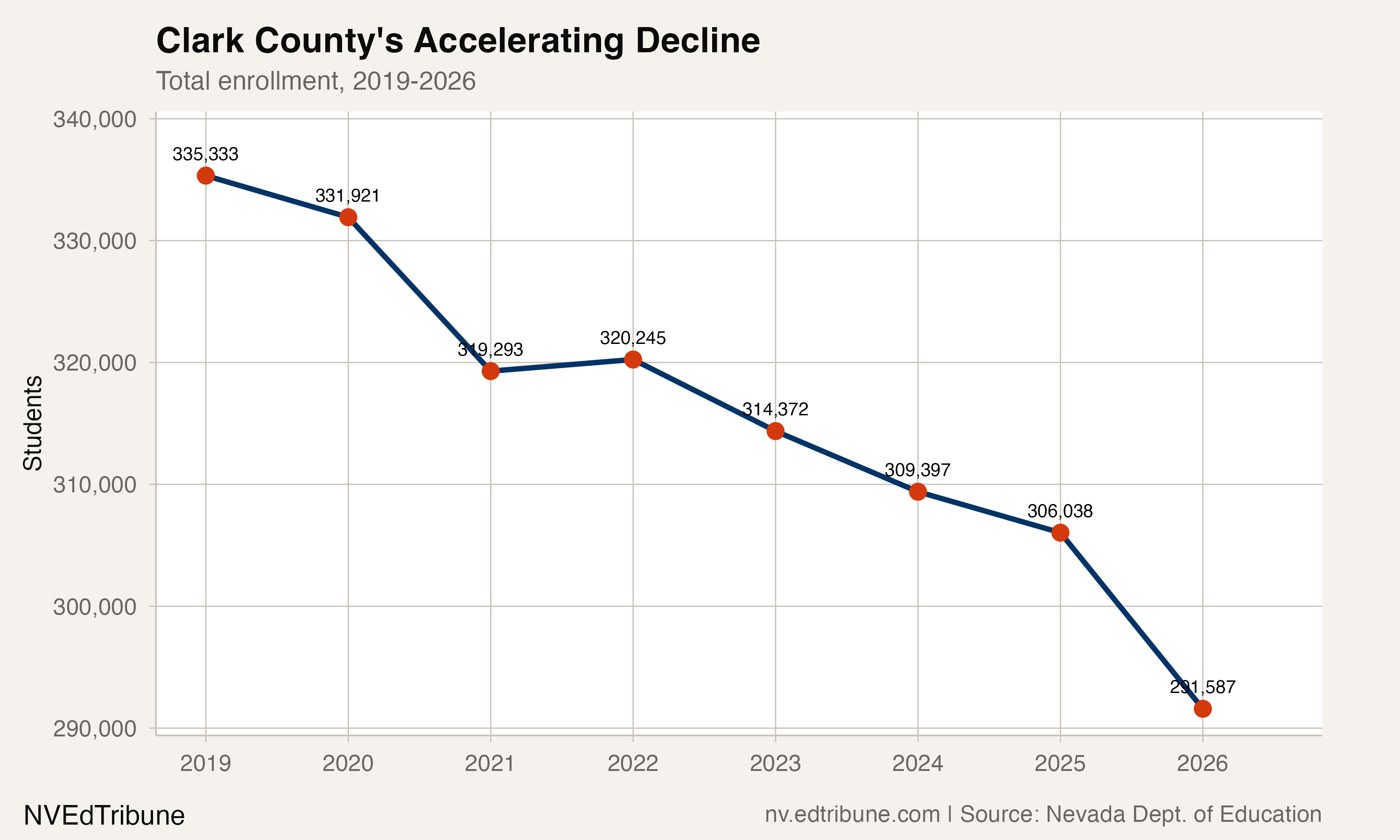
The district projects enrollment will fall further to 282,643 in 2026-27, which would reduce revenue by roughly $50 million. Already, 284 of its 375 schools face budget cuts, and more than 1,200 staff members have been notified their positions may be eliminated or reassigned.
"For decades, we were hiring thousands of educators, and we were just trying to (serve) children, build buildings." -- Superintendent Jhone Ebert, Las Vegas Sun, Feb. 2026
District administrators have pointed to declining birth rates, slower migration to Las Vegas, and growing competition from charter schools and homeschooling. The kindergarten pipeline tells the rest of the story: CCSD's current kindergarten cohort of 17,618 students is nearly 30% smaller than its senior class of 24,505.
The rural squeeze
The fiscal math is punishing for small counties. Under Nevada's Pupil-Centered Funding Plan, dollars follow students on a quarterly basis, meaning revenue can fluctuate mid-year as enrollment shifts.
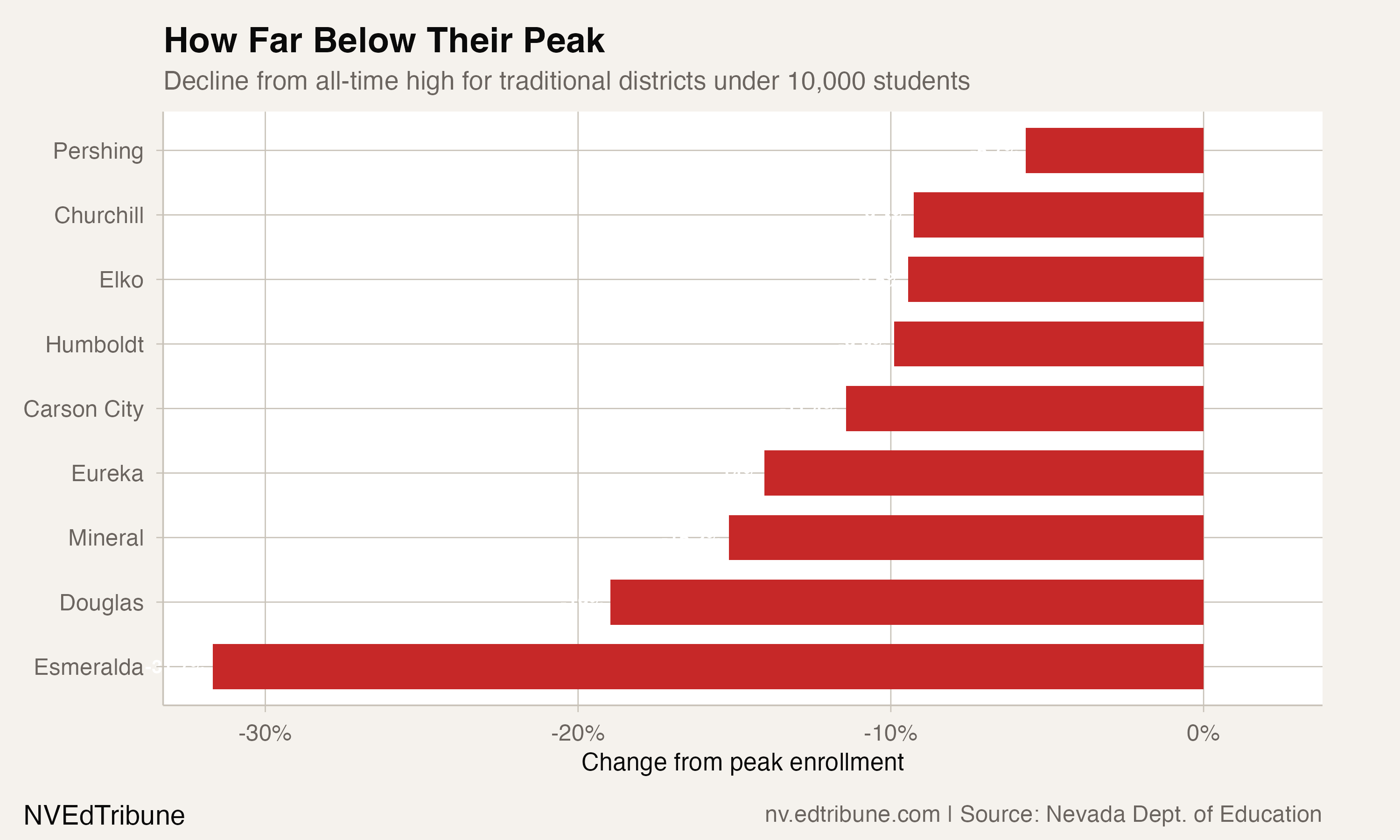
Elko County now enrolls 9,293 students, down from 10,263 in 2019-20, a 9.5% decline. Its superintendent, Clayton Anderson, told The Nevada Independent the district needs to cut $15 million from a $125 million budget. Enrollment has been falling 3-4% annually, just below the 5% threshold that would trigger state funding protections.
"It made it real tough for us to look at our staff and say, 'Yeah, sorry, we gotta put this towards the ending fund balance.'" -- Clayton Anderson, Elko County superintendent, The Nevada Independent, Feb. 2026
Douglas County has lost 1,111 students since 2019, a 19.0% decline, the steepest proportional loss among mid-sized traditional districts. The county's population is aging rapidly: the average resident's age rose from 41.7 years in 2000 to 52 years in 2020, and more than a quarter of residents are over 65. Housing prices have pushed young families out.
"Douglas County is not an affordable location for young families to relocate." -- Keith Lewis, Douglas County superintendent, Record-Courier, May 2022
Former Humboldt County superintendent Dave Jensen warned that the pattern is unsustainable: "We're going to see more and more school districts become insolvent."
Meanwhile, charters set 21 records
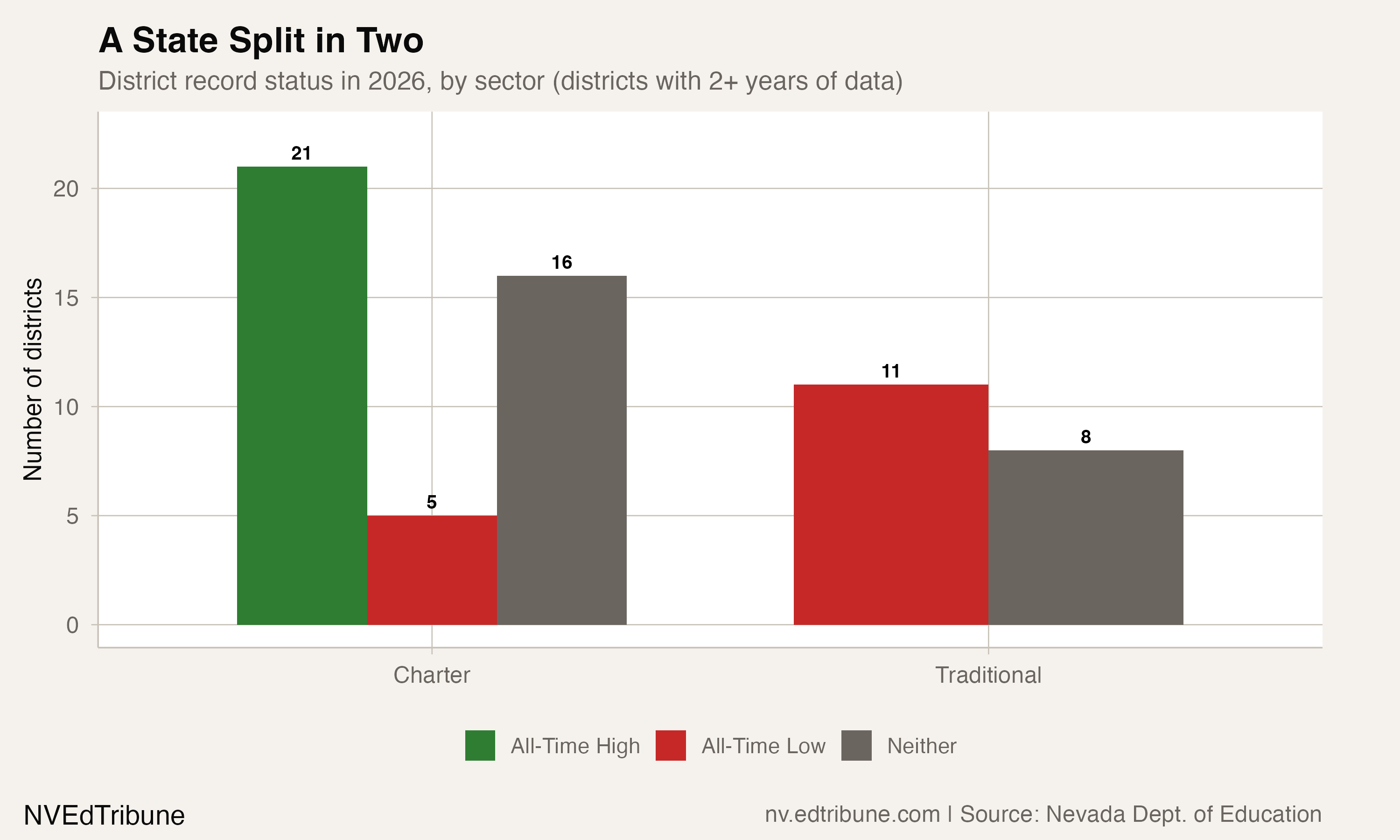
The same year that 11 traditional districts hit all-time lows, 21 charter districts hit all-time highs. Not a single traditional district set a record on the high end.
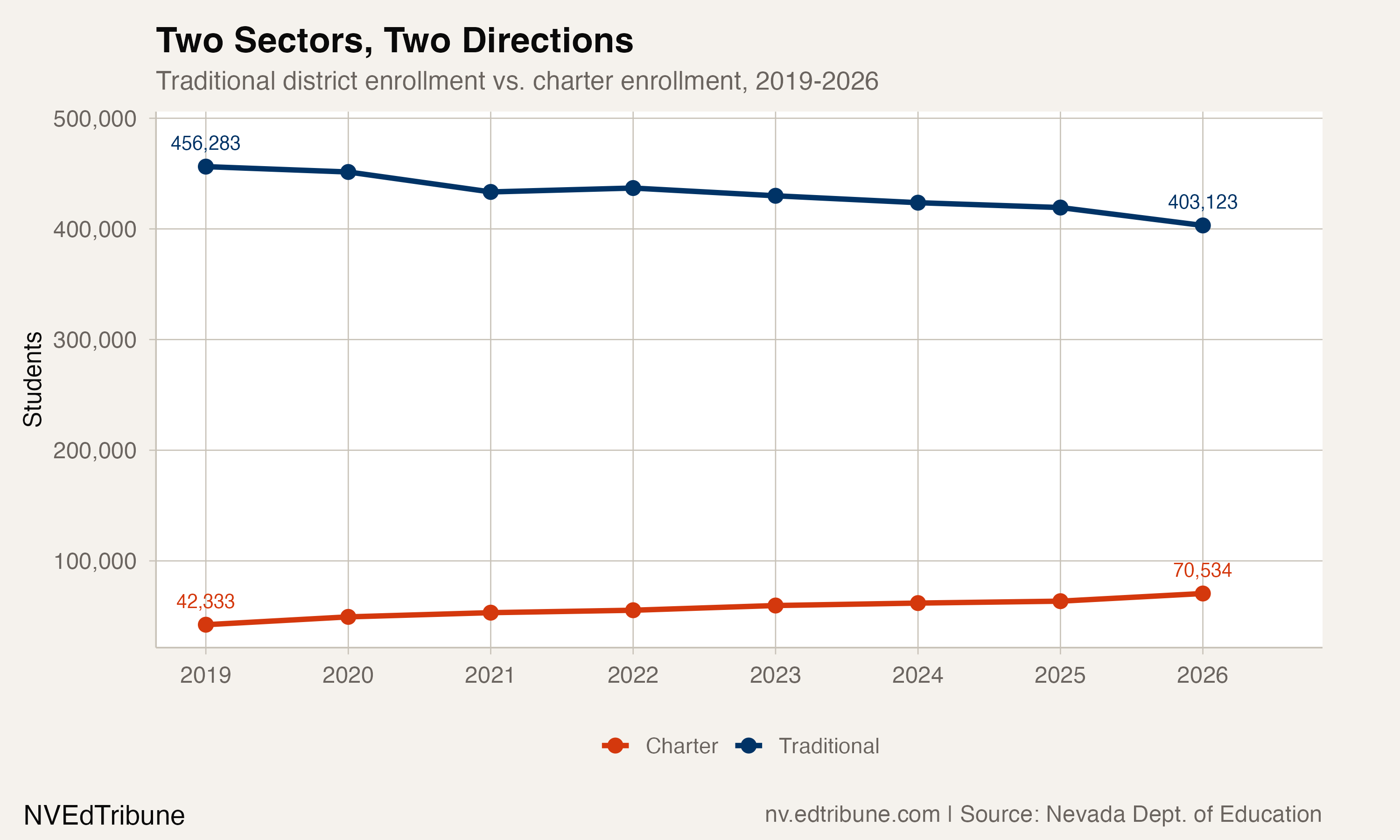
Charter enrollment grew from 42,333 in 2018-19 to 70,534 in 2025-26, a 66.6% increase. The charter sector's share of total Nevada enrollment nearly doubled, from 8.5% to 14.9%. In the same period, traditional districts lost 53,160 students, an 11.7% decline.
The State Public Charter School Authority now oversees more students than Washoe County, making it the second-largest school system in the state. The largest charter networks, Pinecrest Academy (8,474 students) and Doral Academy (6,442), are both managed by Florida-based Academica. Mater Academy of Nevada has grown 170% since 2018-19, from 1,962 to 5,297 students.
Not all charters are growing. Five charter operators also sit at all-time lows, including Democracy Prep (927 students, down 27.4% from its peak) and Nevada Virtual Charter School (1,402, down 35.9%). The virtual school's decline mirrors a national pattern of pandemic-era virtual enrollments receding.
A structural split
The distinction between charter growth and traditional decline is not simply a matter of one sector poaching from the other, though some of that is occurring. Birth rate declines, housing affordability, and interstate migration patterns affect the total pool of students. Charter expansion adds capacity on top of those demographic forces, concentrating the pain in traditional districts that still carry the fixed costs of buildings, transportation, and specialized services.
The result is a state where the number of districts setting records has never been higher on both ends of the spectrum simultaneously. In 2025-26, among the 61 districts with at least two years of data, 21 are at all-time highs, 16 are at all-time lows, and 24 sit between their extremes.
Nevada is no longer simply growing or shrinking. It is doing both at once, and the Pupil-Centered Funding Plan treats every departing student identically: $9,051 out the door. In Elko, that means superintendent Clayton Anderson is cutting $15 million from a $125 million budget while his mining towns lose families. In Esmeralda, it means six teachers will return to three schoolhouses in fall 2026 and count whether the number is still 69.
Detailed code that reproduces the analysis and figures in this article is available exclusively to EdTribune subscribers.
Discussion
Sign in to join the discussion.
Loading comments...