Correction: An earlier version of this article stated that every one of the top 10 growing districts in Nevada from 2021 to 2026 was a charter school and that no traditional district added students over that period. Eight of the top 10 were charter schools, and five traditional districts added students, led by Nye County, which gained 400. The article has been updated.
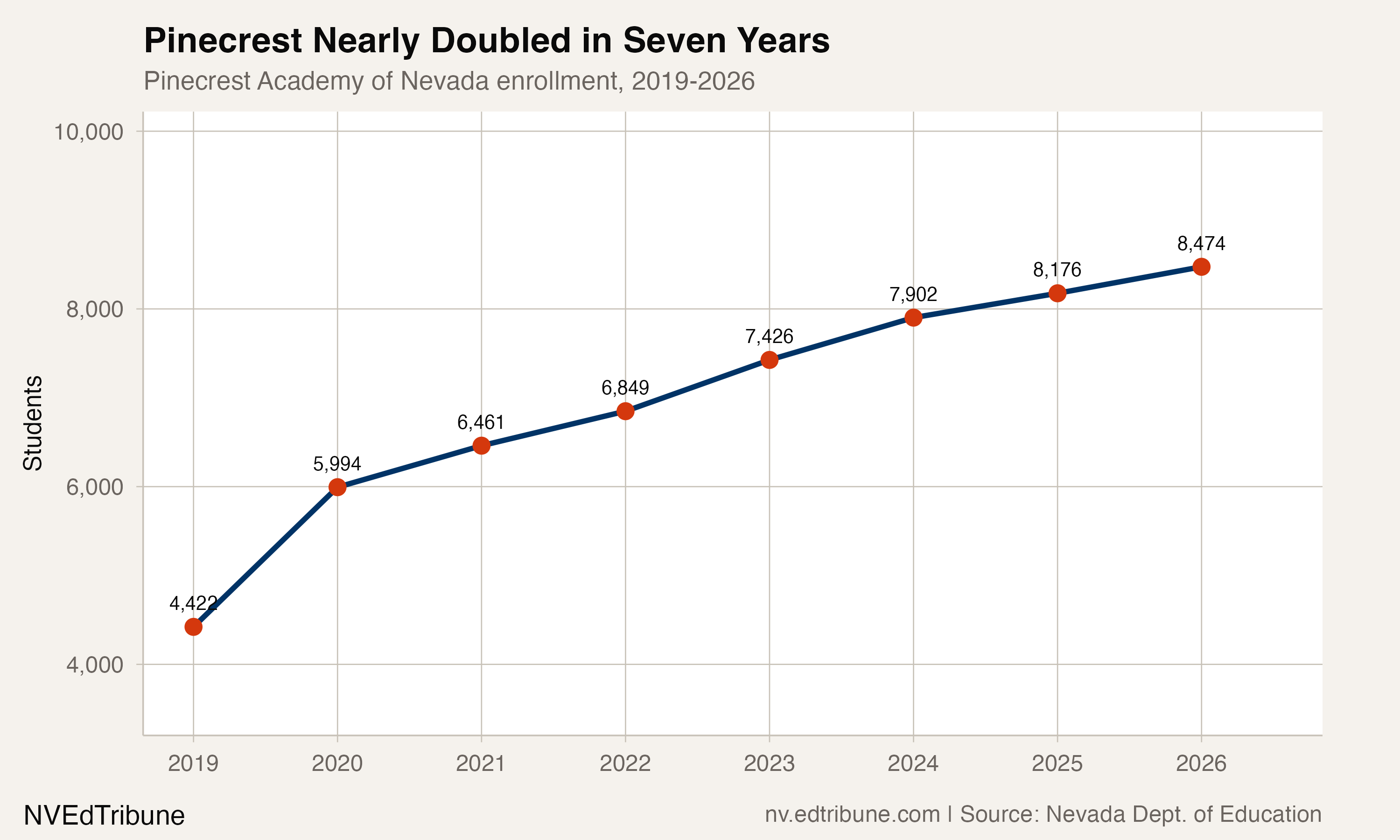
In 2019, Pinecrest Academy of Nevada↗ET enrolled 4,422 students across its Las Vegas campuses. By fall 2025, the network had nearly doubled to 8,474, a 91.6% increase that outpaced every other charter operator in the state and most traditional districts in the country. The growth was not a single event but a compounding trajectory: seven consecutive years of expansion, with no year adding fewer than 274 students.
That trajectory has a destination. Somerset Academy of Las Vegas↗ET, the state's largest charter at 9,534 students, added just 46 students over the same five-year window from 2021 to 2026. Pinecrest added 2,013. The gap between Nevada's two largest charters narrowed from 3,027 students to 1,060. At the current pace, Pinecrest overtakes Somerset within two years.
Seven campuses and a waitlist
Pinecrest operates seven K-12 campuses across the Las Vegas valley, all managed by Academica Nevada, the local arm of Florida-based Academica. The network's growth has been driven by a combination of new campus openings and enrollment cap increases at existing sites. The SPCSA unanimously approved a new Pinecrest campus in the former Sears building at Meadows Mall for up to 645 students. Its Springs campus, approved in late 2022, already has a waitlist of more than 300 prospective K-5 students for 2025-26. Its Cadence and Sloan Canyon campuses sought approval in 2024 to raise enrollment caps above the standard 10% threshold because demand exceeded available seats.
The pattern is consistent: Pinecrest opens a campus, fills it, hits capacity, and then requests cap increases. The network added 1,572 students in 2019-20 alone, its largest single-year gain, likely reflecting a new campus opening. Growth has since moderated to 274-577 students per year, the steadier rhythm of an expanding network filling out existing sites.
Not just Pinecrest
Pinecrest's growth is the most visible edge of a broader charter surge. Among charters operating in both 2021 and 2026, the top eight growth engines were all managed or affiliated with established networks.
Mater Academy of Nevada↗ET added the most students in absolute terms: 2,034, a 62.3% increase that brought its Las Vegas enrollment from 3,263 to 5,297. Coral Academy of Science Las Vegas↗ET added 1,667 (+42.9%). Sports Leadership and Management Academy nearly doubled from 1,066 to 1,988. Beacon Academy grew from 324 to 1,087, a 235.5% increase.
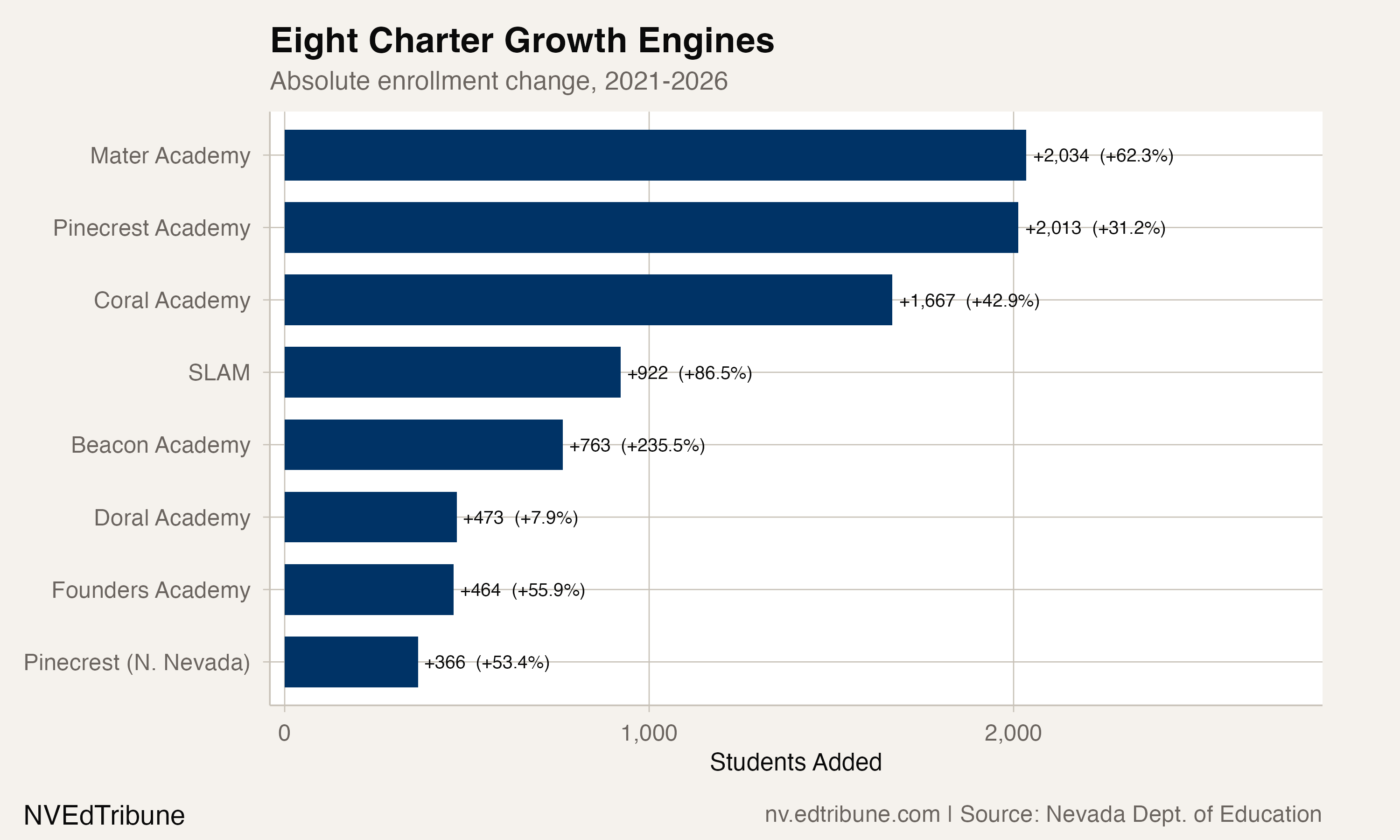
Eight of the top 10 growing districts in Nevada from 2021 to 2026 were charter schools. Only five traditional districts added students over that period, led by Nye County, which gained 400.
The Academica question
Five of Nevada's six largest charters, Pinecrest, Somerset, Doral Academy, Mater Academy, and SLAM, share a common management company: Academica Nevada. Together with CIVICA Academy, these six Academica-managed brands enrolled 33,172 students in 2026, or 47.0% of all charter students statewide.
Academica describes itself as a service provider that handles operations while individual school boards retain autonomy over academics, staffing, and curriculum. The company charges $450 per student, roughly 6% of guaranteed per-pupil funding. But the concentration raises structural questions. Nearly half of Nevada's charter sector is operationally dependent on a single for-profit entity headquartered in Miami.
The Nevada Independent reported in November 2025 that reading proficiency in state-run charters runs nearly 12 points higher than the statewide public school average. That performance gap fuels parent demand. But the same reporting flagged a demographic disparity: 64% of charter students qualify for free or reduced-price lunch, compared to 86% of traditional public school students, suggesting charters are drawing from a somewhat less economically disadvantaged population.
"Enrollment in Nevada's state charter school network is up 2.3 percentage points this year." — The Nevada Independent, Nov. 30, 2025
A sector reshaping itself
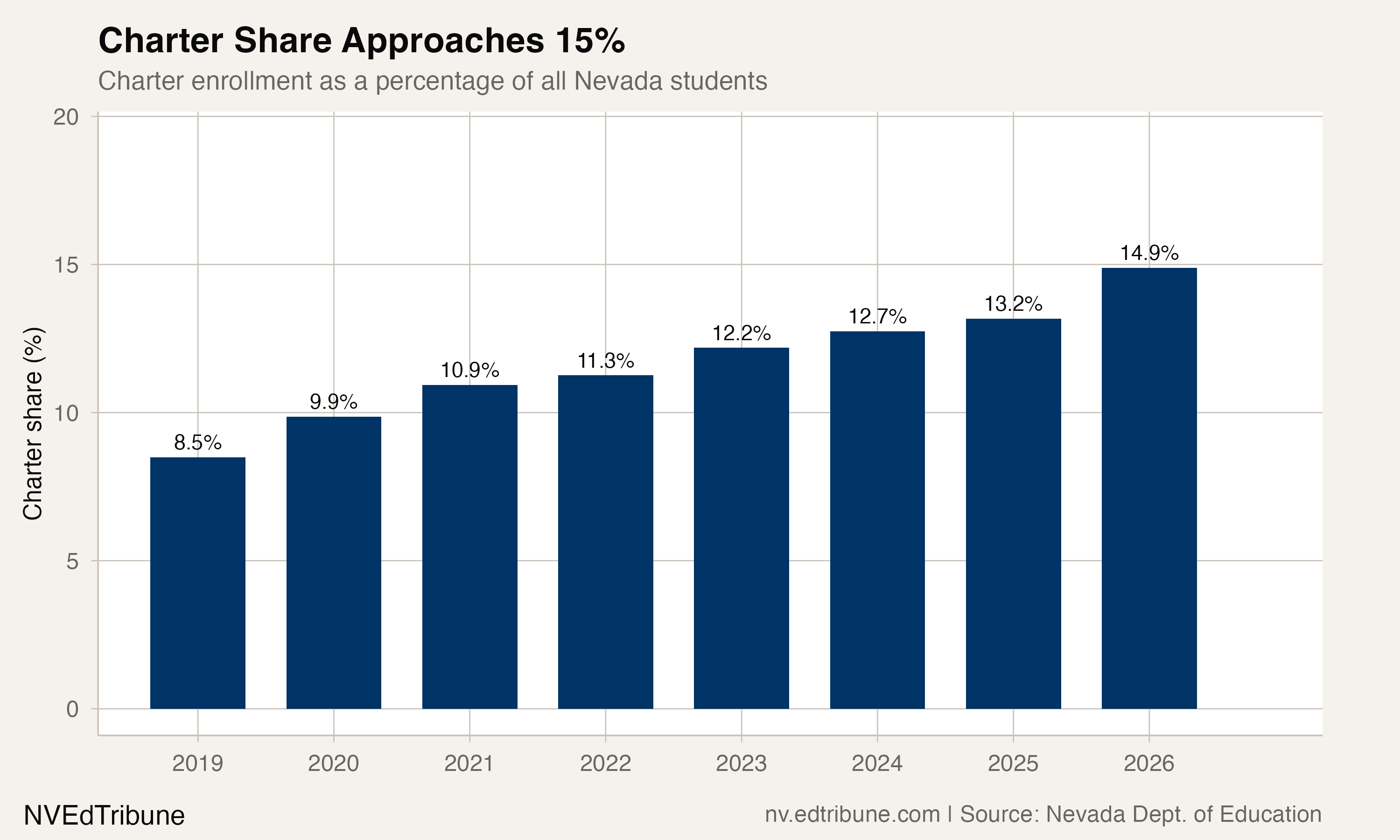
The charter share of Nevada's total enrollment rose from 8.5% in 2019 to 14.9% in 2026. The number of charter entities nearly doubled from 29 to 51. In 2026 alone, nine new charter entities appeared in the data, collectively enrolling 5,914 students. Six of those were former Clark County School District↗ET-sponsored charters that transferred to SPCSA oversight in January 2025, including Odyssey Charter School (2,391 students) and The Delta Academy (1,315).
That transfer marked CCSD's complete exit from charter school operation. As CCSD's director of charter oversight, Gia Moore, put it: "Now they have the state public charter authority that can best serve them." The shift consolidated virtually all charter oversight under SPCSA, which now functions as the second-largest school system in the state.
The 2026 charter jump, 6,925 students in a single year, was the sector's second-largest annual gain on record. But 5,914 of those students were already enrolled in existing schools that changed authorizers. The organic growth from charters present in both years was 1,691 students, a meaningful but less dramatic figure.
Pinecrest's changing student body
Pinecrest's growth has not simply replicated the demographics of the population it started with. In 2019, 48.3% of Pinecrest students were white. By 2026, that share had fallen to 34.6%. Hispanic enrollment grew from 24.8% to 31.1% of the network. Asian students rose from 8.5% to 12.8%.
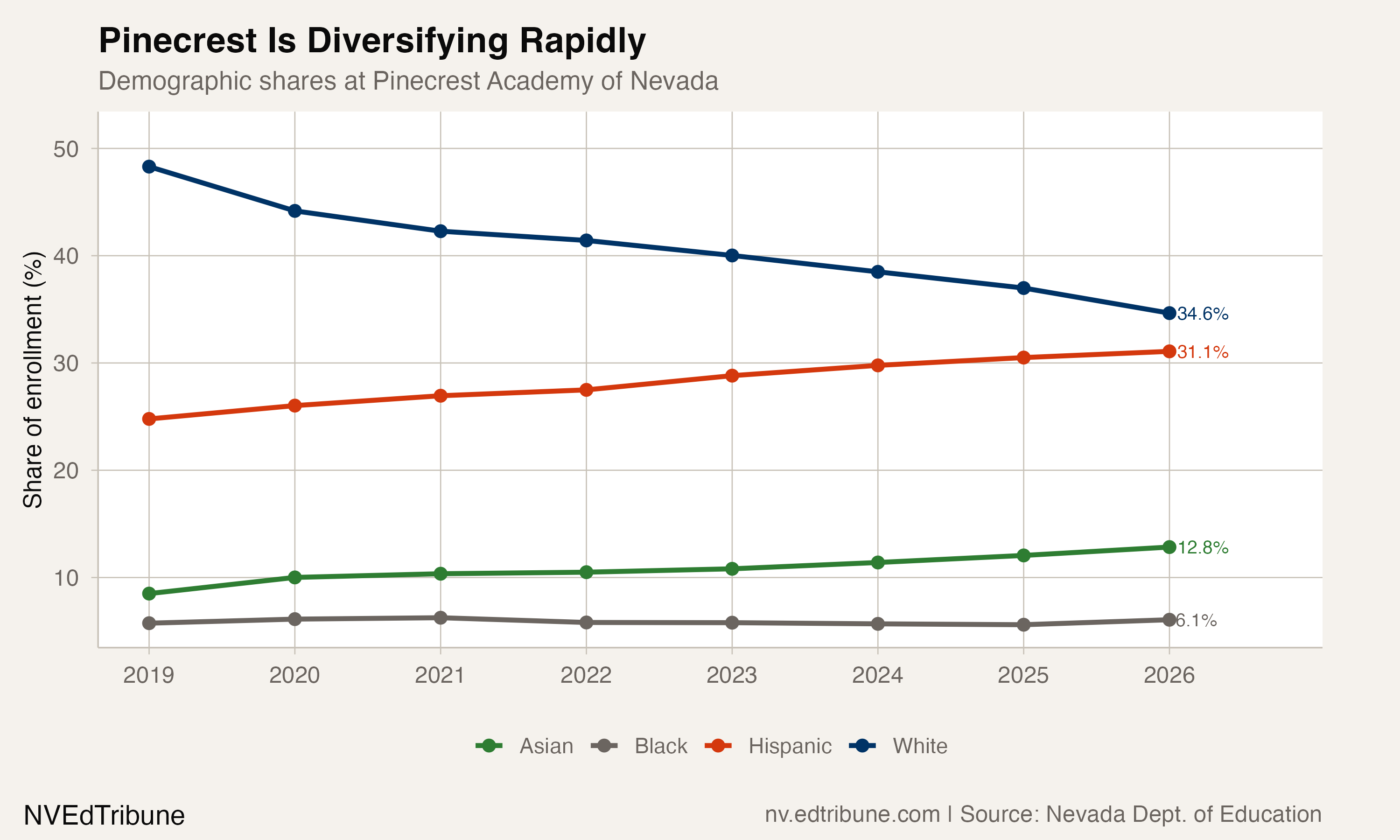
The diversification complicates a common critique of charter schools as enclaves for white and affluent families. Pinecrest's white share is now close to Clark County's overall profile. Mater Academy, by contrast, serves a predominantly Hispanic population: 83.5% of its 5,297 students identify as Hispanic, with white students comprising just 3.0%. Coral Academy splits more evenly, with 27.7% white, 31.7% Hispanic, and 17.7% Asian.
The charters growing fastest in Nevada are not monolithic. They serve different communities through different models, from Mater's STEAM-focused east Las Vegas campuses to Pinecrest's K-12 network across Henderson and the broader valley. What they share is sustained enrollment demand in a state where traditional district enrollment has fallen in five of six years since 2020.
The other side of the ledger
Nevada's traditional sector lost 53,160 students between 2019 and 2026, an 11.7% decline. Clark County alone shed 43,746 students, including 14,451 in 2025-26, its largest single-year drop. The charter sector added 28,201 students over the same period, meaning charters absorbed the equivalent of about 53% of traditional losses, though the relationship between the two is not a simple transfer.
Some charter growth reflects new families choosing charters over traditional schools. Some reflects families leaving Clark County entirely, with charters retaining a higher share of a shrinking population. A $51 million federal grant to support 27 charter schools, the largest U.S. Department of Education grant ever awarded to a Nevada nonprofit, signals that the expansion infrastructure is in place for continued growth.
The convergence of Pinecrest and Somerset will test whether the charter sector's growth model has a ceiling. Somerset's near-flat enrollment suggests a plateau that Pinecrest has not yet reached. Whether Pinecrest's trajectory bends downward as it approaches 9,000-10,000 students, or whether it sails past Somerset into five figures, will say something about the depth of unmet demand for charter seats in the Las Vegas valley.
Detailed code that reproduces the analysis and figures in this article is available exclusively to EdTribune subscribers.
Discussion
Sign in to join the discussion.
Loading comments...