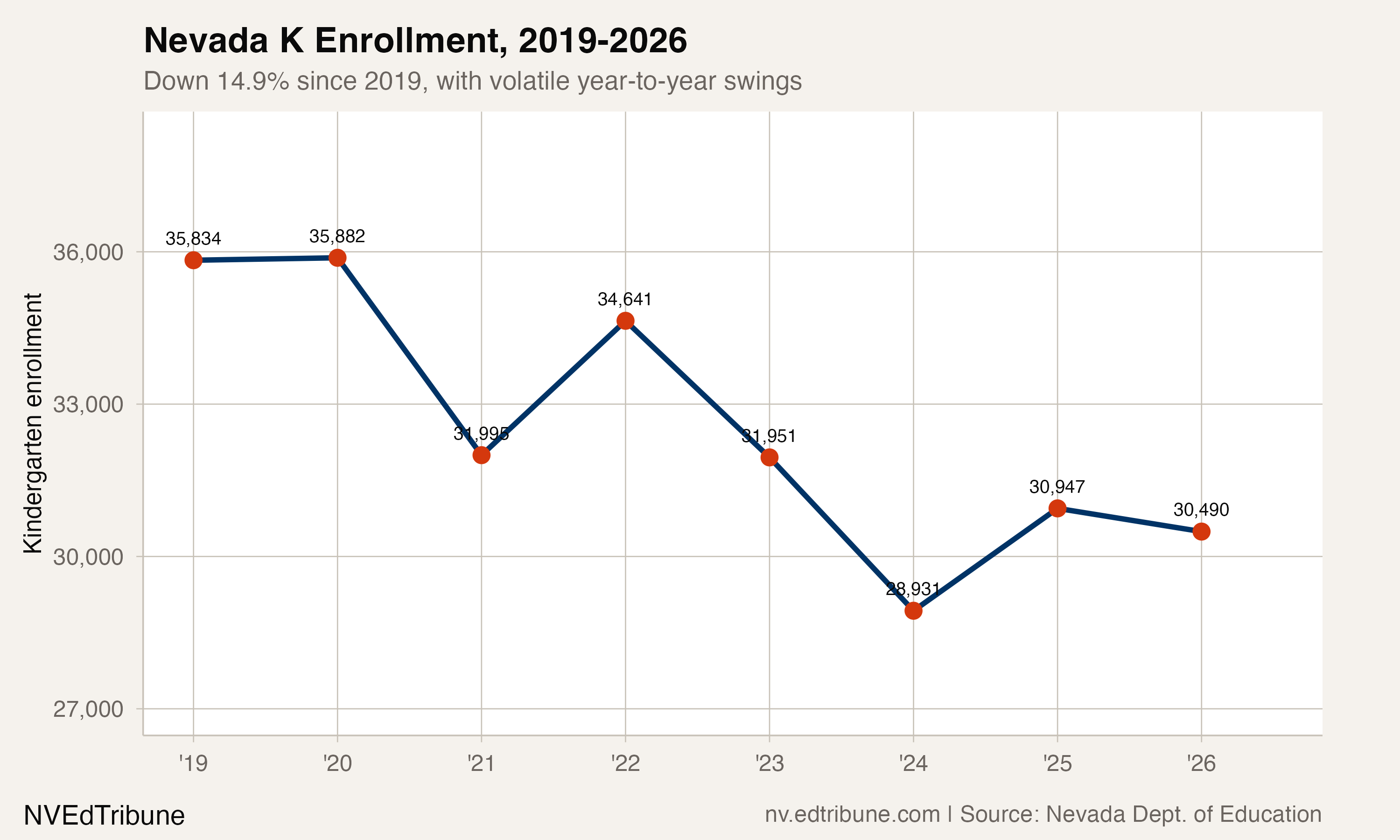
Nevada enrolled 30,490 kindergartners in 2025-26. It enrolled 37,730 twelfth graders. That gap of 7,240 students is not a one-year anomaly. It is the structural reality of a school system that has been losing more students at the front door than it graduates at the back for five consecutive years.
Since 2018-19, kindergarten enrollment has fallen 14.9%, a loss of 5,344 students. Over the same period, 12th grade enrollment grew 11.5%, adding 3,884 students. The result is a pipeline inversion: every grade from kindergarten through eighth lost students since 2019, while every high school grade gained them. Nevada's K-12 system is not just shrinking. It is aging.
A lopsided system
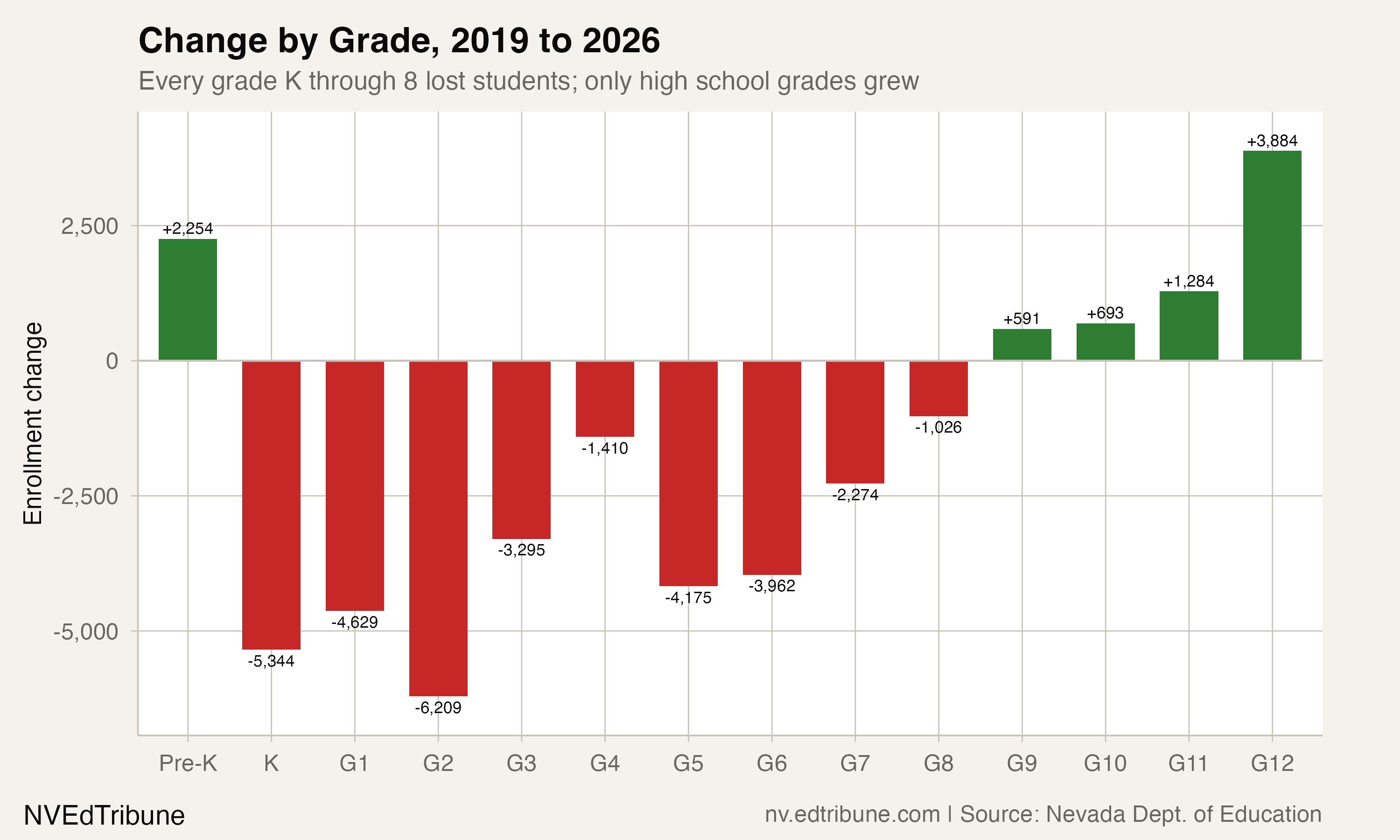
The enrollment change by grade since 2019 tells the story of two different school systems occupying the same state. Grades PK through 5 shed 22,808 students, a 9.8% decline. Grades 6 through 12 lost just 810, a 0.3% dip that rounds to stagnation.
Second grade took the hardest hit of any single grade, losing 6,209 students (17.0%). Kindergarten lost 5,344 (14.9%). First grade lost 4,629 (12.8%). The losses get smaller with each step up the grade ladder, then flip to gains at ninth grade. Twelfth grade's 3,884-student increase is the mirror image of kindergarten's collapse.
This pattern is not random. It is a demographic wave working its way through the system. The 2019 kindergarten cohort, 35,834 students strong, has retained 101.2% of its enrollment through seventh grade in 2026. Students do not disappear once they enter; the system holds them. The problem is that fewer are entering.
Where the pipeline broke
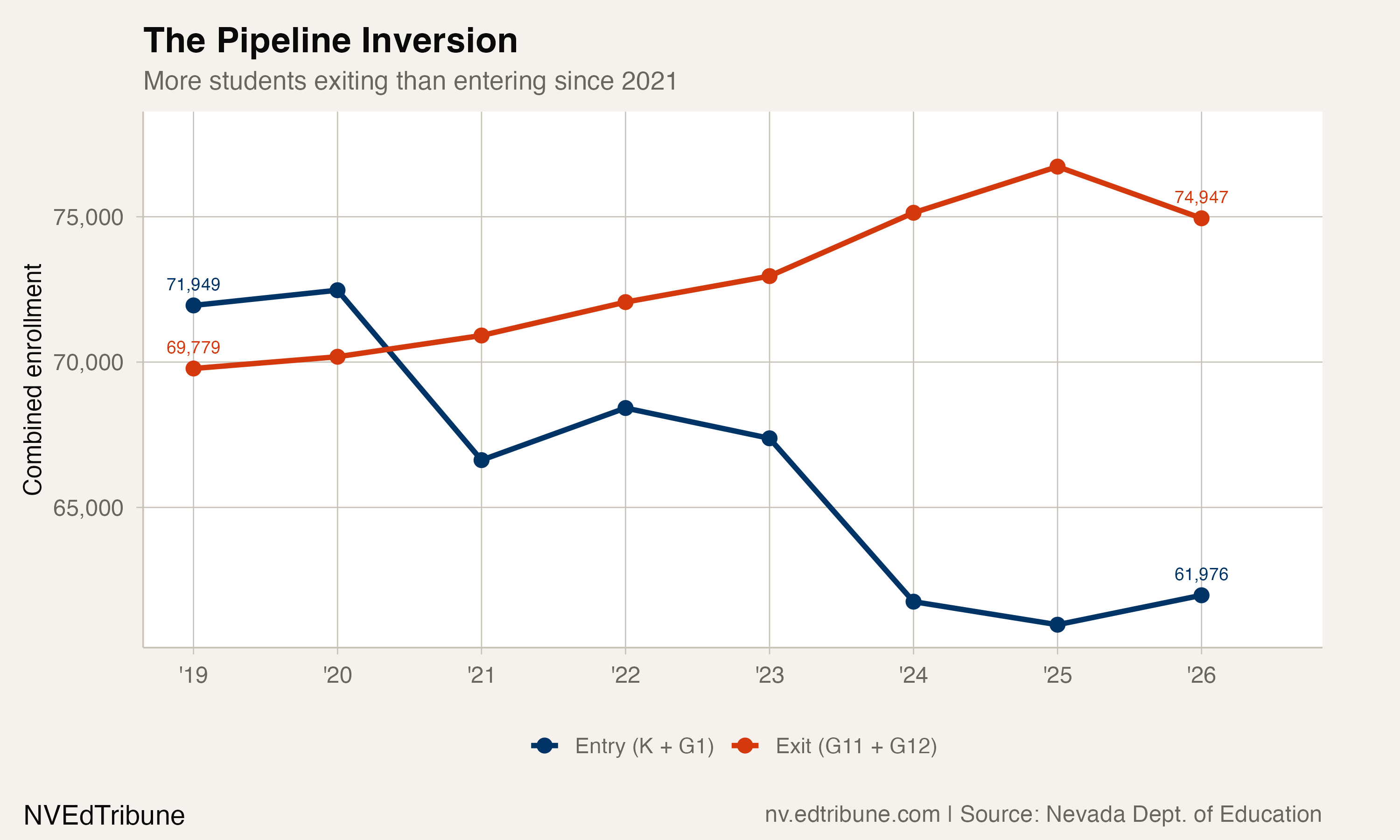
The combined enrollment of kindergarten and first grade exceeded that of 11th and 12th grade by 2,170 students in 2019. By 2021, that relationship had reversed. In 2025, the exit cohort exceeded the entry cohort by 15,762 students, the widest gap in the dataset.
The deficit narrowed slightly to 12,971 in 2026, but the direction has not changed in five years. Nevada's school system is now consistently graduating more students than it takes in at the bottom.
The fiscal math is straightforward. Clark County School District↗ET receives $9,051 per student in base state funding. Each year that the kindergarten class is smaller than the graduating class, the district loses funding for the difference. CCSD's current kindergarten cohort of 17,618 is nearly 30% smaller than its senior class of 24,505, a gap of 6,887 students worth roughly $62 million in annual funding.
Clark County is the whole story
Of the 5,344 kindergartners Nevada lost between 2019 and 2026, 5,317 disappeared from Clark County. The rest of the state, collectively, lost 27.
Clark County's kindergarten enrollment fell 23.1%, from 22,995 to 17,678. Washoe County↗ET lost 760 kindergartners (14.9%), but that decline was offset by stability or growth elsewhere in northern and rural Nevada. The net effect outside Clark: essentially flat.
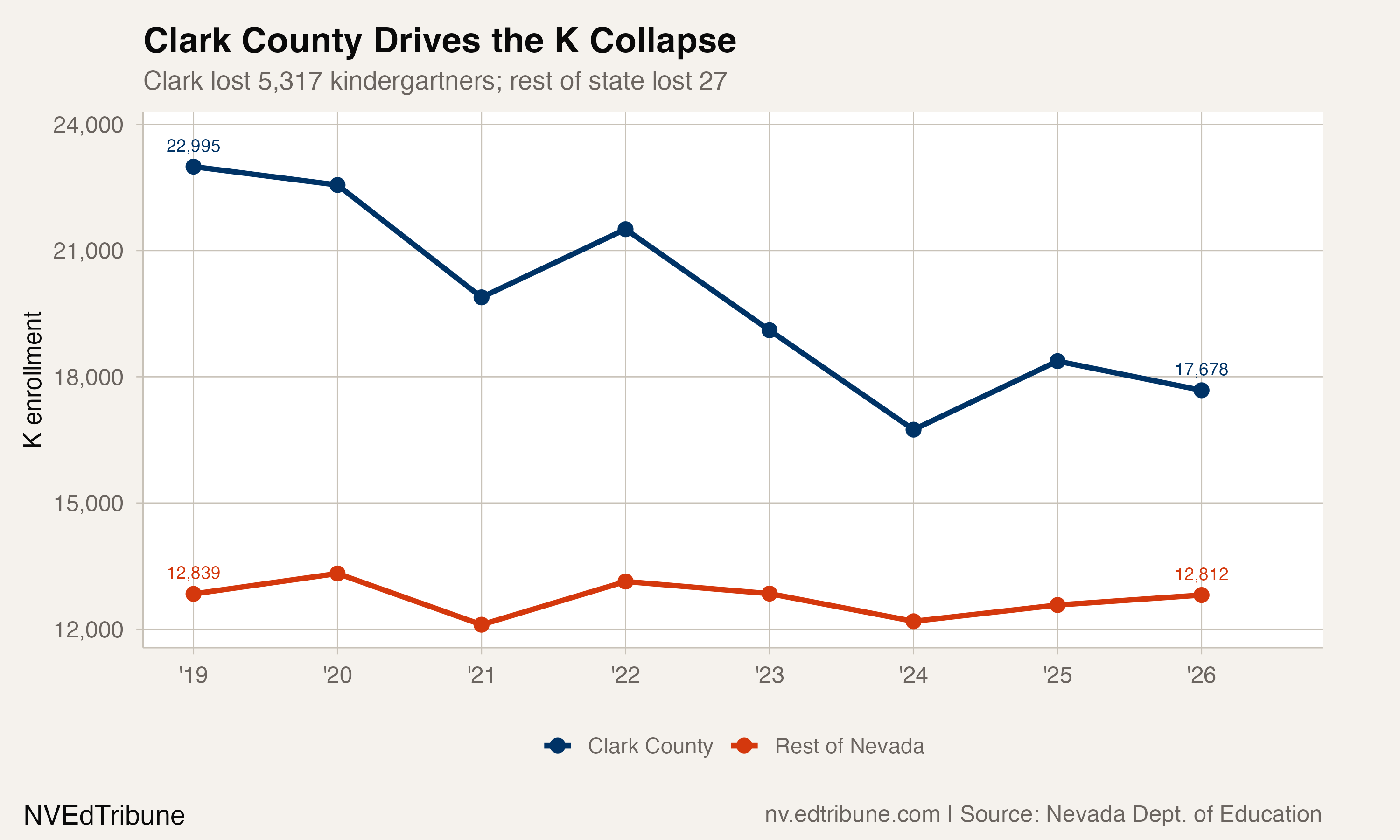
The concentration is striking. Clark County educates about two-thirds of Nevada's students, but it accounted for 99.5% of the state's kindergarten losses. This is not a statewide demographic shift playing out evenly. It is overwhelmingly a Clark County phenomenon.
CCSD Superintendent Jhone Ebert framed the scale for state lawmakers: "My graduating class last year was 24,000 children, with a kindergarten class of 17,000 children," she told the legislature. The district projects losing approximately 5,000 students per year over the next two years.
The budget consequences are already materializing. CCSD announced that 284 of its 375 schools face budget reductions for 2026-27, with $50 million less in available school funding. More than 1,200 positions have been identified as surplus.
Birth rates, not departures
The most likely driver of the kindergarten collapse is that Nevada is producing fewer children. According to a Pew Research analysis, the state's fertility rate fell 17.2% from 2011 to 2023, roughly 6.6 percentage points steeper than the national average decline. Nevada recorded approximately 51 births per 1,000 women in 2023, its lowest rate in 30 years, and the nation's fifth-largest drop over the past decade.
Clark County births fell from over 30,000 in 2007 to approximately 24,000 in 2024, a decline that tracks almost exactly with the kindergarten enrollment curve five years later. The children who would have been in kindergarten in 2025-26 were born in 2019 and 2020, years when Clark County births were already well below their peak.
One competing explanation is that families are leaving Nevada or choosing private and homeschool alternatives in larger numbers. But the rest-of-state kindergarten data undermines this. If outmigration or private school choice were the primary driver, the losses would not concentrate so entirely in Clark County. Rural Nevada, which has fewer private school options, would show sharper declines. Instead, rural and northern K enrollment has been essentially flat.
Pre-K is growing in the opposite direction
While kindergarten shrank 14.9%, pre-K enrollment grew 19.4%, from 11,598 to 13,852. The two lines have diverged sharply since 2021.
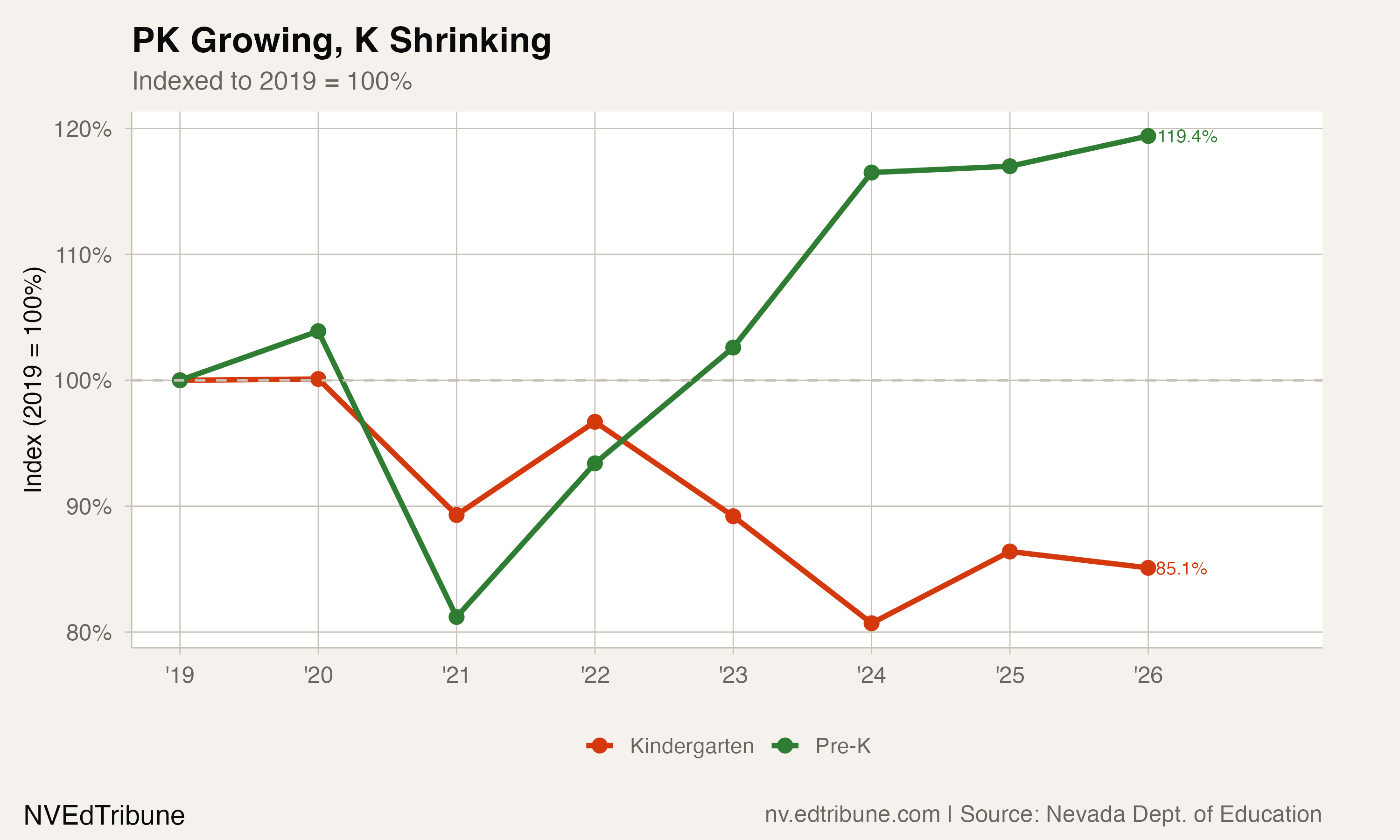
The pre-K expansion reflects deliberate state investment. The Nevada Ready! program, which has operated since 2001, nearly doubled its free pre-K seats from approximately 3,200 students in 2024-25 to nearly 5,900 in 2025-26. The legislature approved over $76 million for the next two years and expanded income eligibility from 200% to 250% of the federal poverty line. The program is projected to grow to approximately 8,500 seats by 2026-27.
But expanding pre-K does not rebuild the kindergarten pipeline. Pre-K enrollment is a measure of access and policy priority. Kindergarten enrollment is a measure of how many five-year-olds exist. Nevada can serve a growing share of its four-year-olds through public pre-K while the absolute number of children entering kindergarten continues to fall.
The ratio of kindergartners to the previous year's pre-K class illustrates the disconnect. In 2020, there were 309 kindergartners for every 100 pre-K students the year before, reflecting the fact that most children entering K had no public pre-K experience. By 2026, that ratio fell to 225. More pre-K students, fewer kindergartners.
The sawtooth and what it hides
Nevada's kindergarten trend line is not a smooth decline. It is a sawtooth: sharp drop in 2021, partial rebound in 2022, another drop in 2023, a record low of 28,931 in 2024, then a partial rebound to 30,947 in 2025 before falling again to 30,490 in 2026. The oscillation is unusual for a demographic metric.
The volatility may partly reflect pandemic-era disruption in kindergarten entry timing. Nevada's compulsory school age begins at six, not five, which means kindergarten attendance is not legally required. Some families may have delayed kindergarten entry during 2020-21 (producing the sharp drop) and enrolled the following year (producing the 2022 rebound). The alternating pattern in 2023-2026 is harder to explain with timing alone and likely reflects the underlying birth rate decline asserting itself.
What the sawtooth obscures is the floor. The 2024 low of 28,931 and the 2026 reading of 30,490 are the two lowest kindergarten counts in the eight-year dataset. Whether the next reading rises or falls, both are well below the 35,000+ level that prevailed before the pandemic.
What comes next
The pipeline inversion guarantees that Nevada's total enrollment will continue declining for at least four to five more years, even if kindergarten enrollment stabilizes tomorrow. The small cohorts now in first and second grade will replace larger 2025-26 middle and high school cohorts. PK-5 enrollment, already down 9.8%, has further to fall. Grades 6-12, which have been essentially flat, will begin declining as the smaller elementary cohorts reach them.
For Clark County, the arithmetic is particularly unforgiving. The district will lose approximately $50 million in funding for 2026-27, with further reductions likely each subsequent year as the enrollment gap between entering and exiting classes persists. The 284 schools facing budget cuts in 2025-26 may be a permanent condition, not a temporary adjustment.
UNLV economist Stephen Miller projects Clark County will exceed 3 million residents by 2060. But the newcomers are not five-year-olds. They are retirees, remote workers, and young professionals drawn by Nevada's tax advantages. Clark County is already living the paradox of a growing county with a shrinking school district. The kindergarten numbers say it will keep living it for a while.
Detailed code that reproduces the analysis and figures in this article is available exclusively to EdTribune subscribers.
Discussion
Sign in to join the discussion.
Loading comments...