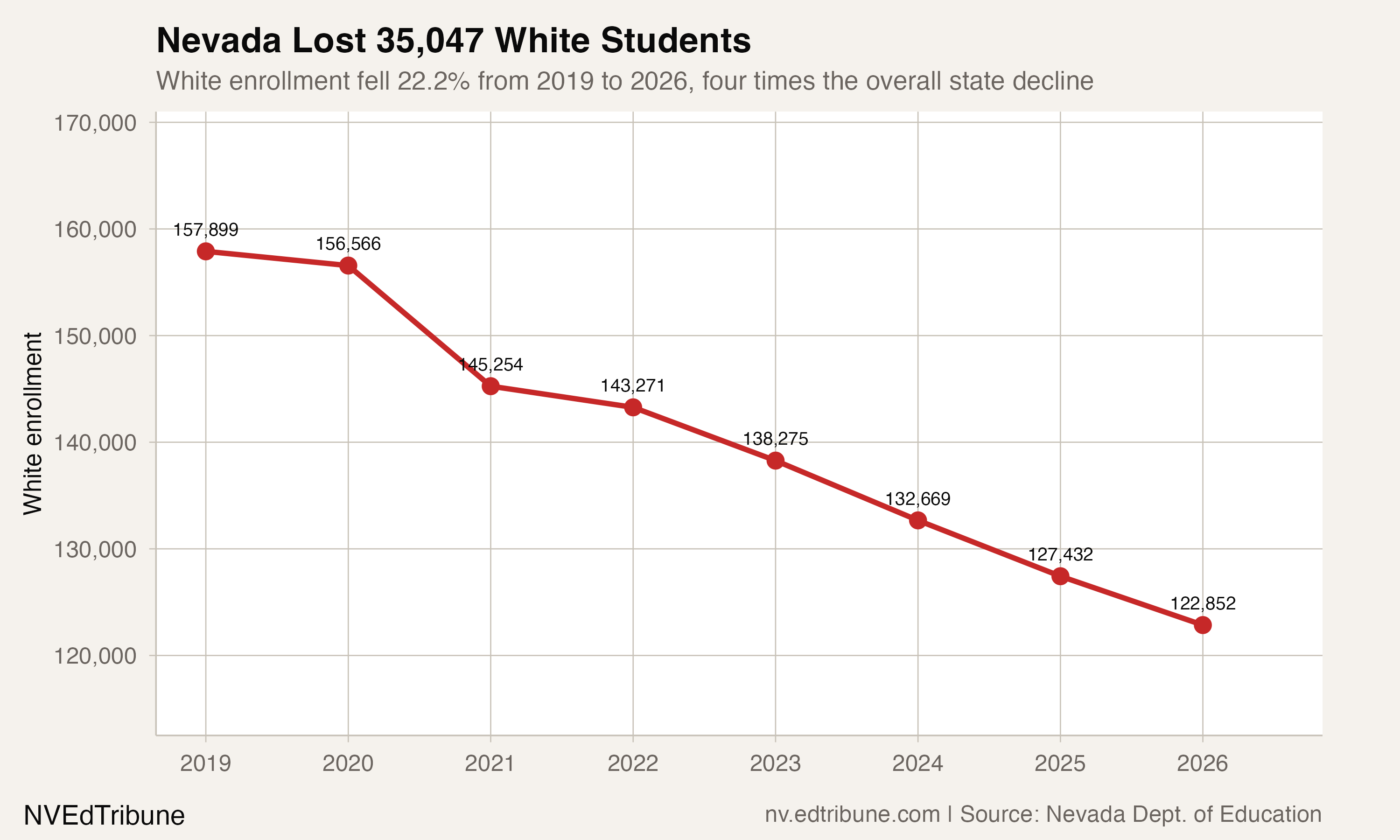
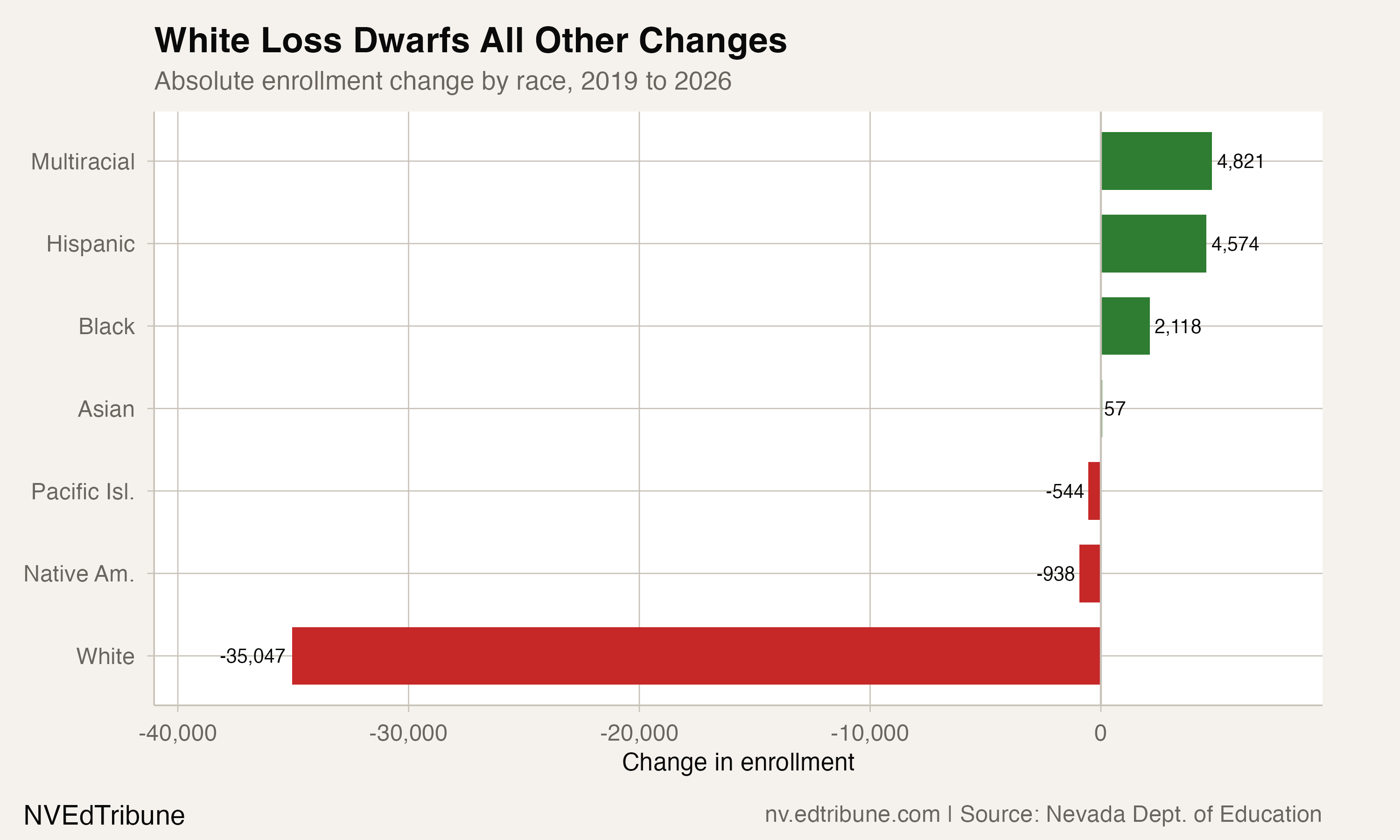
Nevada's public schools lost 24,959 students between 2019 and 2026. White students alone account for 35,047 of that loss, a 22.2% decline. The math only works because other groups partially offset the drop: Hispanic enrollment grew by 4,574, Black by 2,118, and multiracial by 4,821. Strip out those gains, and the white exodus would have left Nevada with a far deeper enrollment crater.
The decline is not proportional. Nevada's overall enrollment fell 5.0%. White enrollment fell four times faster. In the state's two largest school systems, the shift is redrawing the demographic map. Clark County School District↗ET now enrolls fewer than one in five white students. In Washoe County School District↗ET, Hispanic students overtook white students for the first time in 2022 and have widened the gap every year since.
35,000 students, seven years
White enrollment stood at 157,899 in the 2018-19 school year. By 2025-26, it had fallen to 122,852. The losses were not concentrated in a single year. After a modest 1,333-student dip in 2020, the COVID disruption of 2021 accelerated the decline to 11,312 in a single year, a 7.2% drop. The following year brought a smaller loss of 1,983. But beginning in 2023, losses settled into a steady 4,000 to 5,600 per year, a sustained annual rate of 3.5% to 4.1%.
White share of total enrollment fell from 31.7% to 25.9% over the same period, a 5.8 percentage-point drop. Hispanic share rose from 42.7% to 45.9%. Black enrollment held roughly steady in share terms at 12.4%, though it grew by 2,118 students in absolute terms. The multiracial category grew the fastest in percentage terms, up 14.7%, adding 4,821 students.
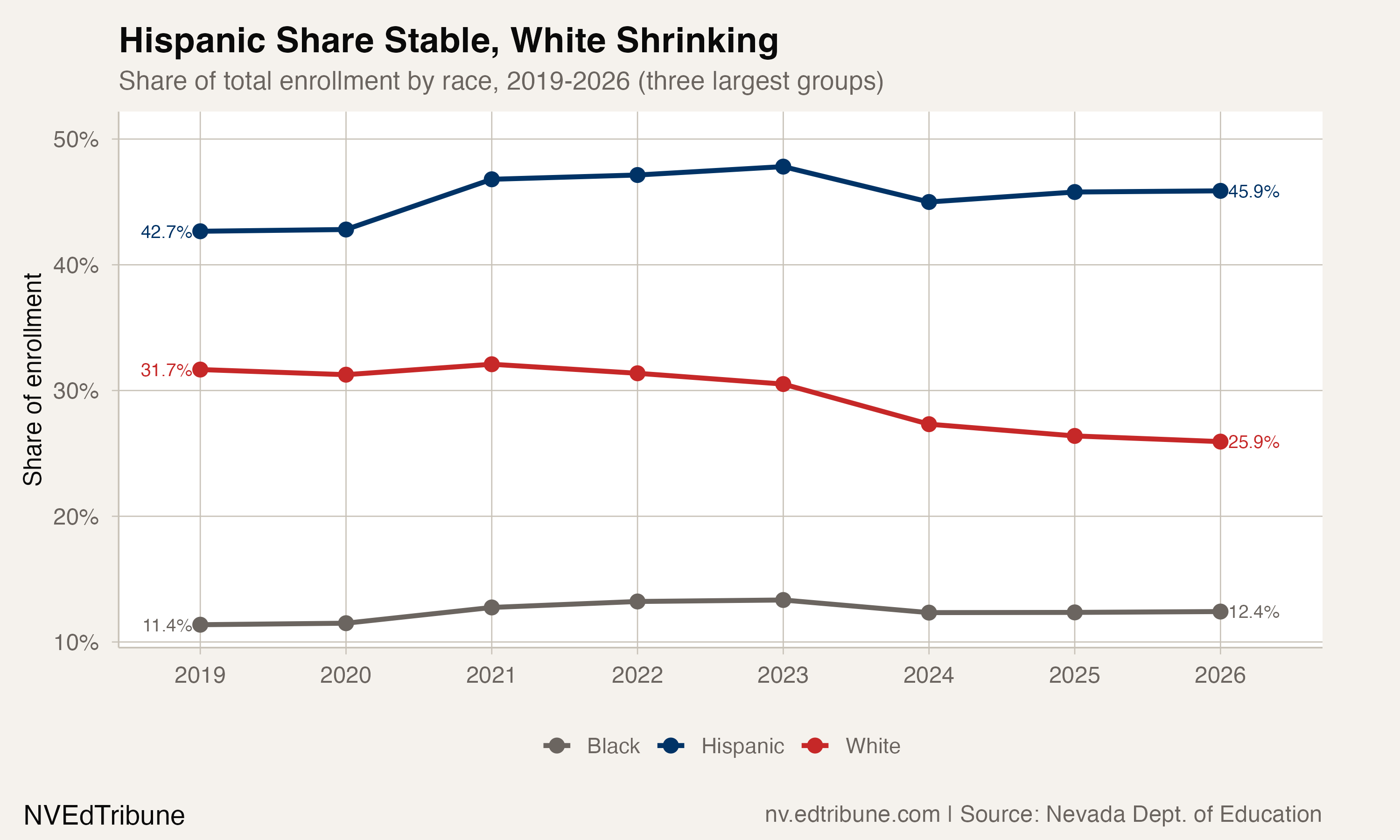
A caveat on the share data: Nevada's multiracial enrollment figures are missing entirely for 2021 through 2023, which inflates other groups' apparent shares in those years by roughly seven percentage points. The share spike visible in the chart during those years is an artifact of this gap. The absolute student counts for all groups, including white, are unaffected.
Clark County carries the weight
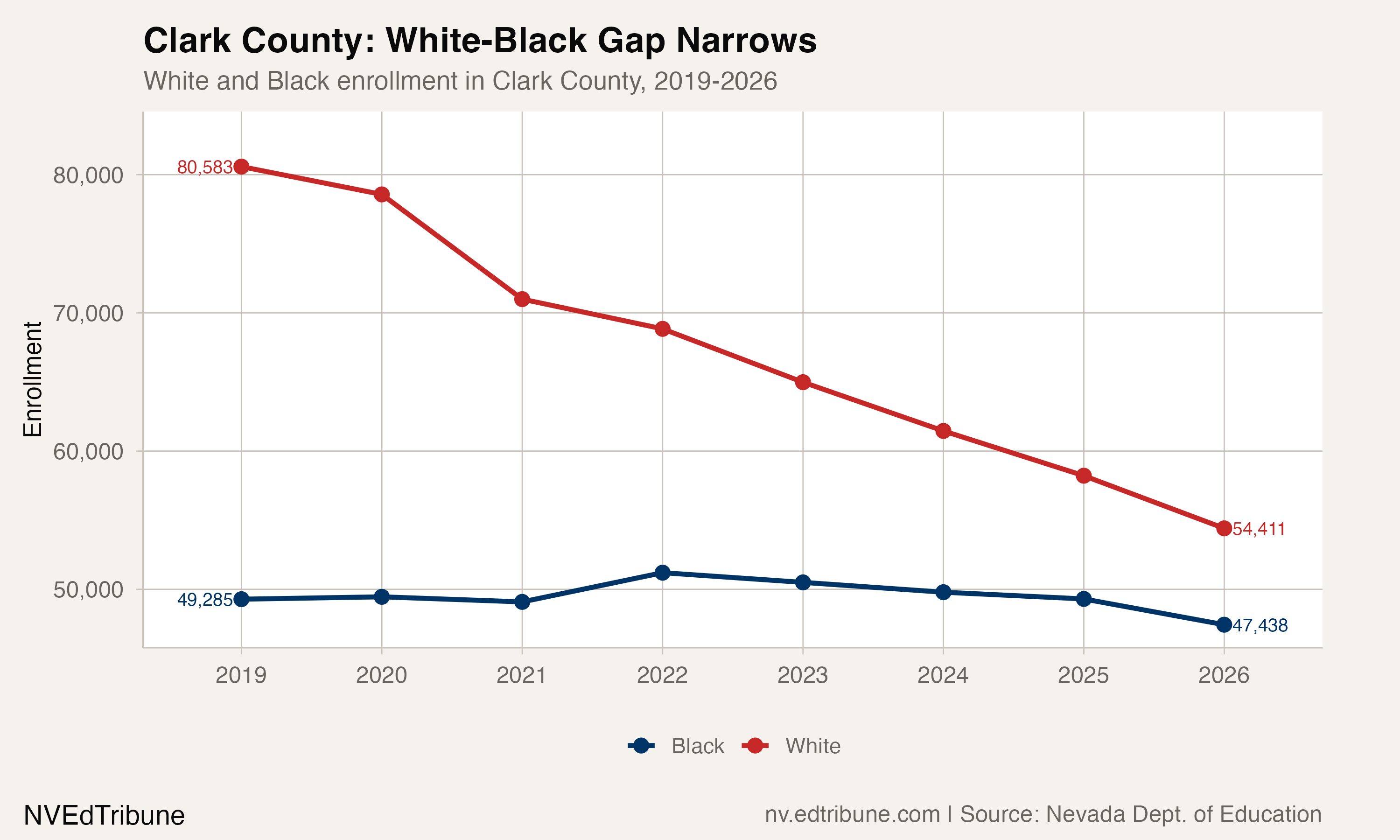
Three-quarters of the statewide white loss, 26,172 students, came from Clark County alone. White enrollment in the nation's fifth-largest district fell from 80,583 to 54,411, a 32.5% decline that outpaces the state rate by 10 percentage points.
The concentration makes sense given the math. Clark County enrolled 51% of Nevada's white students in 2019 and still enrolled 44% in 2026. But the rate of decline there is steeper than elsewhere. White students made up 24.0% of Clark County enrollment in 2019. By 2026, that share had fallen to 18.7%.
The gap between white and Black enrollment in Clark County narrowed from 31,298 students to 6,973 over this period. White enrollment fell by 26,172 while Black enrollment dipped by 1,847. At the current rate, Black enrollment in Clark County will surpass white within three to four years.
Washoe's quiet crossover
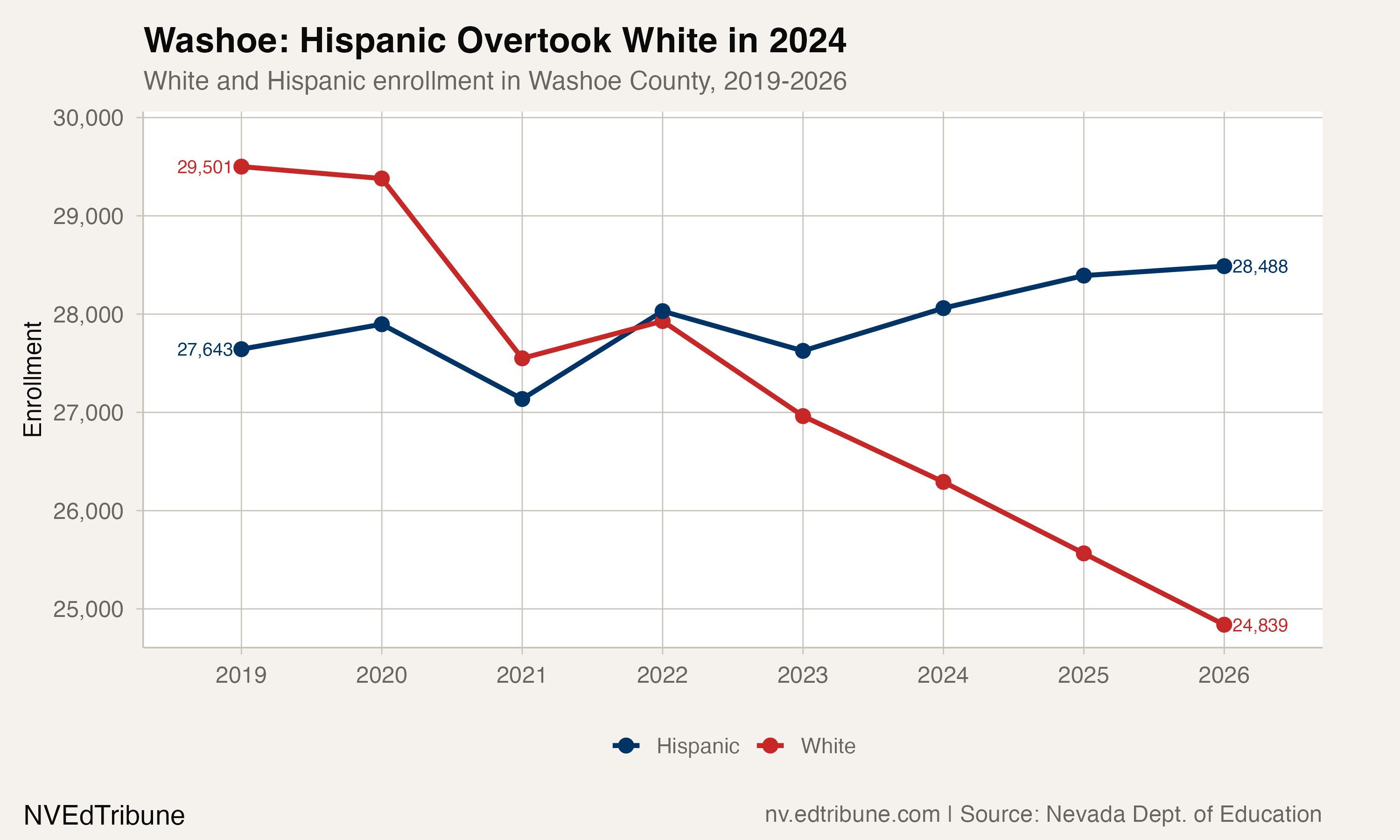
In Washoe County, the state's second-largest traditional district, Hispanic students overtook white students in 2022. The gap was narrow that year: 28,030 Hispanic to 27,929 white, a difference of 101 students. By 2026, it had widened to 3,649 students (28,488 Hispanic vs. 24,839 white). Washoe lost 4,662 white students over the seven-year period, a 15.8% decline, while Hispanic enrollment grew by 845.
Only 12 of Nevada's 19 county districts still have a white enrollment majority. The largest of these is Lyon County, where white students make up 56.4% of 9,060 total students. Clark County (18.7%) and Washoe County (39.0%) are both majority-minority. The 12 white-majority counties enroll a combined 33,951 students, roughly 7% of the state total.
Fewer white children being born, more families leaving
Two forces are compressing white enrollment simultaneously.
The first is demographic. Nevada's fertility rate fell 17.2% between 2011 and 2023, the fifth-steepest decline among states, driven in part by steep drops in teenage pregnancies and declining birth rates among all racial groups. The kindergarten pipeline reflects this: Clark County projects an incoming kindergarten class of approximately 17,000 students against a graduating class of 23,000. White families, who tend to be older on average and have lower fertility rates nationally, are disproportionately affected by this trend.
The second is school choice. Nevada's charter sector has grown from roughly 11,000 students to over 70,000 since the State Public Charter School Authority was founded in 2011, according to The Nevada Independent. But charter growth does not fully explain the white decline, because white enrollment is falling in charters too: white share of charter enrollment dropped from 40.1% in 2019 to 25.1% in 2026. Whatever is pulling white families out of traditional public schools is not depositing them in charter schools at the same rate.
Part of the explanation may be exits from public education entirely. Private school enrollment, homeschooling, and interstate out-migration all likely contribute, though Nevada does not track these transitions comprehensively. The state passed open enrollment legislation in 2025 allowing easier intra-district and inter-district transfers, but that policy shuffles students within the public system rather than explaining exits from it.
What reporting suggests
The fiscal consequences are already visible. Clark County faces a $50 million budget shortfall for 2026-27, driven by enrollment loss and rising employee costs:
"Once you get to 35-40 kids in a class, it's crowd control. It's not a good environment for learning." — Rebecca Dirks Garcia, president-elect of the Nevada Parent Teacher Association, News3LV, January 2026
The district has identified more than 1,200 positions as surplus for next school year, including 682 licensed employees, 500 support professionals, and 64 administrators. Only 595 vacant positions exist to absorb them.
"I've talked to people at elementary schools where now they're assuming that there's going to be 39 kids in a fifth-grade class." — News3LV, February 2026
The charter sector's growth only deepens the budget math. Traditional districts lose per-pupil funding for every student who transfers. Charter schools in Nevada demonstrated nearly 12 percentage points higher reading rates than the statewide public school average in 2024-25, giving families an academic rationale that compounds the demographic shift.
The multiracial question
The multiracial category deserves separate attention. It grew by 4,821 students (14.7%) between 2019 and 2026, the fastest percentage growth of any race group. Some of that growth may represent genuine demographic change as interracial families become more common. But some fraction likely reflects reclassification: students who would previously have been counted as white now identifying as multiracial. If a meaningful share of the "white decline" is actually a shift into the multiracial category, the true departure of white-identifying families from Nevada schools is smaller than 35,047. The data cannot distinguish between these explanations.
What comes next
White enrollment in Nevada's public schools is now where Hispanic enrollment was in 2019 relative to the total: roughly one-quarter. The state is seven years into a demographic transformation that shows no sign of decelerating. If white losses continue at the post-2022 pace of 4,000 to 5,600 per year, Nevada's public schools will enroll roughly 100,000 white students by the end of the decade, half of where they stood in 2019.
Districts that lose enrollment lose funding. The districts losing the most white students, Clark and Washoe, are also the ones where English learner enrollment, bilingual program demand, and specialized instructional needs are concentrated. Per-pupil funding does not distinguish between a classroom of native English speakers and one where half the students need bilingual support. Clark County lost 26,172 white students in seven years. It did not lose any of the instructional complexity that comes with the students who remain.
Detailed code that reproduces the analysis and figures in this article is available exclusively to EdTribune subscribers.
Discussion
Sign in to join the discussion.
Loading comments...