Tuesday, July 14, 2026

The Rural Absenteeism Crisis: Three Nevada Counties Above 34%

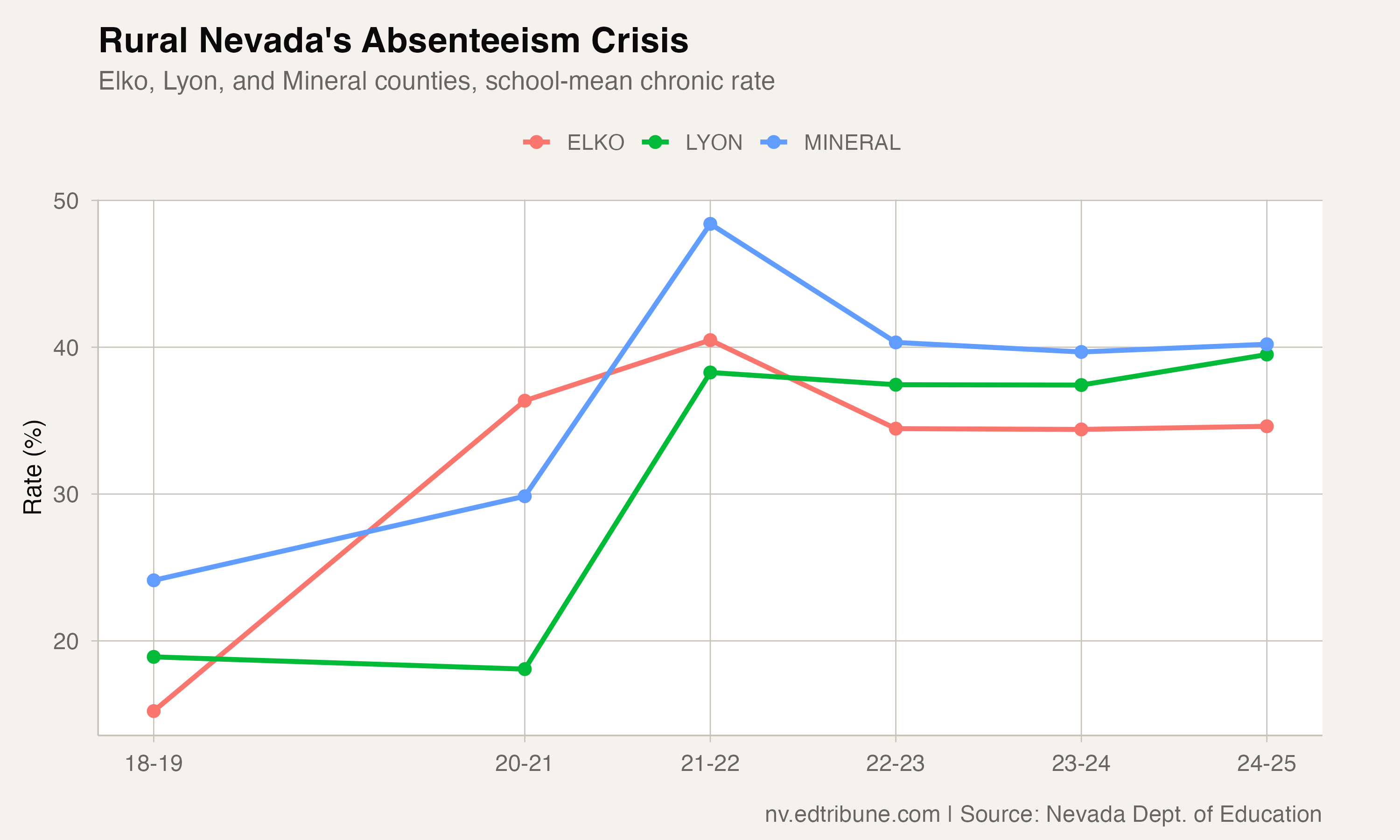
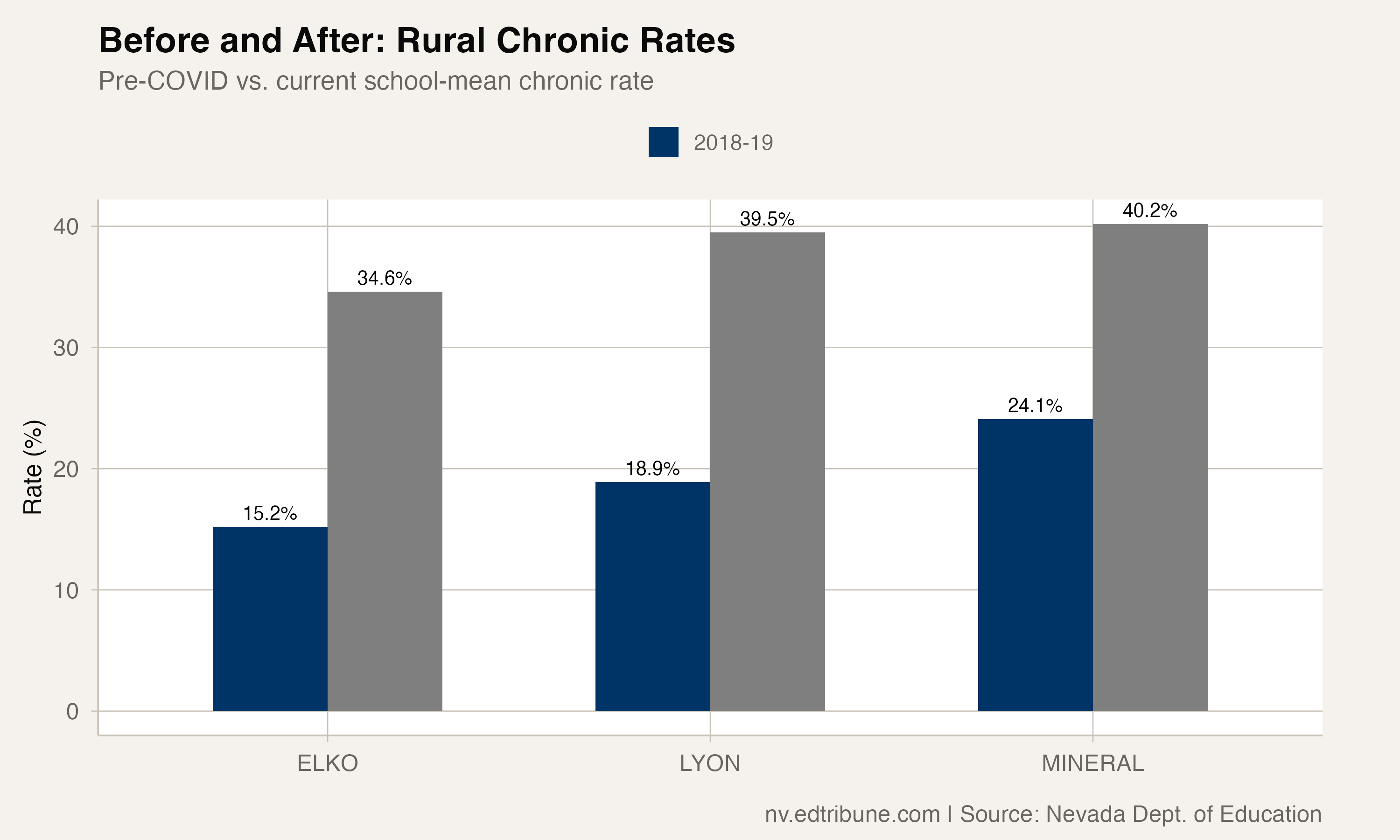
Elko, Lyon, and Mineral counties have chronic rates of 34.6%, 39.5%, and 40.2% respectively, all more than double their pre-COVID levels.

At Owyhee High School in Elko County, 59.5% of the 89 students were chronically absent in 2024-25. The school serves the Duck Valley Indian Reservation on the Nevada-Idaho border, more than 100 miles north of the city of Elko on a two-lane highway. On any given school day, more students have missed enough school to be considered chronically absent than have not.

Owyhee is an extreme case, but it exists on a spectrum that defines rural Nevada's attendance crisis. Three counties -- ElkoET, LyonET, and MineralET -- all have school-mean chronic absenteeism rates above 34%, all more than double their pre-COVID levels. Each faces a distinct version of the same structural problem: the barriers to getting to school every day are harder to overcome in places where distances are longer, services are fewer, and alternatives are thinner.

Chronic absenteeism trends for Elko, Lyon, and Mineral counties

Three districts, three trajectories

The numbers look similar but the paths diverge. Elko CountyET (9,809 students, 28 schools) surged from 15.2% pre-COVID to 40.5% at peak and has plateaued around 34.5% since 2022-23. The district's rate has barely moved in three years: 34.5%, 34.4%, 34.6%. Recovery stalled.

Lyon CountyET (9,047 students, 18 schools) went from 18.9% pre-COVID to 38.3% at peak. But unlike Elko, Lyon has not stabilized. Its rate continued climbing: 37.4% in 2022-23 and 2023-24, then 39.5% in 2024-25, a new all-time high.

Mineral CountyET (594 students, 4 schools) spiked highest of all, reaching 48.4% in 2021-22 before declining to 40.2%. The smallest of the three, Mineral's data is the most volatile, but the current rate remains 16.1 points above its pre-COVID 24.1%.

Pre-COVID vs. current chronic rates for the rural trio

The geography of absence

Rural absenteeism is fundamentally a geography problem layered onto everything else. Elko County spans 17,203 square miles, an area larger than Connecticut and Rhode Island combined, with 28 schools spread across Elko, Spring Creek, Wells, West Wendover, Carlin, Owyhee, and Jackpot. Some families drive 30 to 60 minutes each way. A car that breaks down does not mean a missed bus stop; it means no way to get to school at all.

Lyon County's communities stretch along the I-80 and Highway 50 corridors, with 20 to 40 miles between Fernley, Dayton, Yerington, and Silver Springs. Mineral County's schools in Hawthorne and Schurz serve a population scattered across a high desert county bisected by Walker Lake.

In all three counties, there are no public transit options. There are no Uber drivers. The school bus is the only organized transportation, and it does not reach every home. Nevada ranks 51st nationally for youth mental health access, and the shortage is most acute in these rural communities, where a child having a mental health crisis may face a two-hour drive to the nearest provider.

The school-level picture

The worst-affected schools share a pattern: isolation plus poverty plus high shares of Native American or Hispanic students. In Elko County, the three Owyhee schools on the Duck Valley Reservation average 49.5% chronic absenteeism. The Jackpot schools near the Idaho border average 54%. In Mineral County, Hawthorne Junior High hits 56.4%, and Schurz Elementary (serving the Walker River Paiute community) reaches 36.8%.

But the crisis extends well beyond reservation and border communities. In Elko proper, both the high school (38.5%, 1,433 students) and the middle school (34%, 681 students) exceed 30%. In Lyon County, Fernley High School, the district's largest campus at 1,321 students, has a 46.4% chronic rate.

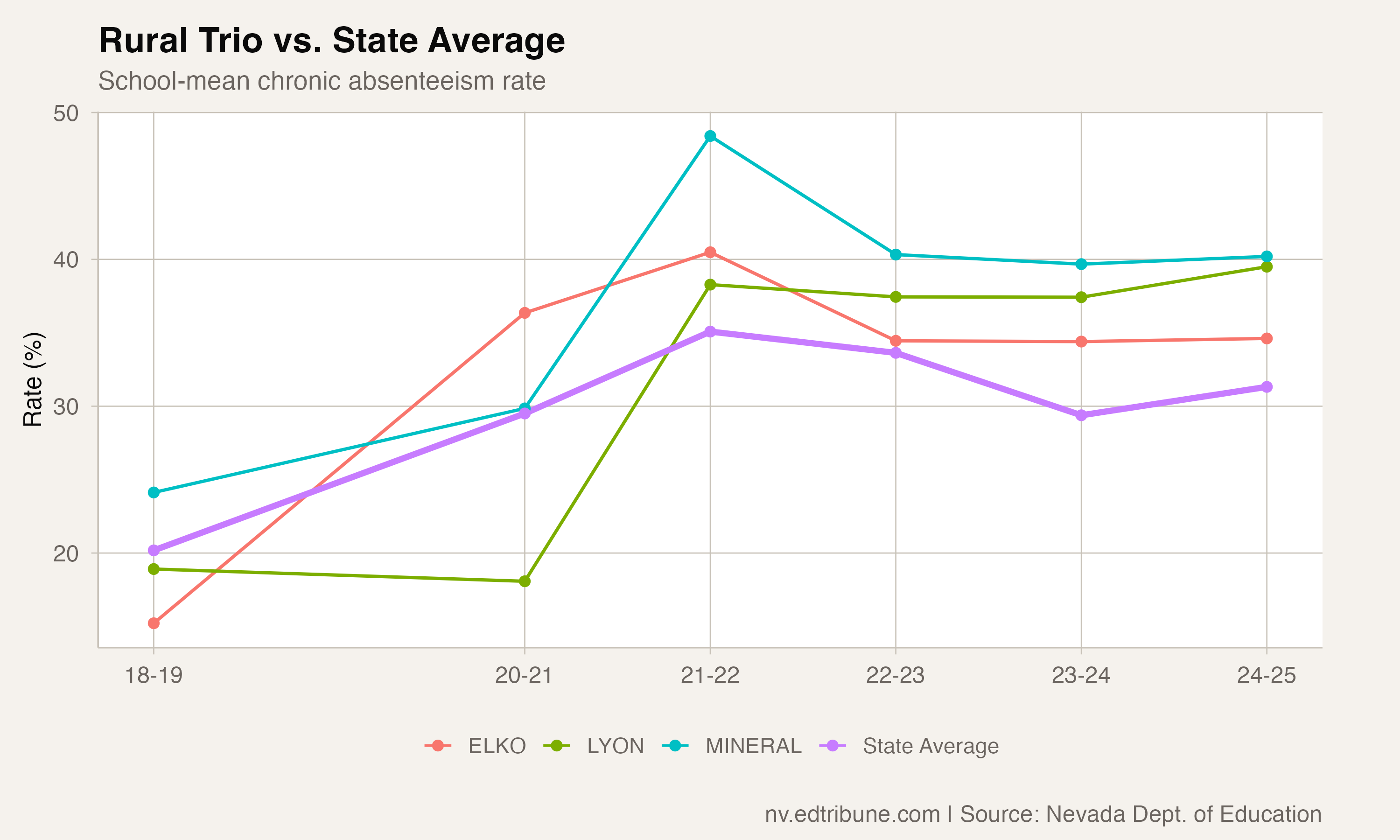
Rural trio compared to state average over time

What rural means for solutions

Urban attendance interventions -- home visit teams, attendance offices, community partnerships -- are designed for density. They struggle in counties where homes are 30 miles apart and a single "home visit" can consume half a day. The scale economics that allow Clark County to run a dedicated attendance office do not work in a district of 594 students spread across two communities.

What might work in rural Nevada is different: transportation solutions (flexible bus routes, gas card programs), telehealth for behavioral health, and community-based approaches that treat the school as the social hub it already is in small towns. But these solutions require funding that rural districts, despite receiving higher per-pupil weights under the Pupil-Centered Funding Plan, often struggle to deploy effectively against the sheer geographic challenge.

Detailed code that reproduces the analysis and figures in this article is available exclusively to EdTribune subscribers.

Discussion

Loading comments...