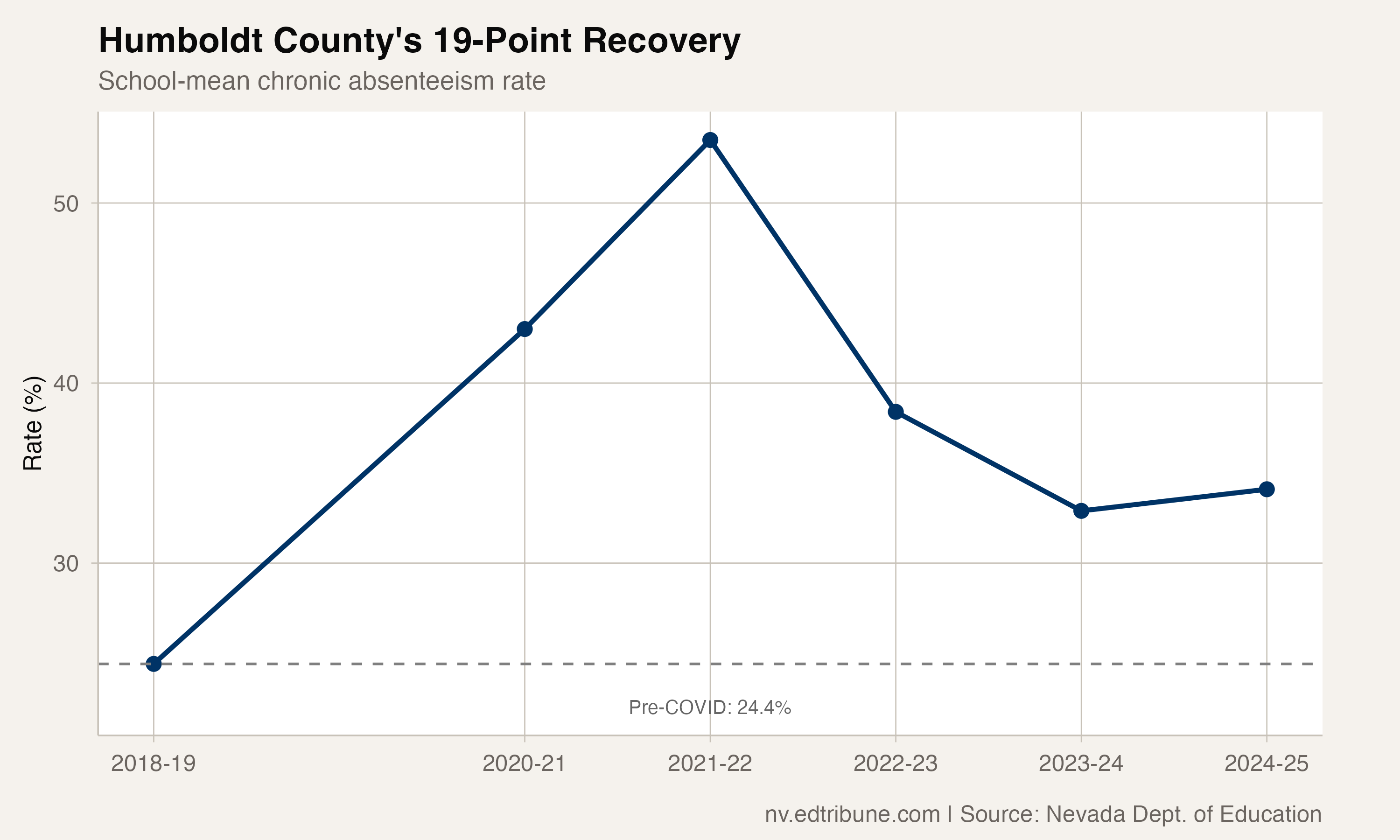
In 2021-22, more than half of all students in Humboldt County School District↗ET were chronically absent. The school-mean chronic rate of 53.5% was the highest of any Nevada district that year, a staggering figure for a rural mining community of 3,334 students in north-central Nevada.
Three years later, the rate stands at 34.1%. That 19.4-point decline is the largest improvement of any Nevada district from its COVID-era peak, nearly double the next-closest recovery. Humboldt County is still well above its pre-COVID rate of 24.4%, but the trajectory is unmistakable: a district that was in free fall has stabilized and begun to recover.
The recovery in context
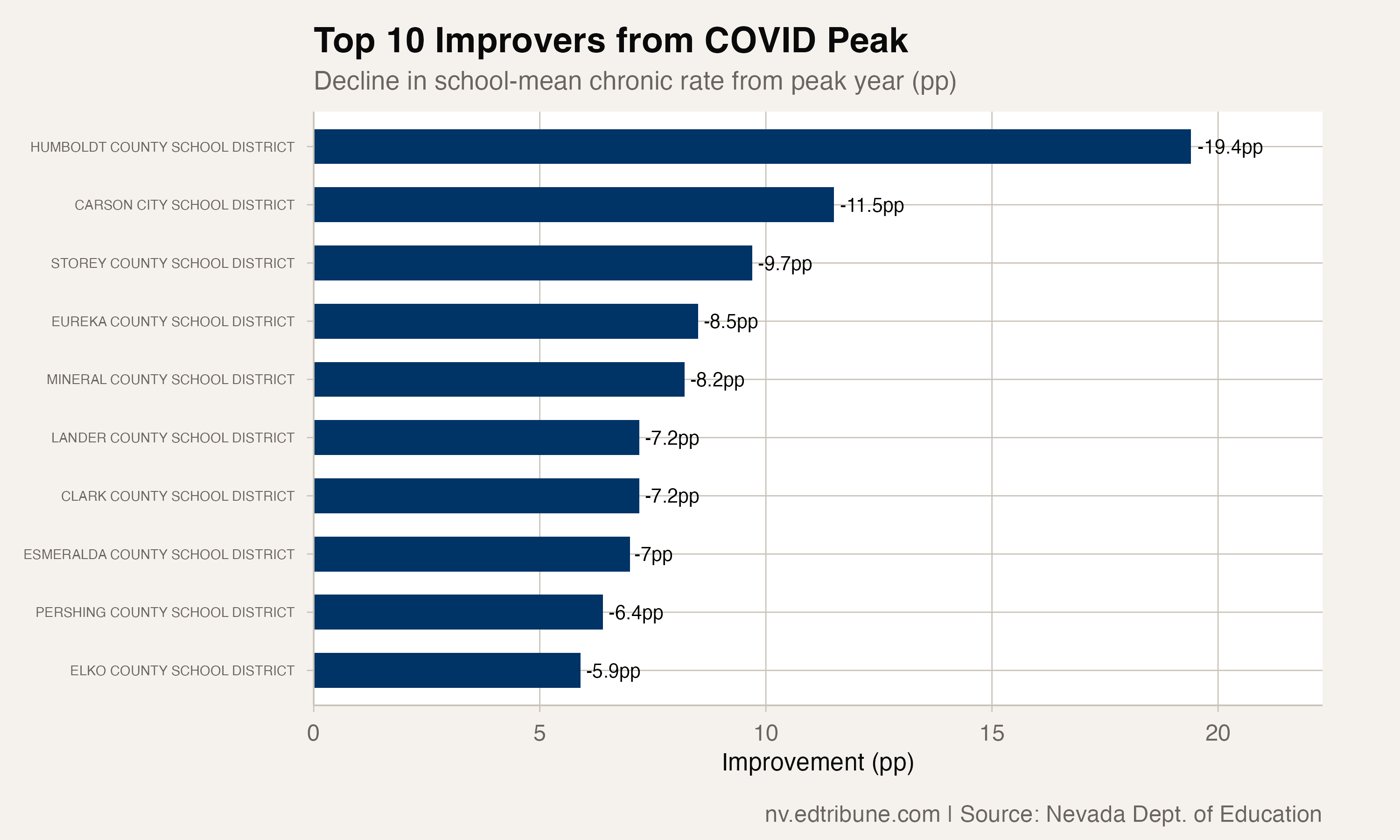
Humboldt's 19.4-point improvement from peak towers over the rest of the state. The next-largest recovery belongs to Carson City at 11.5 points, followed by Storey County at 9.7. Most districts have recovered between 5 and 8 points. The statewide average declined about 3.8 points from peak before reversing in 2025.
The improvement has not been linear. The biggest single-year drop came between 2021-22 and 2022-23, when the rate fell 15.1 points from 53.5% to 38.4%. Progress slowed to a 5.5-point decline in 2023-24, reaching 32.9%. Then in 2024-25, the rate ticked up 1.2 points to 34.1%, a mild reversal consistent with the statewide pattern but modest enough to read as a plateau rather than a trend change.
Inside the schools
The McDermitt schools on the Oregon border tell a particular story. McDermitt High School (50%, 36 students), McDermitt Elementary (44.2%, 52 students), and McDermitt Junior High (44%, 25 students) serve the remote Fort McDermitt Paiute and Shoshone Reservation community. These schools have chronically high absenteeism driven by isolation, poverty, and the specific challenges of reservation life: the nearest grocery store is an hour away, and medical appointments require a full day's travel.
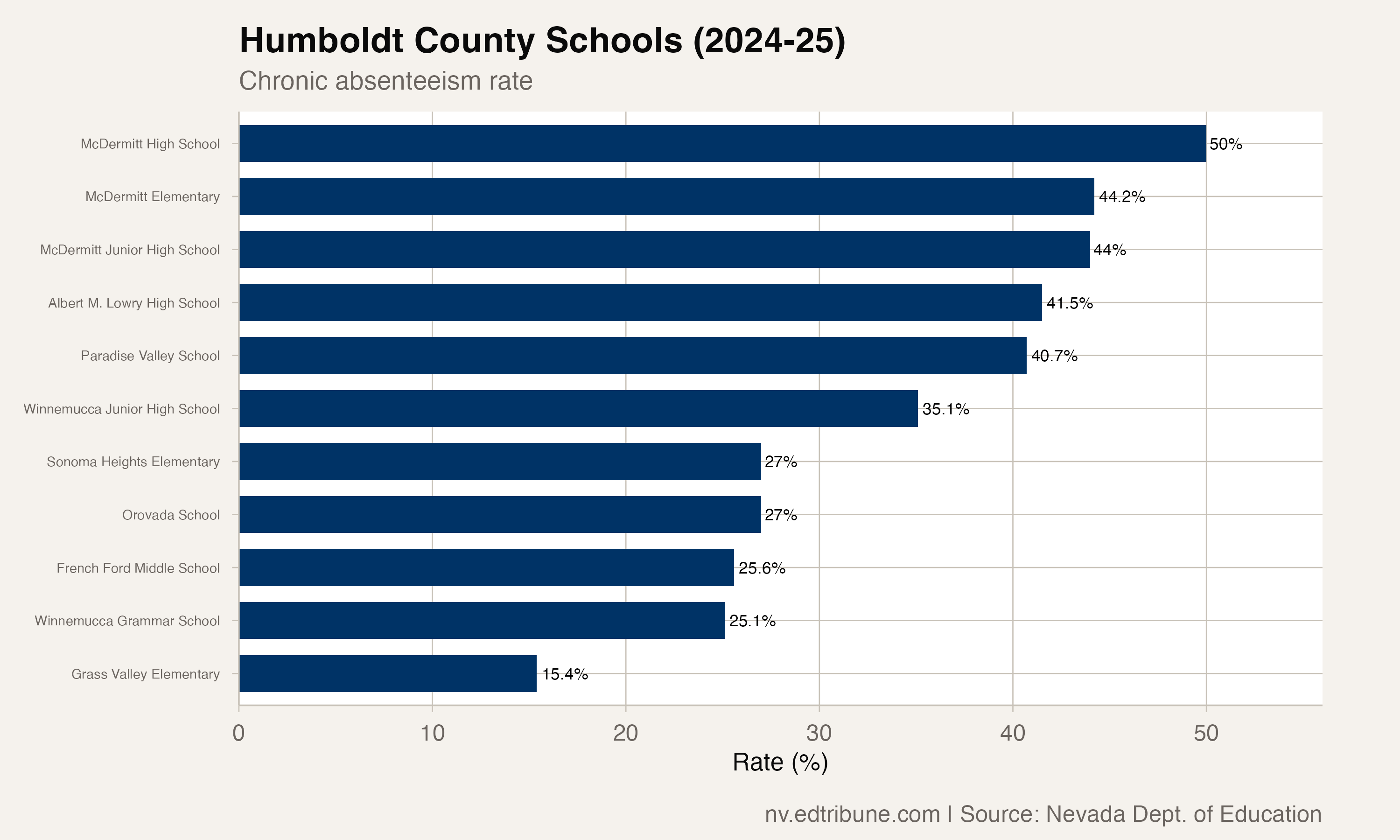
In Winnemucca, the picture is brighter. Grass Valley Elementary has the district's lowest rate at 15.4% among 472 students. Winnemucca Grammar School sits at 25.1%, and French Ford Middle School at 25.6%. These are not pre-COVID-level numbers, but they are manageable.
Albert M. Lowry High School, the district's largest school at 989 students, runs at 41.5%. As the only comprehensive high school in the region, its rate pulls disproportionate weight in the district average.
What may explain it
Humboldt County's turnaround coincided with several developments that are difficult to disentangle. Communities In Schools of Nevada expanded its presence in the district, embedding coordinators who connect chronically absent families with transportation, food, and mental health resources. The district also benefited from strong gold mining revenues that supported local school budgets even as state funding remained tight.
The mining economy cuts both ways for attendance. Humboldt County's gold mines employ many families on shift schedules that do not align with school calendars. The 12-hour shifts common in mining operations can leave older students responsible for younger siblings during school hours. But the mines also bring relatively high wages and economic stability to a region that might otherwise face the deeper poverty-driven absenteeism seen in other rural communities.
The gap that remains
At 34.1%, Humboldt County is still 9.7 percentage points above its pre-COVID rate of 24.4%. The district has recovered 66.7% of its COVID-era increase, the third-highest recovery rate in the state behind Eureka County (which fully recovered) and Pershing County (50%).
Whether the remaining gap closes depends on whether the factors driving improvement can overcome the structural challenges that keep rates elevated: vast distances, limited mental health infrastructure, and a local economy whose rhythms do not match the school calendar.
Detailed code that reproduces the analysis and figures in this article is available exclusively to EdTribune subscribers.
Discussion
Sign in to join the discussion.
Loading comments...